2026 will separate security teams that act from those that hesitate

Ryan Knisley
Chief Strategy Officer
For most security teams, 2025 was a grind: tight budgets, loud threats, and a year of nonstop conversation about AI, automation, and efficiency.
2026 is when we find out which teams actually did something about it.
I’m not talking about who has the best strategy deck or the most tools. I’m talking about the teams that understand their environment, know what matters most, and can act decisively when pressure hits. And that pressure is coming from multiple directions at once: market contraction, faster attacker cycles fueled by AI, and geopolitical risks that are no longer confined to “critical infrastructure” headlines.
When all of that lands at the same time, hesitation stops looking like caution and starts looking like liability. The teams that win are the ones who can prioritize quickly and act without needing a week of validation first.
These are the shifts I think security leaders should plan for now, before the year forces the plan on them.
Prediction 1: Budget shock, not budget tightening
A lot of people are framing 2026 as “modest cuts.” I don’t buy that framing.
What I expect is budget shock, including mid-year reductions and restructuring, especially in tech, paired with tougher expectations from leadership about what security should be able to deliver.
The more important point is why. It’s not that security is getting deprioritized. Efficiency is getting audited. AI is reshaping how organizations think about productivity, and boards and CFOs will assume security should feel that shift, too. They’ll want ROI and operational proof, not plans and promises.
That shows up in plain questions like:
Where are we spending time that we shouldn’t have to spend anymore?
What work is still manual that should be automated by now?
What outcomes improved because we invested in all of this?
Teams operating in “2025 mode” will struggle to answer with anything other than intention. The survivors will be the ones who already operationalized efficiency in how work gets done: less friction, better-connected data, and fewer workflows that depend on heroics.
Prediction 2: Attackers regain the advantage with AI
Last year, defenders finally had real AI parity with attackers. Models became accessible, automations improved, and for the first time in a while, it felt like defenders could actually close the gap.
That advantage doesn’t hold if AI stays stuck in evaluation mode.
Attackers iterate daily. They test and refine constantly. Most defenders don’t move with that tempo, even when the tooling is available, because adoption runs through governance committees, approvals, and extended reviews.
That gap matters more than who has the “best AI.” We’re going to see breaches in 2026 where the post-incident takeaway is hard to ignore: the defenses existed, but the team wasn’t positioned to use them fast enough.
This isn’t really an AI story. It’s an operating model story. If your environment can’t support fast, confident action, AI becomes another program that arrives too late to change outcomes.
Prediction 3: The actionability awakening
Most teams already bought automation. A surprising number still don’t use it to drive action.
Instead, they validate by hand. They jump between platforms. They export, reconcile, sanity-check, and finally take the step they could have taken earlier if they trusted what they were seeing.
I get why that happens. Security has real consequences. But under budget pressure, that “double-check everything” habit becomes harder to justify, especially when leadership starts scrutinizing operational overhead the same way they scrutinize spend.
And the truth is, if your best people are spending their days confirming what systems already know, you don’t have a tooling problem. You have a workflow problem.
This year, inefficiency starts getting measured in a new way. The question leadership will keep coming back to is simple: why does it still take so much human effort to move from signal to action?
Teams that respond with changes, not explanations, will move faster. Teams that can’t will do more work with fewer resources and more scrutiny.
Prediction 4: Deepfake risk becomes an enterprise problem
The deepfake conversation is about to shift from “interesting” to urgent.
For years, this threat was easy to keep at arm’s length. It sounded like something that happened to other companies, or only in extreme cases. That framing breaks down when fake candidates, fake employees, and fake identities turn into real access, real payroll, and real exposure.
North Korea is part of this story, but it’s not the only point. The broader theme is simpler and more uncomfortable: identity trust at scale is fragile, and most organizations are not set up to validate it continuously.
It comes down to readiness. When identity, asset, and access data are already connected, teams can spot what’s off, investigate quickly, and shut it down with confidence. When it’s fragmented, the response turns into a slow scramble, with leadership asking how it ever got this far.
What security leaders should do now
You can’t control everything 2026 throws at your program, but you can control how quickly your team can act. If you’re setting priorities right now, I’d focus on one thing: reducing the distance between knowing and doing.
That means fewer manual handoffs, fewer disconnected sources of truth, and less time spent validating what your systems already collect. It also means building the kind of trust in your data that lets you take action without needing a week of reconciliation first.
Automation only matters if it’s trusted and used. AI only matters if it shortens the path from signal to decision to action. This year will reward the teams that already operate that way. Everyone else will be forced to learn it under pressure.
Categories
- Axonius News

Get Started
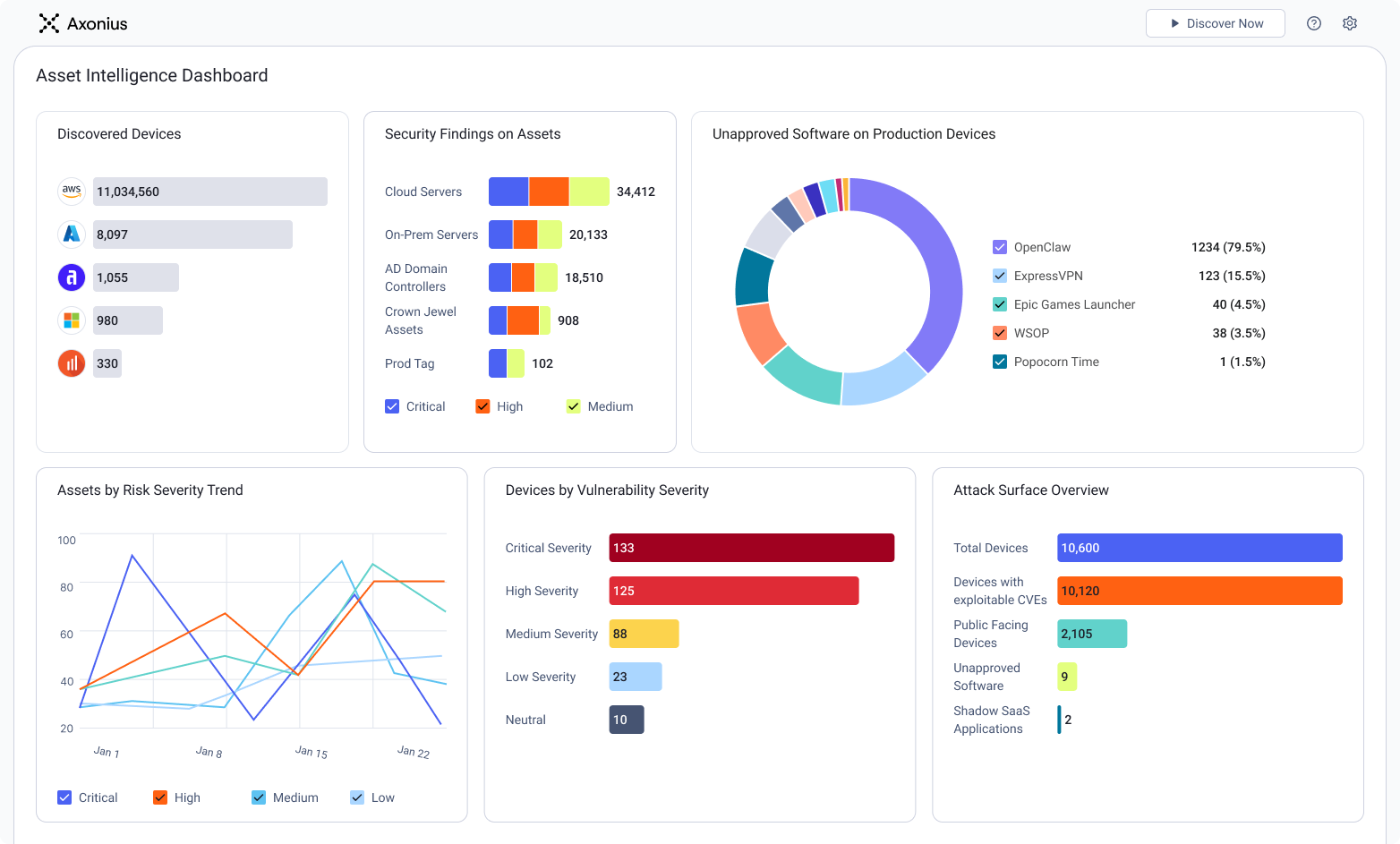
See how to make asset intelligence actionable with a guided demo:
- Stop chasing data — work from one asset model your entire team can trust.
- See what's exposed before it's a problem — surface coverage gaps automatically.
- Turn alert noise into action — cut thousands of alerts down, to the ones that matter.