Why IVIP is reshaping IAM

Julissa Caraballo
Principal Product Marketing Manager, Axonius

For years, identity has been called “the new perimeter.” Today, it’s more accurate to say identity is the new infrastructure of security — governing how users, machines, and software interact, and shaping access and risk decisions across the organization.
But for many organizations, identity remains one of the least trusted datasets in the enterprise. The disconnect between how critical identity has become and how fragmented identity data actually is has led to the emergence of a new category: Identity Visibility and Intelligence Platforms (IVIP).
Gartner created this category because existing IAM categories were never designed to solve the foundational problem identity environments now face: the inability to continuously see, correlate, and understand identity risk across systems.
IVIP fills that gap with a continuous identity intelligence layer that turns fragmented identity data into something teams can trust and act on.
And that shift is beginning to reshape the entire IAM market.
How identity became fragmented
Modern identity environments are fragmented because identity has expanded faster than traditional architectures were designed to handle.
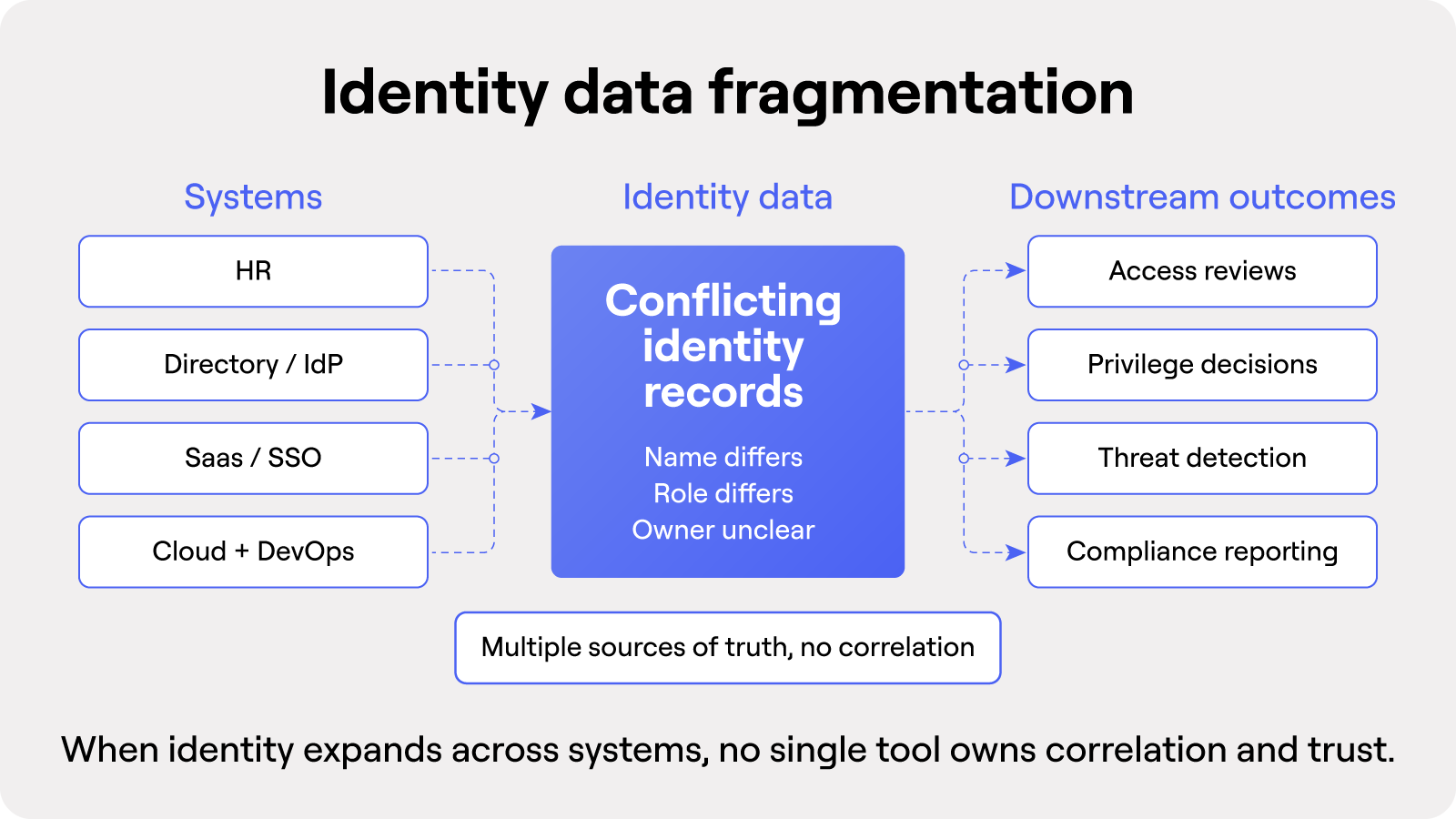
HR systems manage workforce records
Directories handle authentication
SSO brokers connect users to SaaS
Cloud platforms create native identities and roles
DevOps pipelines generate service accounts and API keys
Each of these systems maintains its own version of identity. Attributes don’t always match, accounts get duplicated, and access paths are opaque. Over time, identity data becomes inconsistent and nearly impossible to reconcile.
What makes this especially dangerous is that identity data underpins decisions everywhere — from access governance to threat detection to compliance reporting. All of it assumes identity records are accurate and complete. In practice, they rarely are.
Why traditional IAM programs struggle to deliver outcomes
Even strong IAM programs fall short when the underlying identity data is unreliable:
IGA efforts drag on and still produce inconsistent role models because entitlement data is incomplete
PAM often covers only a subset of privileged accounts, leaving significant administrative access unmanaged
Access reviews become bloated because reviewers lack the context to make informed decisions
These issues are often blamed on tooling or process, but the root cause is almost always the same: poor identity data quality.
Without continuous identity visibility and correlation, governance becomes brittle, security teams miss key risks, and automation becomes unreliable. IVIP changes the equation by making identity data continuously visible, correlated, and usable.
Why Gartner created the IVIP category
Gartner introduced IVIP because existing identity categories weren't designed to provide continuous identity intelligence across the ecosystem. IGA, PAM, ITDR, and CIEM each address part of the problem, but none were built to fill a critical gap: unifying identity data, continuously evaluating posture and risk, and providing clean identity intelligence to downstream tools.
IVIP isn't about replacing governance or enforcement tools. It's about ensuring those tools operate on a reliable and comprehensive identity foundation.
In other words, IVIP exists because identity programs can’t scale without this intelligence layer.
What “identity visibility and intelligence” actually means
IVIP is about turning identity from a static dataset into a continuously evaluated security domain. Instead of treating identity as isolated accounts in separate systems, IVIP platforms build a unified identity graph. It correlates: identities and accounts across systems; entitlements and permissions; usage patterns and access behavior; and ownership and accountability.
.png)
Human and non-human identities are evaluated together rather than through separate governance models. This unified view enables continuous posture assessment, detection of hygiene issues like MFA gaps and privilege creep, and identification of toxic access combinations that create real-world exploitability.
More importantly, IVIP platforms are designed to feed this intelligence into other systems — IGA platforms, PAM tools, ITDR platforms, exposure management systems, and Zero Trust architectures — so governance and security controls can operate with far greater accuracy and confidence.
Where IVIP fits in the Identity Fabric
The concept of Identity Fabric has gained traction as organizations try to integrate IAM, IGA, PAM, ITDR, and Zero Trust into cohesive architectures. But integration alone doesn't fix inconsistent identity data.
IVIP becomes the backbone of the Identity Fabric by providing a consistent, normalized view of identity that all systems can reference. It enables shared risk scoring, unified ownership models, and coordinated remediation across platforms.
In this way, IVIP doesn't compete with Identity Fabric strategies. It makes them operationally viable.
Why non-human identities accelerated the need for IVIP
One of the strongest forces driving IVIP adoption is the explosion of non-human identities.
Service accounts, API tokens, automation bots, and AI agents now outnumber human users in many environments. They often have broad privileges, limited visibility, and unclear ownership.
Traditional IAM tools were built around human lifecycle management. They weren't designed to discover, classify, and continuously evaluate machine identities across cloud, SaaS, and DevOps pipelines.
IVIP platforms treat non-human identities as first-class citizens in the identity model. They evaluate their behavior, access scope, and risk posture using the same intelligence framework applied to human users.
As automation becomes more embedded in business operations, this approach is becoming essential to understanding and reducing identity-driven exposure.
Why identity governance is shifting to continuous assurance
IVIP is gaining traction because identity changes faster than periodic governance can keep up. Automation, AI, and third-party integrations have made identity the control plane for digital business, with access and entitlements constantly shifting across cloud, SaaS, and DevOps environments.
.png)
Traditional IAM assumes risk can be managed through quarterly access reviews and annual audits. But when access changes day to day, this model leaves long windows of exposure.
IVIP enables continuous evaluation. Access reviews become context-rich and focused on meaningful changes, rather than static permission lists. Audit evidence is continuously generated, not manually assembled.
And most importantly, identity assurance becomes an operational discipline, not an annual event.
What IVIP means for the identity market
The rise of IVIP is beginning to reshape how organizations evaluate identity maturity.
Instead of asking whether an organization has implemented IGA or PAM, the more important question becomes whether the organization actually understands its identity landscape in real time.
This shift places greater emphasis on data correlation, continuous posture evaluation, and identity risk prioritization than on workflow orchestration alone.
It also changes how identity tools compete and cooperate. Platforms that provide strong intelligence layers will increasingly serve as strategic control points, while enforcement tools will depend on that intelligence to operate effectively.
IAM architectures are becoming data-centric rather than tool-centric.
How to approach IVIP adoption
IVIP isn't a rip-and-replace strategy. It's an augmentation strategy.
Organizations don't need to dismantle their IAM investments to adopt identity visibility and intelligence. In fact, IVIP platforms are most powerful when they enhance existing tools by improving data quality and expanding visibility.
IVIP should be evaluated as:
A way to accelerate stalled IAM programs
A method to improve security outcomes without rebuilding workflows
A foundation for scaling identity governance across cloud, SaaS, and automation
Because IVIP platforms operate primarily at the data and intelligence layer, time-to-value is typically measured in weeks rather than months.
Why identity intelligence is now mandatory
Identity governance, lifecycle management, and threat detection all collapse when identity data is incomplete, inconsistent, or outdated.
Without visibility, organizations can't govern effectively. Without intelligence, they can't secure proactively. Without trusted data, automation becomes fragile and risky.
IVIP exists because modern identity environments can no longer be managed through disconnected tools and periodic validation.
As identity continues to define access, risk, and trust across digital ecosystems, visibility and intelligence are no longer optional. They're the foundation of everything that follows.
And that's why IVIP is reshaping IAM.
Categories
- Identity

Get Started
See how to make asset intelligence actionable with a guided demo:
- Stop chasing data — work from one asset model your entire team can trust.
- See what's exposed before it's a problem — surface coverage gaps automatically.
- Turn alert noise into action — cut thousands of alerts down, to the ones that matter.