Axonius and Elastic: See what's happening. Know what's there

Frederico Hakamine
Technical Evangelist Director, Axonius

Every SOC is built around events: alerts, detections, anomalies. The infrastructure to catch them has never been more capable, and leaders like Elastic are making event-based detection faster every year. And for good reason. Knowing what's happening in real time is foundational for great security.
But a complete security picture requires two data types, not one.
The second is state: the full inventory of assets that touch your data and processes. This includes devices, identities, applications, SaaS tools, and cloud workloads. Many of these never generate an alert. They exist, running silently, and understanding their posture is what gives security teams the context to act when something does fire.
When an alert does fire, the instinct is immediate:
Where is this happening?
How widespread is it?
What's the state of that system?
What business service does it support, and what's at stake?
Without this information, you spend precious time fetching the right context to act on.
Today, Axonius and Elastic are announcing a native integration that brings both together: Axonius asset intelligence directly inside Elastic Security, alongside the events you're already investigating.
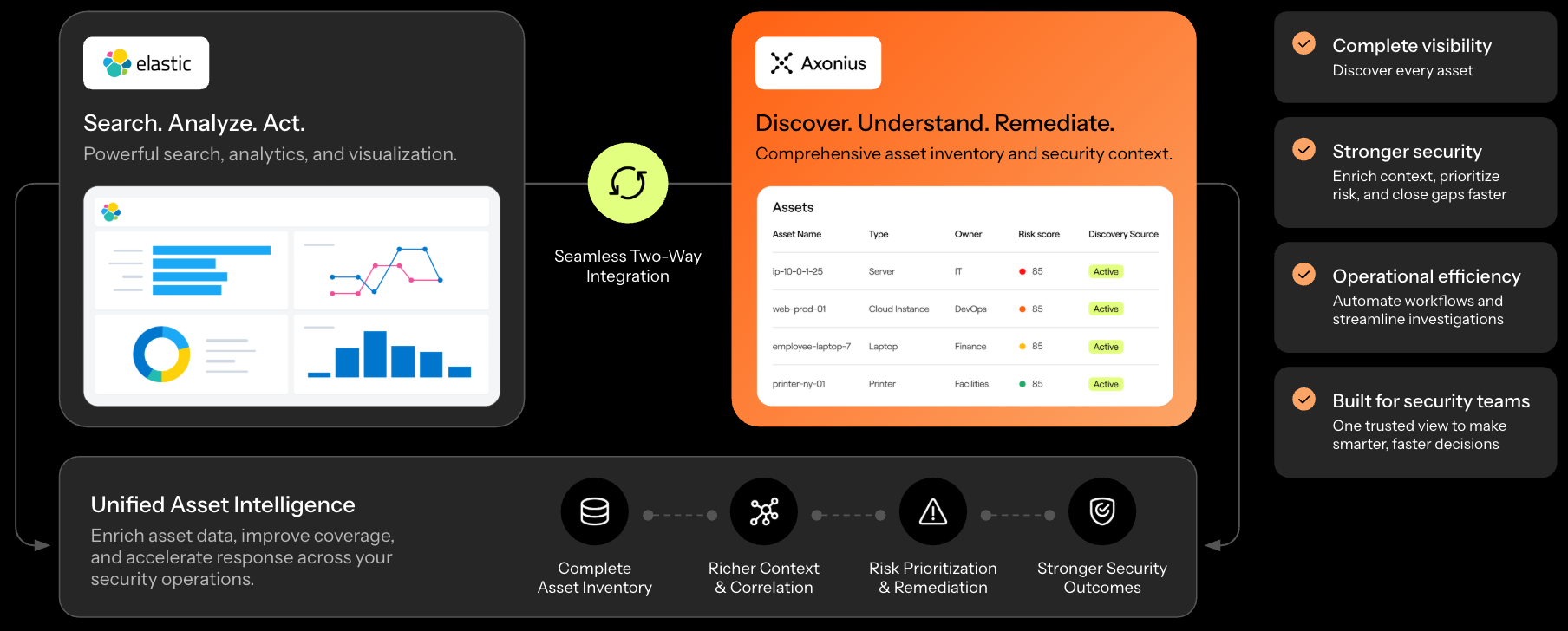
How Axonius asset intelligence works inside Elastic Security
The integration is agentless: no new agents to deploy, no network taps. Axonius asset data is periodically indexed into Elastic and available as a lookup layer for ES|QL (Elasticsearch Query Language) queries and Elastic Workflows.
During an investigation
When an alert fires, the asset context from Axonius is already in Elastic: compute, network, identity, application, exposures, and much more. Analysts can correlate asset context to events without leaving the investigation. The first minutes of an incident are spent on response, not reconnaissance.
Understanding relationships and blast radius
A compromised device may be connected to critical systems. A user account may have broad access across the environment. Axonius also correlates relationships across your assets, giving security teams visibility into what's related, what compensating controls are in place, and where the gaps are.
Surfacing silent risks that never fire events
Not every risk announces itself. Shadow IT, coverage gaps, misconfigured assets: these don't fire events, but they represent real risk exposure. Axonius surfaces these problems as exposures and security findings, extending the investigation surface in Elastic beyond the event stream to the full state of the environment.
Example: Streamlining the OMB M-26-14 mandate
We built the Axonius and Elastic integration to support the strictest visibility standards on the books, including the U.S. Office of Management and Budget’s memorandum M-26-14, which requires federal agencies to prove they know every asset that should be logging.
OMB M-26-14, Ensuring Effective and Efficient Agency Logging and Network Visibility, is the successor to M-21-31. Where M-21-31 pushed agencies toward a tiered, "log-everything" maturity model, M-26-14 takes a more practical, risk-based posture: log what matters, and maintain the network and asset visibility to know what should be logging in the first place.
That second half is where most programs quietly fail. A SIEM can only alert on what it receives. If a system isn't logging, the SIEM will never generate a notable event for it, no matter how good the detection content is. Every unlogged asset is a silent blind spot: invisible to the SOC, and invisible to the mandate's intent. You cannot log what you cannot see, and you cannot prove coverage you cannot measure.
Axonius and Elastic close that gap completely:
Elastic establishes ground truth for logging. Elastic ingests, normalizes, and deduplicates logs across your environment, producing the definitive list of every device and system actually sending logs today.
Axonius establishes ground truth for what exists. Through the native integration, Axonius pulls that Elastic data in and correlates it against its authoritative asset inventory: Axonius Cyber Assets aggregating what's known across 1,400+ sources and 40+ asset types, and Axonius Cyber-Physical Assets (CPA) adding real network-driven discovery of the IT, OT, IoT, and cyber-physical devices that agents, scanners, EDR, and the CMDB never see.
The delta becomes an immediate hunt list. Axonius diffs what exists against what's logging in Elastic and hands the SOC a complete, prioritized list of every device that should be logging but isn't: a ready-made worklist to get those systems onboarded into logging and under detection.
That loop is exactly what M-26-14 asks agencies to operationalize. Axonius CPA delivers the network visibility the memo calls out by name, surfacing devices no log source or scanner has ever reported. Axonius Cyber Assets delivers the authoritative inventory that turns "we think we're covered" into a measured, provable coverage number. And Elastic delivers the logging and detection that the visibility makes complete.
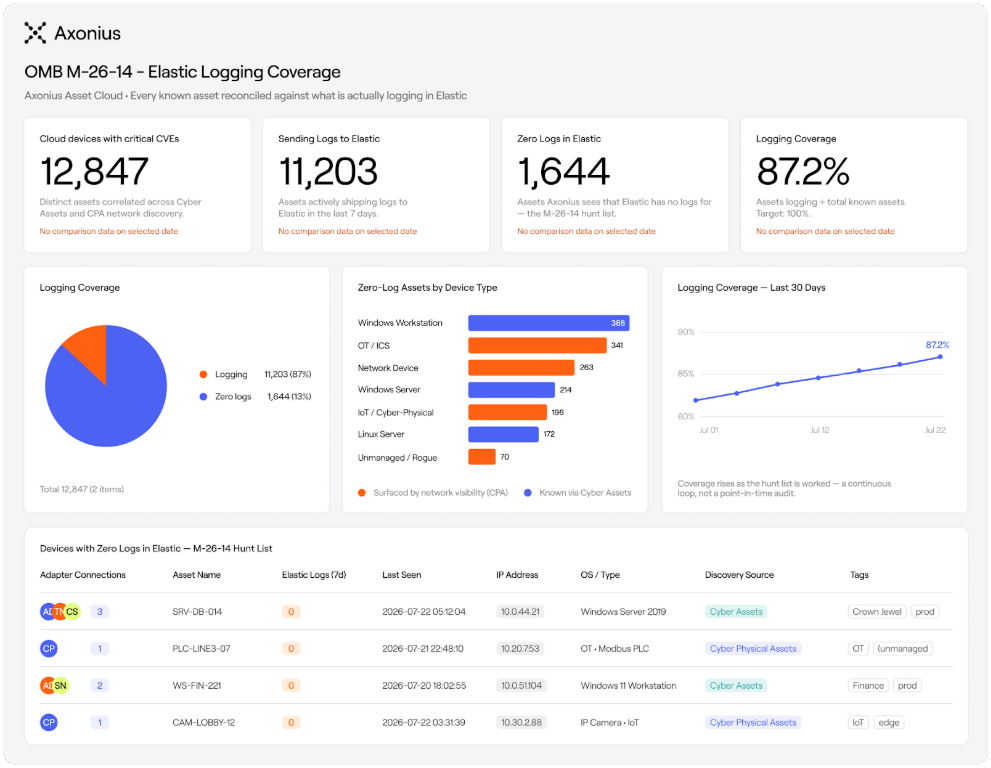
The result is a closed, continuous coverage loop rather than a point-in-time audit: every asset accounted for, every logging gap surfaced the moment it appears. And a defensible answer to the question at the heart of M-26-14: can you prove that every system that should be logging actually is?
Event data and asset state, in one place
Most security programs operate with events, but as soon as they need asset intelligence, they end up stitching together data about assets in security silos. In a federal SOC under M-26-14, that gap is the difference between compliance on paper and detection in practice.
Axonius and Elastic get both from the same place. Elastic delivers the event and the detection. Axonius delivers the state, the network visibility, and the proactive actions. Together, they solve the mandate's two hardest problems at once: analysts aren't left holding an alert without the context to act, and no asset stays silently outside the logging perimeter.
Get started with the Axonius and Elastic integration
The integration between Axonius and Elastic is available in the Elastic integrations marketplace. Our friends at Elastic wrote a great post on how to use it.
Not yet an Axonius customer? Book a demo today.
Categories
- Asset Management
- Security
- Threats Vulnerabilities
- Compliance And Frameworks
- Axonius News
- Management

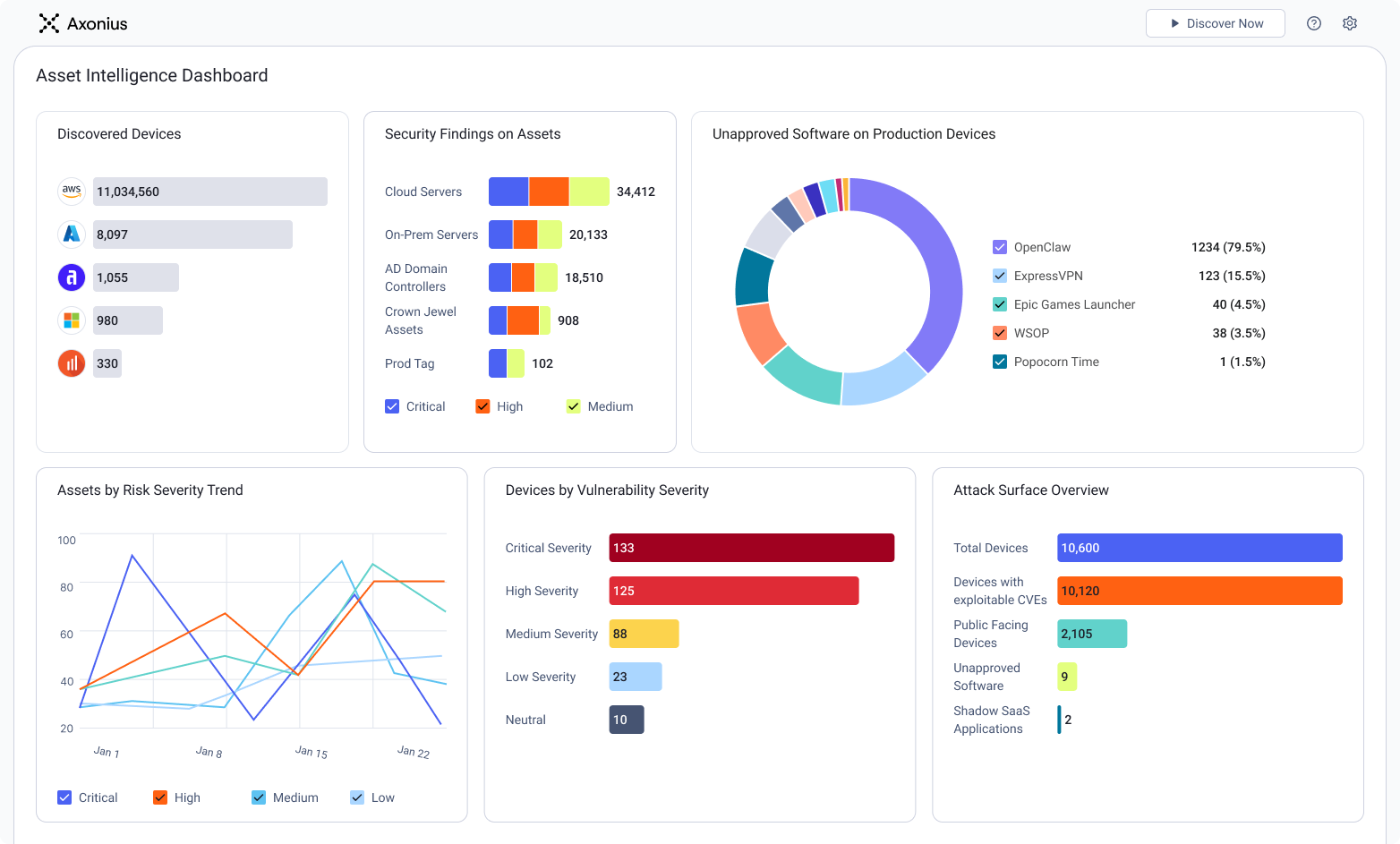
Get Started
See how to make asset intelligence actionable with a guided demo:
- Stop chasing data — work from one asset model your entire team can trust.
- See what's exposed before it's a problem — surface coverage gaps automatically.
- Turn alert noise into action — cut thousands of alerts down, to the ones that matter.