You found the security risk. Good luck finding who owns it.

Yotam Katz
Senior Product Manager, Axonius

Avi Meltser
Senior Full Stack Engineer, Axonius
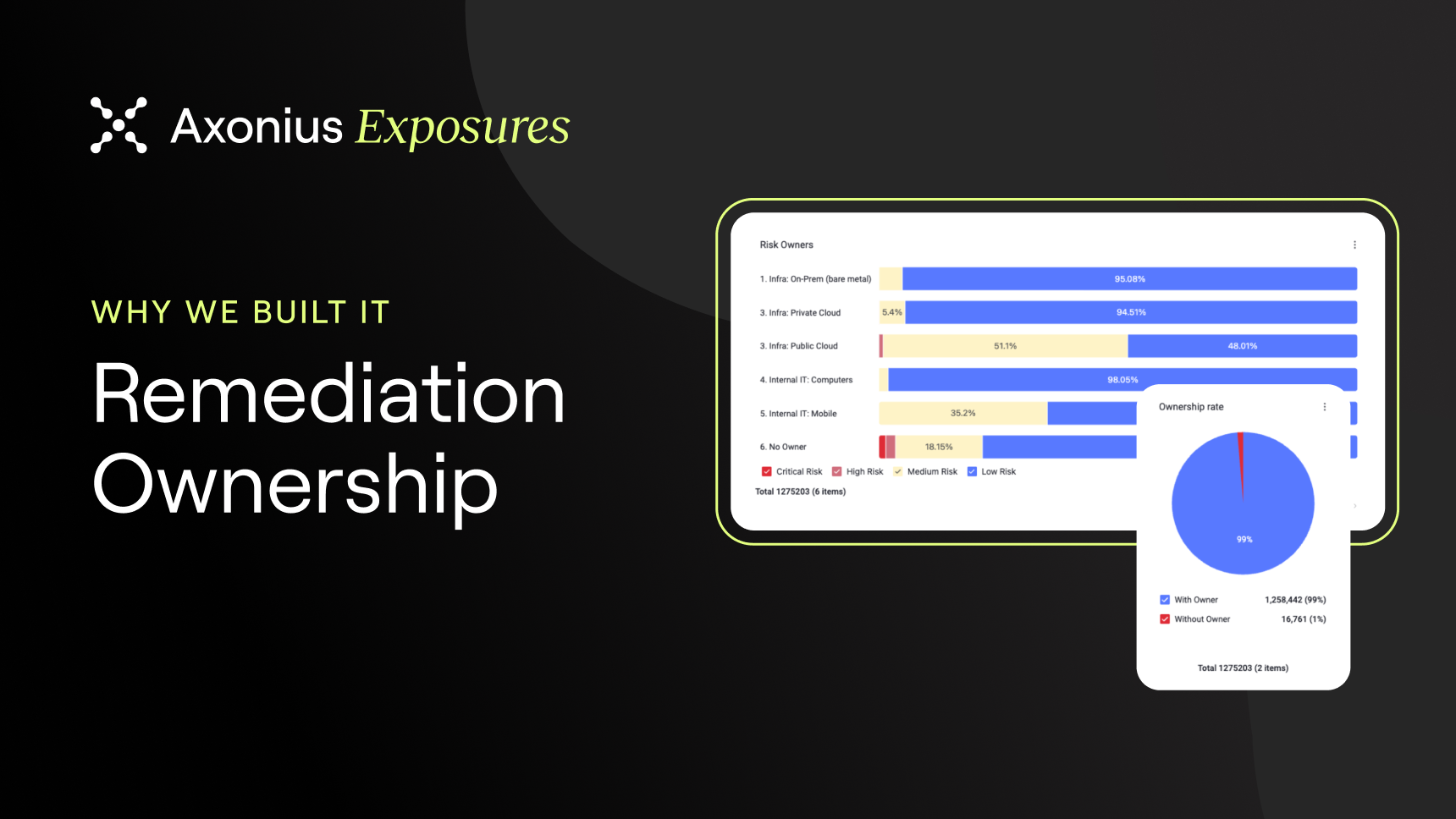
This blog is part of Why We Built It, a series on the gaps in exposure management that security pros are still stuck solving by hand, and what we built to close them:
|
You collected thousands of security findings in a queue. You can read every one of them and gauge the importance to the business. But you can't answer the question that moves any of them forward: "who fixes this?" The fix itself is often quick, yet security remediation stalls because the hunt for the right person can take days.
The organization isn't built to hand you that answer, so security teams build the ownership map themselves. Spreadsheets go stale as soon as a reorg happens or systems change. Then come the Zoom calls when nobody knows which group is on the hook, the escalation emails when the call doesn't settle, and the manager-to-manager handoffs when the email gets ignored.
While that runs, the SLA clock keeps ticking — and with mean time to exploit dropping toward zero and below, every day spent hunting an owner is a day the finding stays exploitable. Security pros are accountable for the delay.
The signals that would name an owner already exist; they’re just scattered and inconsistent. An AWS tag marks a resource "production." An Active Directory group lists the IT admins. A CMDB record assigns a business unit. A GitHub repository org points to the team that shipped the code. No single tool reads all of these together, so the security pro becomes the integration layer: cross-referencing org charts, CMDB exports, and half-remembered conversations about the last reorg.
The missing piece: a way to compute the owner from the signals already in your environment, enforced dynamically as a rule, before anyone has to ask.
How to assign security remediation ownership automatically
To solve that, we built Remediation Ownership.
Remediation Ownership is a rule-driven engine that decides who owns security risks (findings, exposures, vulnerabilities, misconfigurations) based on the asset, identity, security, and business signals Axonius aggregates from our 1,400+ integrations. Each rule has two parts:
A scope. A query that defines the class of findings the rule governs. Example: "findings on EC2 instances tagged env=prod in the payments VPC."
An assignment. Who owns those findings (a team or an individual) and how they get involved (a ticket in Jira, a Slack message, an automated action) at the urgency the finding warrants.
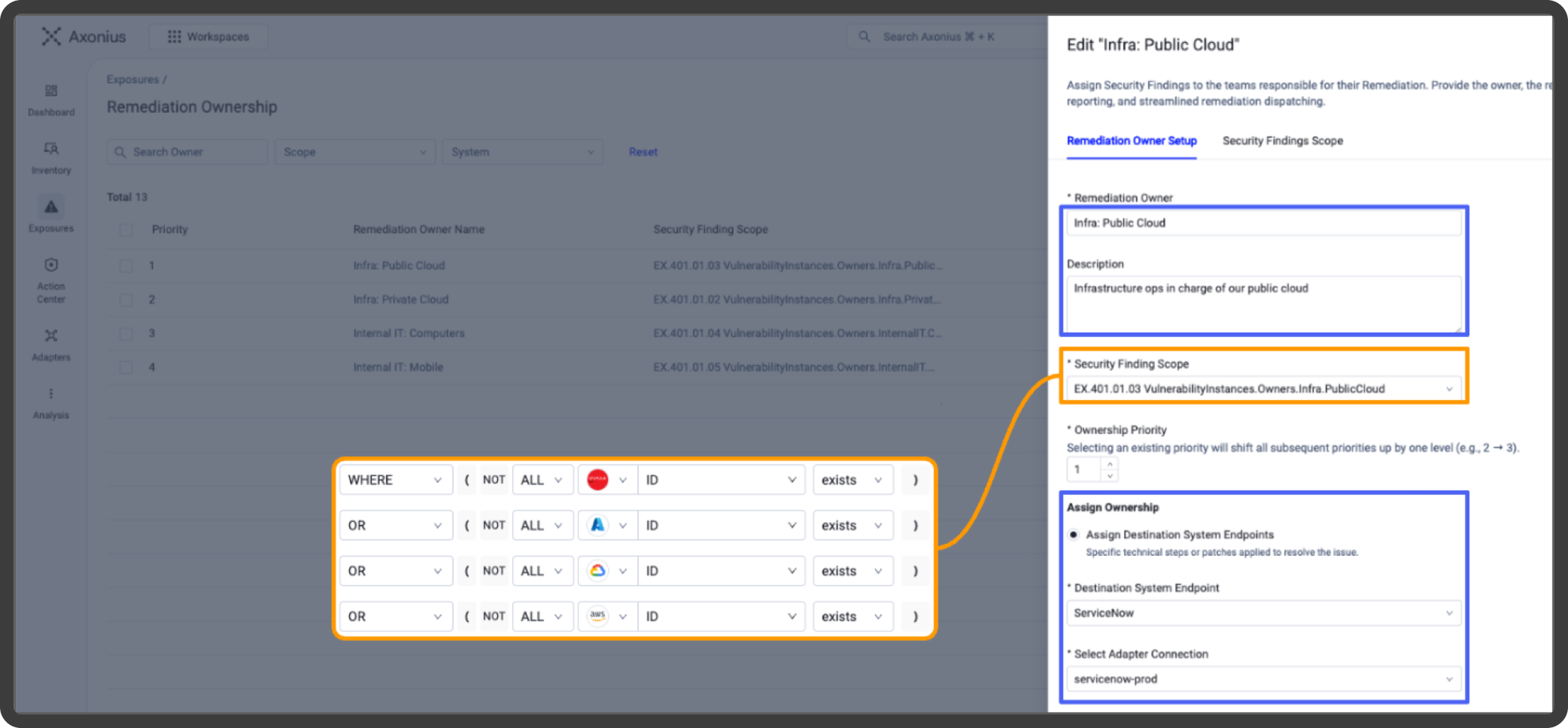
Ownership scope (in orange) and assignment (in blue)
Whenever a discovery cycle runs, every security finding is linked to its owner, achieving zero mean time to ownership (no pause to hunt anyone down). Ownership recomputes against the current state of the environment, so a reorg, an acquisition, or a tag change shows up in the next cycle's assignments.
In addition to reaching zero mean time to ownership, Remediation Ownership unlocks KPIs that measure if security is getting support from the business:
Ownership rate: the share of findings with and without owners
Security findings and SLAs per owner: in a comparable way that shows which owners are leading (or lagging) by volume and risk.
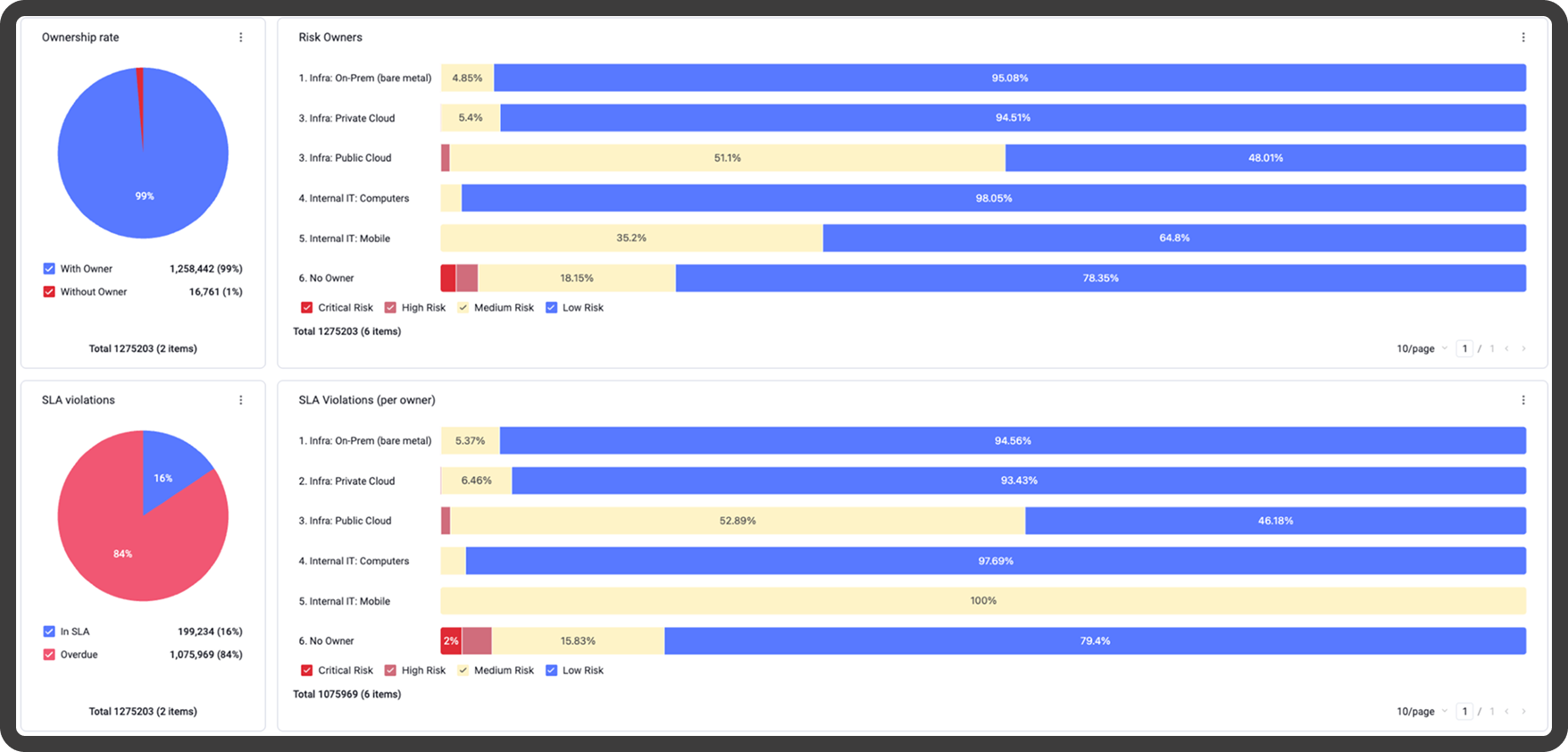
Dashboard with ownership rate and SLAs distributed per business owner
Why we built Remediation Ownership
Remediation Ownership exists to take the owner hunt off your plate — the menial work (spreadsheets, cross-referencing) and the political work (meetings, escalations, email chains) that stand between a finding and a fix. You shouldn't be doing any of that:
Owner lookup is not security work
Security pros shouldn't spend their week as a switchboard. People who choose security work end up cross-referencing asset IDs against org charts and writing escalation emails, because no tool joins the signals that decide ownership. The owner of a finding is decided by tags, group memberships, network zones, CMDB records, HR directories/cost centers. Those signals exist, and we bring them to the same place.
Ownership rules should match your real org chart
A vendor default shouldn't decide who owns what in your environment. Ownership varies by department, by signal, and by how the organization is structured. A retail chain splits responsibility differently from a bank or a conglomerate. An acquisition leaves assets mid-transfer for months. Rules use the Axonius queries and data with full flexibility to mirror how your organization actually splits ownership.
Ownership should move with risk
The right owner shouldn't be a static field. A routine missing patch on a test box and a critical exposure on a payments server are not the same problem, and they should not route to the same place. Even on the same host, different findings can belong to different teams: an OS upgrade routes to one group, a third-party app update to another, and that split changes depending on region or whether the system is on-prem or cloud-hosted. Ownership has to resolve at the finding level, not the asset level.
Remediation Ownership works alongside the rest of Axonius Exposures (the risk score, threat intelligence), so a severe enough exposure, or a specific threat actor behind it, can route to a different, more senior group than the routine case.
Remediation Ownership follows the same design principles as the Axonius platform (works with 1,400+ systems, doesn't require intrusive integrations to work, drives automatic actions, and is fully customizable), making it ergonomic for security teams, ready to fit into your existing program.
Get started with Remediation Ownership
To get started with Remediation Ownership, access your Axonius Dashboard, go to Exposures > Remediation Ownership, click Create, and follow our instructions to author your first ownership rule.
If you're not an Axonius Exposures customer yet, have specific questions, or want to explore Axonius Exposures in depth, book a personalized demo with us.
Categories
- Threats Vulnerabilities
Get Started
See how to make asset intelligence actionable with a guided demo:
- Stop chasing data — work from one asset model your entire team can trust.
- See what's exposed before it's a problem — surface coverage gaps automatically.
- Turn alert noise into action — cut thousands of alerts down, to the ones that matter.