Tokio Marine HCC: Turning a “Company of Companies” into One Source of Truth


1,001-5,000
Tokio Marine HCC unified 16 autonomous business units under a single, trusted source of truth by automating daily, multi-source asset reconciliation with Axonius. What once required weekly manual updates now delivers real-time visibility that eliminated blind spots, accelerated security alignment, and transformed their CMDB into a self-healing system.
Key Challenges
Each Tokio Marine HCC business unit operated with its own flavor of tools and tracking systems, multiple SCCM instances, overlapping vCenters, fragmented SolarWinds deployments, and a patchwork of spreadsheets and homegrown databases.
You can’t secure assets if you don’t know you have them. That’s always been my guiding principle, visibility has to come first.
Building the Asset Intelligence Fabric
Today, Tokio Marine HCC uses multiple automated update enforcements, all controlled through the Axonius Enforcement Center. These routines reconcile CMDB records, update configuration items, and retire assets across four major categories: cloud, physical, VM, and mobile.
“The Enforcement Center is our safety net,” Carolyn noted. “The visibility it provides for CMDB updates means nothing gets missed.”
Over time, these automated reconciliations have transformed Tokio Marine HCC’s CMDB into what Carolyn calls a “self-healing environment” - one that continuously corrects discrepancies, revalidates stale data, and closes the loop between IT, Security, and Operations. Each new data feed strengthens the accuracy of the whole system.
This data is enriched and validated across 16 business units and thousands of endpoints, each reconciled against the master CMDB. Axonius pulls and deduplicates signals from every feed, ensuring every record aligns to the same object, owner, and lifecycle status.
“If something drops off or stops reporting, Axonius flags it before it becomes a blind spot,” Carolyn explained. “That’s what a self-healing CMDB does, it doesn’t wait for someone to notice a problem.
Vulnerability Management and Security Alignment
As Tokio Marine HCC’s security posture matured, asset visibility became the foundation of its vulnerability and exposure management process. Axonius now connects to vulnerability tools like Qualys and endpoint protection systems like CrowdStrike to correlate coverage and reveal blind spots.
“Before, the security team had to export spreadsheets from each tool and manually match them,” Carolyn said. “Now they can instantly see what has CrowdStrike but not Qualys, or what’s missing from Zscaler.”
The integration between IT and Security has created a shared language around risk. When an asset appears in multiple feeds but not in the CMDB, it’s flagged as an unmanaged device, prompting Carolyn’s team to validate ownership and decide if it should be tracked.
This visibility also accelerated vulnerability remediation: Axonius allows the ITAM and security teams to assign vulnerabilities to the correct owner faster, bridging the communication gap that often slows down enterprise patching.“Location and user information verified by multiple tools has eliminated the ‘that’s not ours’ response,” Carolyn said. “Now, everyone knows exactly who owns what.”
Dashboards That Drive Accountability
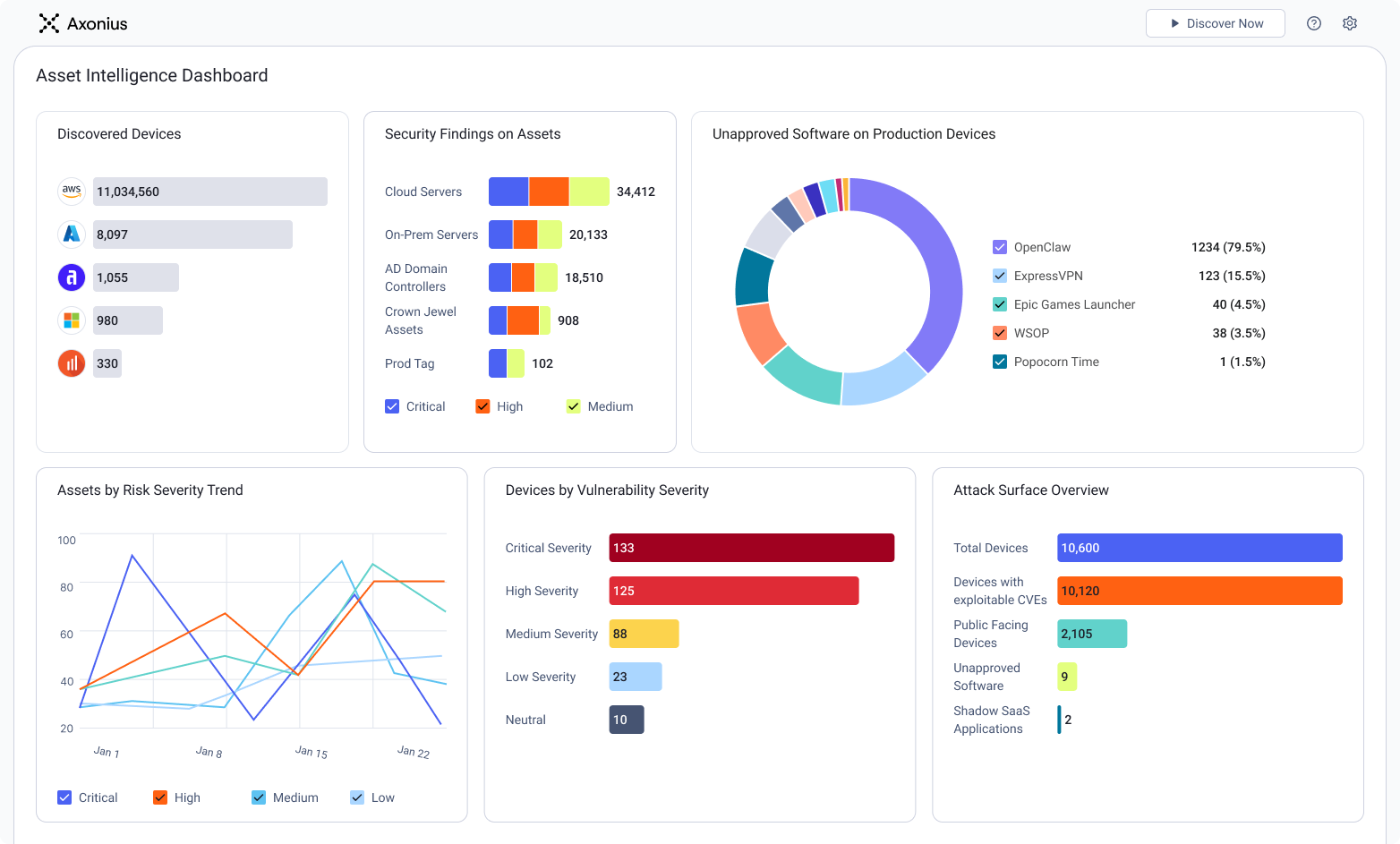
Axonius dashboards have become operational tools for both IT and business leadership. Daily reconciliation reports and debt scorecards provide a single view of asset currency, OS lifecycle risk, and ownership accountability across all 16 units.
Key dashboards include:
ITAM OS and Application Debt Scorecards – tracking outdated operating systems and applications by business units and senior IT owners.
Update Tracking Dashboards – monitoring patch compliance and update status across device types.
ITAM Admin Dashboards – offering daily reconciliation summaries and enforcement logs.
“Our leadership can log in, drill down, and see exactly where things stand,” Carolyn said. “No more spreadsheets being tossed back and forth.”
When we brought in Axonius, it instantly became the connective tissue between IT, Security, and the CMDB. We went from reconciling data once a week to trusting it every morning.
Results
Eliminating Data Staleness
Before Axonius, the CMDB was updated once a week, often leaving data a week out of sync. Today, updates occur daily across all CI classes and asset types, ensuring near-real-time visibility.
“We can now update server, client, and network gear data every day,” said Carolyn. “The best source used to be Tuesday morning. Now it’s every morning.”
Accelerating Response and Remediation
By consolidating multiple data sources, Tokio Marine HCC reduced the time to identify gaps and assign vulnerabilities from days to hours. Security teams now see discrepancies between coverage tools instantly, driving faster remediation cycles.
Building Trust Across Business Units
Axonius gave the IT and Security teams a shared, validated data foundation. This trust is reflected in accountability: when a device shows up in five tools, it’s indisputable proof of ownership.
“I’ve eliminated the phrase, ‘that’s not mine,’” Carolyn said. “When you can show that five tools see it, the conversation changes.”
Reducing Tool Overlap
With Axonius serving as the correlation layer, Tokio Marine HCC began rationalizing redundant discovery tools across business units, a measurable cost reduction while maintaining global coverage.
Improving Audit Readiness
Daily reconciliations and consistent data normalization have elevated Tokio Marine HCC’s audit posture. Instead of waiting for quarterly CMDB cleanups, Carolyn’s team can generate current, validated inventories on demand.“There’s no silver bullet,” she said, “but Axonius sets a gold standard for asset data consolidation and ease of us

Get Started
See how to make asset intelligence actionable with a guided demo:
- Stop chasing data — work from one asset model your entire team can trust.
- See what's exposed before it's a problem — surface coverage gaps automatically.
- Turn alert noise into action — cut thousands of alerts down, to the ones that matter.