Step 1: Connect everything you already run
Axonius integrates with your existing stack through Adapters with no agents, no network taps required. From endpoint protection and identity providers to cloud infrastructure, SaaS apps, and CMDBs, Axonius pulls asset data from over 1,400 systems via API.
If you have it, we integrate with it. Ground to cloud, your entire environment is in scope from day one.
Step 2: Correlate and deduplicate every asset record
Your tools don't agree. That's not a people problem. It's a data architecture problem.
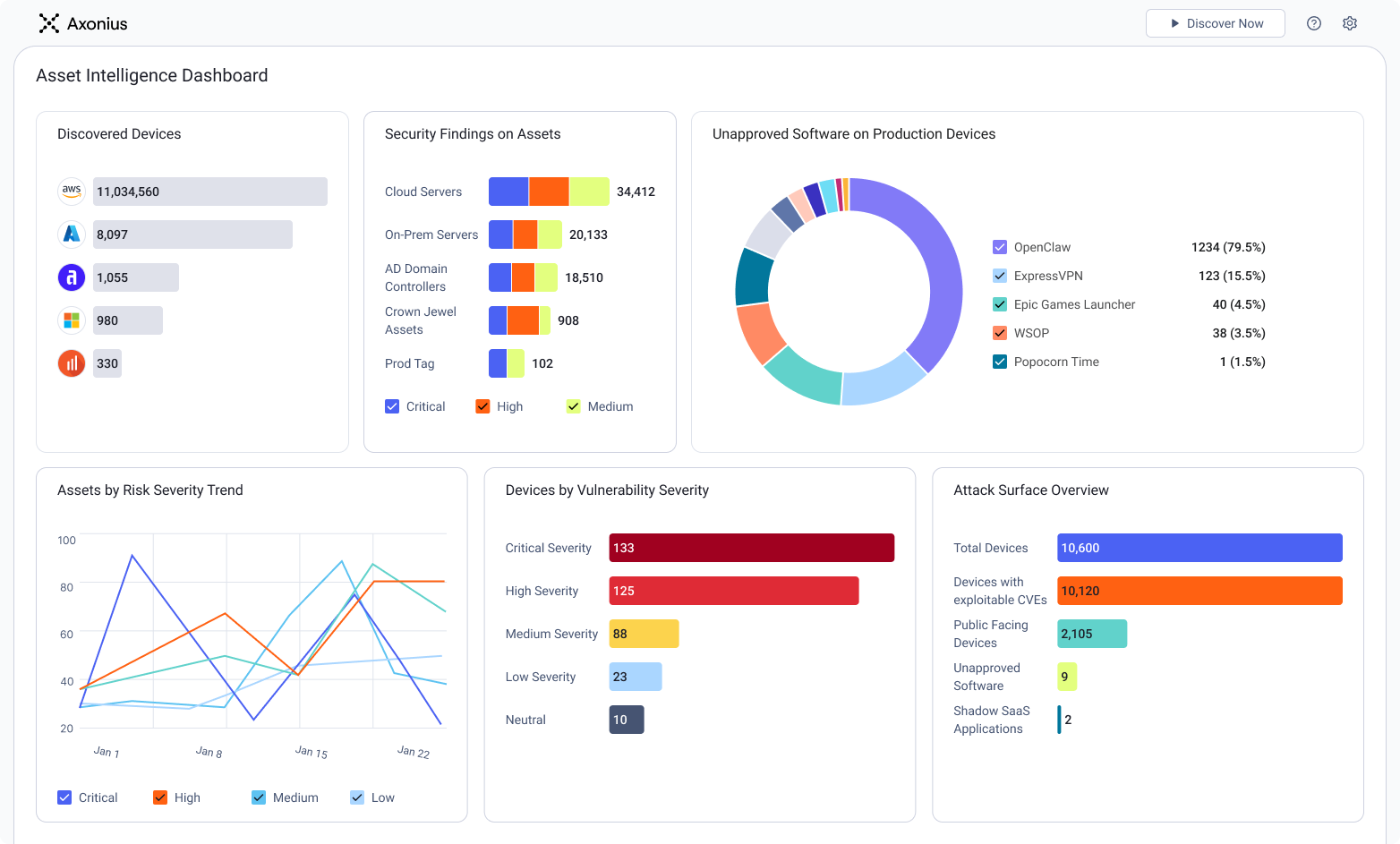
Axonius automatically correlates records from across every adapter, collapses duplicates, and produces a single, continuously updated asset record for every device, identity, SaaS application, and cloud resource in your environment. The result is one model your whole team can trust, not a report from whichever tool someone happened to open last.
Step 3: Scope what actually needs attention
Total visibility means nothing without context. Axonius layers business, security, and asset context onto every asset — from crown jewel status and internet exposure to ownership and compliance frameworks — so your team knows not just what exists, but what matters.
Surface assets missing controls, identify toxic combinations of risk signals, and stop wasting cycles on findings that don't represent real exposure.
Step 4: Prioritize across your entire finding set
Security findings don't live in one tool. Axonius aggregates findings from every source in your stack and applies the Axonius Risk Score, a weighted model combining business context, asset context, and security signals, to help you prioritize the risks that truly matter.
No more CVSS-only triage. No more alert queues that bury critical exposures under low-severity noise.
Step 5: Assign ownership and drive remediation
Knowing what's wrong is only half the job. Axonius automatically identifies asset owners using business context, assigns accountability, and tracks SLA compliance across risk owners and asset groups.
SLAs are mapped to your policies so stakeholders stay on top of issues without a flood of manual follow-up from your team.
Step 6: Automate reinforcement through your existing tools
Axonius Enforcements let you take direct action on the assets that need it. Query-based enforcement sets fire automatically, deploying agents, patching software, creating tickets, tagging assets, or pushing configurations through tools like CrowdStrike, Microsoft MECM/SCCM, ServiceNow, Jamf, and more.
Set the schedule, define the action, and let Axonius make sure every violation gets resolved.