
The Practitioner's Playbook for Asset Intelligence
AI is a force multiplier on known craft. It automates reconnaissance, scales phishing, and generates malware on demand but it's still attacking the same surface it always has: unpatched devices, over-permissioned identities, and configuration drift no one caught.
The problem isn't the tools. It's the foundation underneath them.
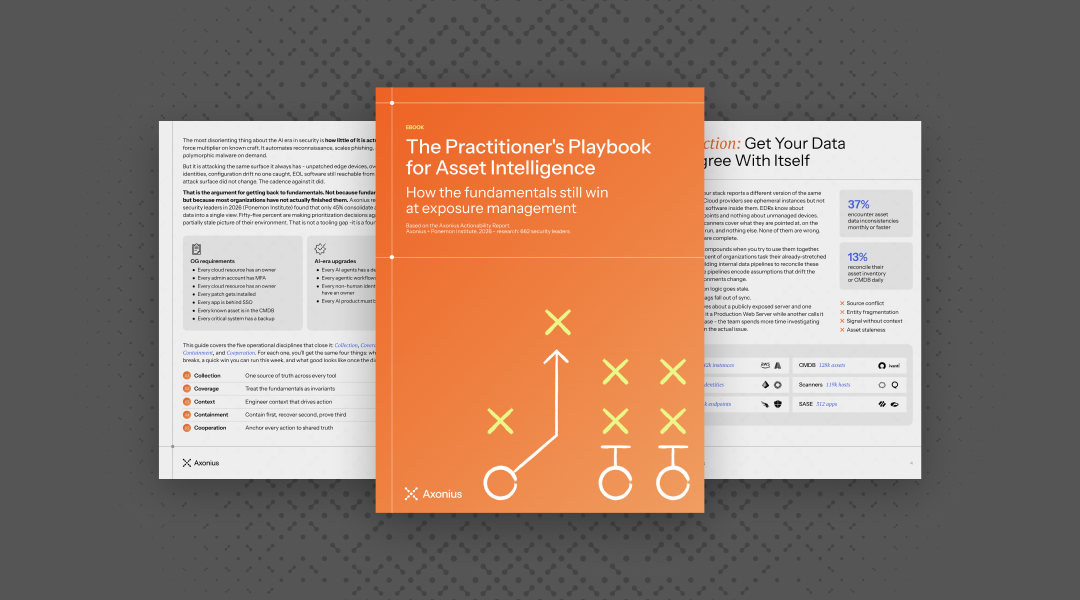
This playbook covers the five operational disciplines that separate teams who stay ahead from those who don't with a quick win for each one you can run this week.
Collection — one continuously reconciled source of truth across every tool
Coverage — verify that the controls you've declared are actually holding
Context — enrich findings with asset criticality, owner, and blast radius before triage
Containment — map how risk moves through permissions, not just perimeter
Cooperation — route the right fix to the right owner, with SLAs that stick
What is exposure management?
Exposure management is the practice of continuously identifying, prioritizing, and remediating security risks across an organization's assets — devices, identities, cloud resources, and applications. Unlike point-in-time assessments, it treats risk as a live condition that requires ongoing visibility and action, not a quarterly report.
What is the difference between CVSS scores and risk prioritization?
CVSS scores measure technical severity in isolation — they can't tell you whether a vulnerable asset is internet-facing, business-critical, or already mitigated by another control. Risk prioritization layers in asset context, exploitability, and business classification so teams can distinguish what needs fixing now from what can be deferred.
What are the five disciplines of asset intelligence?
Asset intelligence depends on five disciplines working together: Collection (one reconciled source of truth across all tools), Coverage (verifying declared controls are actually active), Context (enriching findings with criticality, ownership, and blast radius), Containment (mapping attack paths based on real permissions), and Cooperation (routing remediation to the right owner with defined SLAs).