Axonius Introduces AI Workforce, Providing Security Teams With Virtual Workers to Act on Verified Data

Read the Press Release

Continuous Security Control Monitoring

Continuously monitor security controls and have audit evidence ready on demand

Audit prep shouldn't mean weeks of pulling control data out of disconnected tools. Axonius reconciles asset and control data across your stack, shows where required controls hold and where they don't, and keeps the evidence current between audits.

Product Tour

See how security teams use Axonius to show GRC the current state of their controls without the manual reconciliation.

Your controls span a dozen systems. Your audit evidence shouldn't.
The Challenge

Your controls span a dozen systems. Your audit evidence shouldn't.

Every audit starts with the same question: which assets are covered and by which controls? Security pulls exports from EDR, vulnerability scanners, MDM, and IdPs. Each has its own asset count and its own view of “covered.” Someone spends days matching records and explaining why the totals don’t agree, and the environment has shifted by the time the report is done.

Axonius reconciles asset and control data across your tools and keeps it current. The answer to "are we covered?" is audit-ready evidence you can show on request, not an urgent week-long project.

  • Get a Personalized Demo
Know you're covered before the auditor tells you you aren’t
The Approach

Know you're covered before the auditor tells you you aren’t

  • Define “covered” once - Set which assets, users, apps, and cloud resources need which controls, and record approved exceptions. Build the denominator from the reconciled asset model Axonius creates across every source, so Security, IT, and GRC defend one number.
  • Find gaps while there's time to fix them - Continuously compare control baselines against your security and IT stack. A high-risk vulnerability past SLA, a new device with no EDR, an admin account without MFA: each surfaces as it’s discovered, not just during an audit. Axonius AI can notify the right owners or enforce a fix through Action Center.
    • Closing operational gaps like inactive agents or missed scans? see Fix Coverage Gaps.
  • Hand GRC evidence, not a promise - Auditors see what your team sees, at any point in the year. Coverage and remediation trends, exceptions, and action histories come from the same data your practitioners use.

Outcomes

The control monitoring metrics that tell you if your compliance reporting is actually working

Manual coverage validation hours

Reduce time security spends gathering and reconciling control data for each audit cycle up to 94%.

Control coverage rate

Share of in-scope assets that meet the control baseline. Mature deployments typically go from 70–80% to 95%+ in 90 days.

Coverage-related audit findings

Audit findings tied to control or evidence gaps in a cycle. Customers report these dropping sharply in the first audit cycle after deployment.

How Continuous Security Control Monitoring works in Axonius:

From connection to evidence

Step 1: Connect every system that knows about an asset

API adapters pull from your security, IT, identity, cloud, and SaaS tools. Network collectors bring in IoT and OT and shadow IT devices that no agent or console will ever report. Nothing new to deploy on endpoints.

Step 2: Reconcile into one decision-grade record per asset

Every device, user, app, and cloud resource gets a single record with its control state, owner, exceptions, and history, drawn from every source that sees it.

Step 3: See what's covered and what isn't

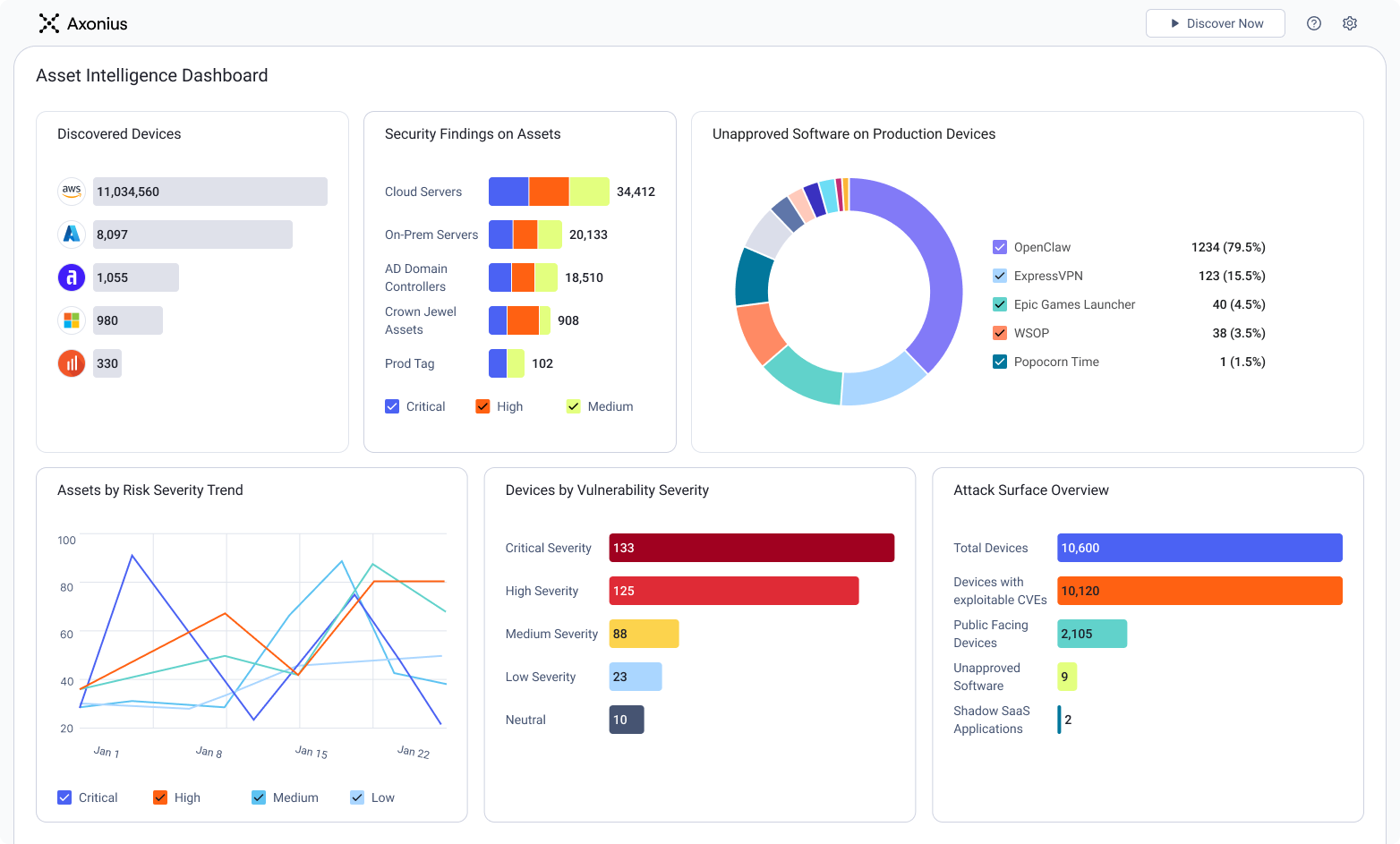
In-scope assets, required controls, and live coverage by asset type, team, or framework. The gaps are visible before anyone opens a spreadsheet.

Step 4: Prove it and fix it from the same place

Generate audit-ready reports from live data. Route gaps through Action Center (600+ actions) to open tickets or run approved remediation, then verify the result.

Axonius adapters & integrations for Continuous Security Control Monitoring:

Axonius connects to 1,400+ sources across your security and IT stack. For control monitoring and audit reporting, key integrations include:

  • ServiceNow
  • Drata
  • Archer (Archer IRM)
  • OneTrust
  • LogicGate
  • Onspring
  • Crowdstrike
  • SentinelOne
  • Tenable
  • Qualys

See all Adapters, and find documentation links

What is continuous security control monitoring?

Continuous security control monitoring checks whether required controls remain in the expected state on the assets where they are required. For operational controls such as endpoint agents and vulnerability scanners, security teams need a current asset scope, a defined coverage policy, observed state from connected systems, and a path to investigate and correct exceptions. The resulting record helps GRC assess evidence between audit checkpoints.

How is control coverage different from a deployed tool count?

A deployed-tool count reports how many installations a tool sees from its own vantage point. Coverage asks whether the required assets are in scope and whether the expected control is present and in the required observable state. An inactive agent, an asset the tool has never seen, or a version outside the approved range can change that answer without changing the deployment count at all.

What evidence can Security give GRC between audits?

The defined coverage scope, observed control state by asset, exceptions with status, coverage trends, and records of corrective action. GRC uses this operational record as evidence for the applicable audit process. Axonius supplies the operational evidence. Audit conclusions and framework mapping remain with GRC.

How does continuous monitoring reduce the manual work of audit preparation?

Security stops rebuilding the same reconciliation for each audit request. Asset and control data from connected tools is already correlated, scoped, and current, so reports run from live data instead of exports matched by hand. Actual savings depend on the connected sources and how much of the process is manual today.

What happens when a control drifts out of policy?

Axonius identifies assets that fall outside the configured baseline and routes them to the right remediation path, through Action Center automation or tracked workflows. After correction, coverage can be rechecked against the same policy. Detection and correction depend on the connected sources, policy configuration, and approved action permissions.

Can Axonius replace a GRC system or an auditor's assessment?

No. Axonius helps Security validate and document operational control coverage. GRC remains responsible for control ownership, framework interpretation, exceptions, and audit decisions. Both teams can work from the same current evidence, but a coverage check is not a full control-effectiveness assessment.

Find your coverage gaps before your next audit does

Find your coverage gaps before your next audit does

See what your own data says about "are we covered?" in a working session with an Axonius expert:

  • Answer coverage questions across all the systems of record from current data, not last quarter's export.

  • Spot the unmanaged, unowned, or out-of-SLA assets an auditor would find first.

  • Give Security, IT, and GRC one view of the same assets.