Asset intelligence is no longer optional in the AI era

Ivan Dwyer
Principal Product Marketing Strategist, Axonius
.jpg%3Fwidth%3D1720%26auto%3Davif%26format%3Djpg%26disable%3Dupscale%26quality%3D95&w=3840&q=95)
For as long as the cybersecurity discipline has existed, having an asset inventory has been foundational. The table stakes answer to the question: “Do we know what we have so we know what to protect?”
Answering that question is harder than it sounds. But for as long as the cybersecurity discipline has existed, we got by with what we had (spreadsheets); ironically a poor representation of what we had (assets).
This has been acceptable to-date because outside of incident response, the work that required an asset inventory was periodic. It entailed monthly patch exercises, quarterly evidence gathering, and occasional hygiene uplifts. Security and IT teams could get what they needed by manually traversing dashboards to compile asset data into spreadsheets. It was time-consuming and painful every time, but there wasn’t much urgency to it, so teams managed.
Those days are long gone. AI is the tipping point, but it’s been happening for years. Since the cloud burst onto the scene and distributed work became the norm, the number of issues, vulnerabilities, and potential exposures has continued to skyrocketed year-over-year. Teams have been fighting fatigue due to these rising volumes: fatigue as a human condition.
AI has now tipped the scale beyond the human condition. Every one of those disciplines that used to be periodic must now be continuous to keep up. Vulnerability management (VM) is now continuous threat exposure management (CTEM). Control coverage is now continuous control monitoring (CCM). Every cybersecurity program (attack surface management, posture management, identity & access management, and risk & compliance) is now continuous and carries the same urgency as incident response.
Asset intelligence underpins every one of these shifts from periodic to continuous security operations. There is no longer room, or an excuse, to spend any manual effort reconciling assets into spreadsheets. Context must be immediate and it must be durable in order to serve every cybersecurity program at machine speed.
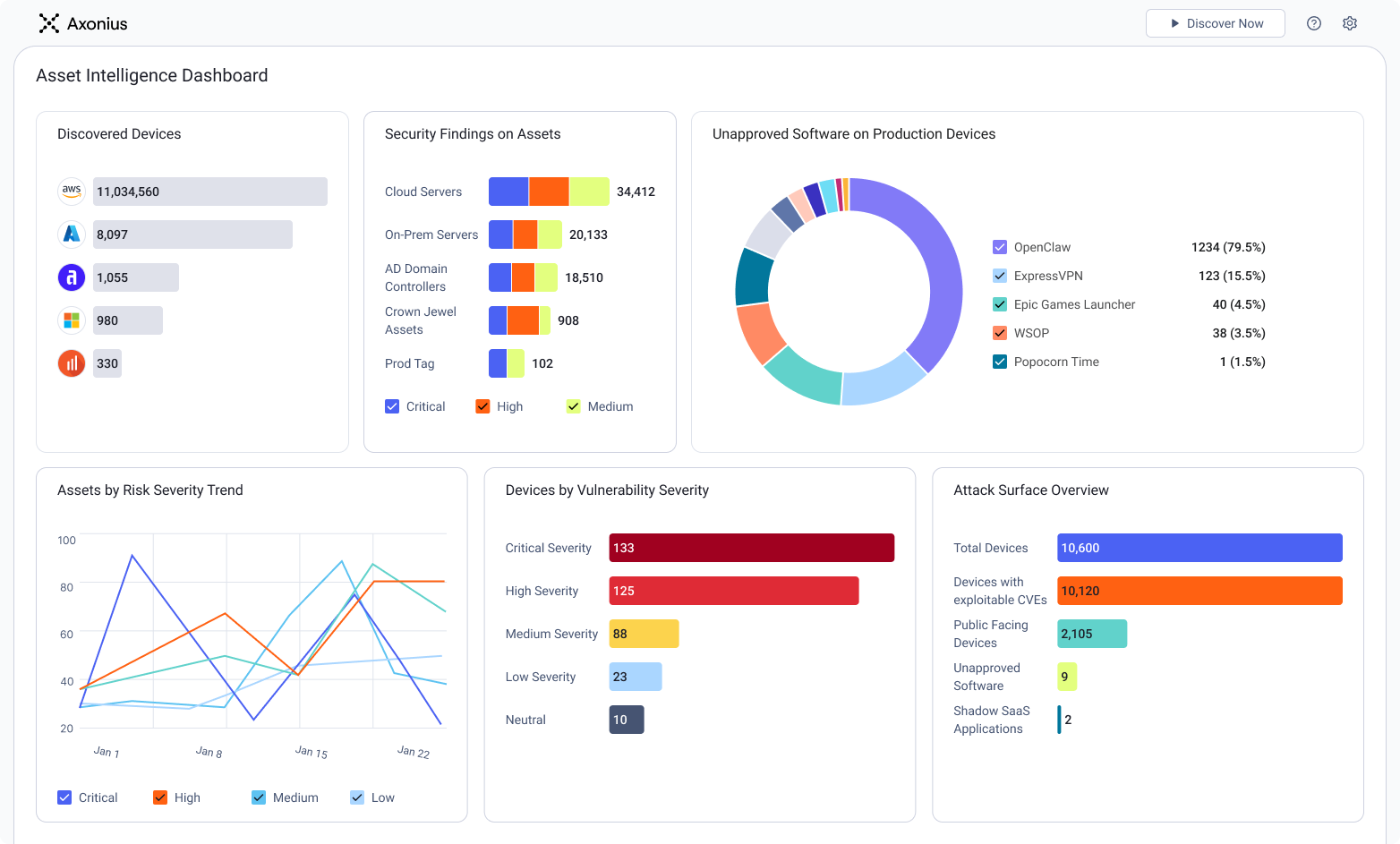
As we’ve stated before, the bar we set for asset intelligence at Axonius is decision-grade, and it shows up as the baseline for every cybersecurity program. Let’s highlight three programs that span: what do we have, is it covered, and is it at risk?
.png)
After AI: Attack surface management
Attack surface management (ASM) began as an exercise that put your IT footprint into a more tangible risk framing: moving from what do we have to what do we have that’s potentially exposed. Cloud, SaaS, remote work, and now AI adoption have turned the attack surface into a continuously moving target.
The expectation is no longer a map you refresh every once in a while. The attack surface must be an always accurate view of the full surface, with every path illuminated from the outside-in and the inside-out. Not just what is exposed, but what it connects to, because an internet-facing asset that reaches a domain controller is a different problem than one that doesn’t.
Fragmentation makes this view hard to achieve continuously. Every system and tool in your stack sees a different slice. Reconciliation requires an elevated position that can assemble all of the parts into a complete, accurate, and up-to-date representation of reality across the entire environment.
Axonius reconciles across 1,400+ bi-directional connections into a single model, then makes the relationships between assets explicit. Just as important, it surfaces the unrelated: the assets with no owner, no management connection, or no endpoint detection and response (EDR), which is often where the real attack surface hides.
“You can’t calculate risk without a denominator. If you don’t know your full attack surface, you can’t tell leadership what percentage of assets are exposed or protected.” - Kara Keene, Senior Manager of Attack Surface Reduction, TransUnion
After AI: Continuous controls monitoring
So much of cybersecurity is getting the fundamentals right. And so much of the fundamentals is placing the right compensating controls in the right places. But validating coverage has always been a point-in-time claim, performed for the next compliance audit. Given how dynamic the attack surface is, drift and gaps are inevitable: an agent stops checking in, a new device class ships outside policy, or a configuration drifts from its baseline.
The expectation has moved from proving coverage as a one-off to holding it continuously. Detections are no longer built just to identify attacks, but also where controls are missing or broken.
The negative space makes proving control coverage harder than it sounds. Your tools that provide compensating controls can tell you where they’re running and how they’re performing, but not where they’re not. This is another instance where reconciliation requires an elevated position. For example, your network security platform detected a device, but that device has no EDR registered.
This is exactly the gap Axonius is built to close. You declare what coverage should look like once, and Axonius keeps watching, detecting deviations such as missing controls, inactive agents, or systems that have gone completely dark.
"If you’re constantly trying to reconcile your asset inventory with your vulnerability agents and your endpoint agents, and you’re always wondering why machines aren’t checking in, a tool like Axonius can help you get your arms around that problem.” - Jon Hocutt, Director of Information Security, Brooks Running
After AI: Vulnerability and exposure management
The headlines have been shining a light on vulnerabilities and exposures since the introduction of Claude Mythos. Those working in security operations (SecOps) have witnessed the steady rise of vulnerability disclosures for years now. The AI tipping point made the conversation non-negotiable. Cybersecurity programs designed for human-speed triage won’t survive machine-speed disclosure.
The only way to escape an even faster game of whack-a-mole is to shift the prioritization mechanism away from blanket scoring systems to cross-domain, internal aware engines that take all of the security findings and place them in the right context. This includes the assets affected, who owns them, what controls surround them, are they exposed, and would there be any business impact.
Cross-domain prioritization also requires reconciliation from an elevated position. Security findings arrive from every scanner and tool in your arsenal, described with its own dialect and within its own scope. Simply aggregating findings just gives you a larger list. Full-context prioritization means looking across the security, asset, and business context together to understand impact potential and exploit feasibility. This is something raw findings won’t get to.
Axonius pulls findings together from across your stack and does what the source can't: scores each one around the full context of the environment, tuned to your specifics. Then it hands the shortlist to the people who can fix it, already sorted by owner, with recommendations ready for action.
"It (Axonius) helps us focus effort where it actually matters instead of spreading resources thin.” - Luis Valenzuela, Head of Data Governance, Data Protection & DLP, InComm Payments
Axonius is decision-grade asset intelligence
With new expectations comes new dependencies. Every cybersecurity program that is now continuous relies on decision-grade asset intelligence as the durable context layer. Moving faster only works when you have the right foundation. Speeding up a broken process, an incomplete view, or a conflicting record compounds in the wrong direction.
An asset inventory is static, a point-in-time snapshot. Asset Intelligence is dynamic, built for the AI era. The organizations that treat durable context as critical data infrastructure for security operations will be the ones who can absorb the AI inflection point.
Get in touch with Axonius to ground your AI-readiness in decision-grade asset intelligence: Request a demo.
Categories
- Security
- Artificial Intelligence Ai

Get Started
See how to make asset intelligence actionable with a guided demo:
- Stop chasing data — work from one asset model your entire team can trust.
- See what's exposed before it's a problem — surface coverage gaps automatically.
- Turn alert noise into action — cut thousands of alerts down, to the ones that matter.