Axonius has the data and Axonius AI has the answer. Axonius AI is generally available.

Teju Shyamsundar
Principal Manager, Product Marketing, Axonius

Avidor Bartov
Co-Founder and Chief Architect
Yuval Meytal
Senior Product Manager, Axonius
Every security and IT team is sitting on more data than it has ever had, yet is further than ever from the answers it actually needs. The information that decides your day is somewhere in your environment: which critical assets are missing an update, which devices have no endpoint detection and response (EDR) agent, and how far a newly disclosed common vulnerabilities and exposures (CVE) really reaches. The challenge is that the data is scattered across dozens of tools that were never designed to talk to each other. The constraint was never the data you have. It's the ability to ask questions across all of it, trust the answer, and take the best remediation action.
Axonius has spent years solving the hard part of asset intelligence for our customers: a single correlated, deduplicated model of your entire asset estate across more than 1,400 bi-directional integrations. We're now making that model easy for anyone on your team to use, whatever their expertise. Announced today, Axonius AI is generally available: a platform-native AI, grounded in your environment, that turns a plain-language question into a trusted answer anyone on your team can use, and, with your approval, acts on what it finds.
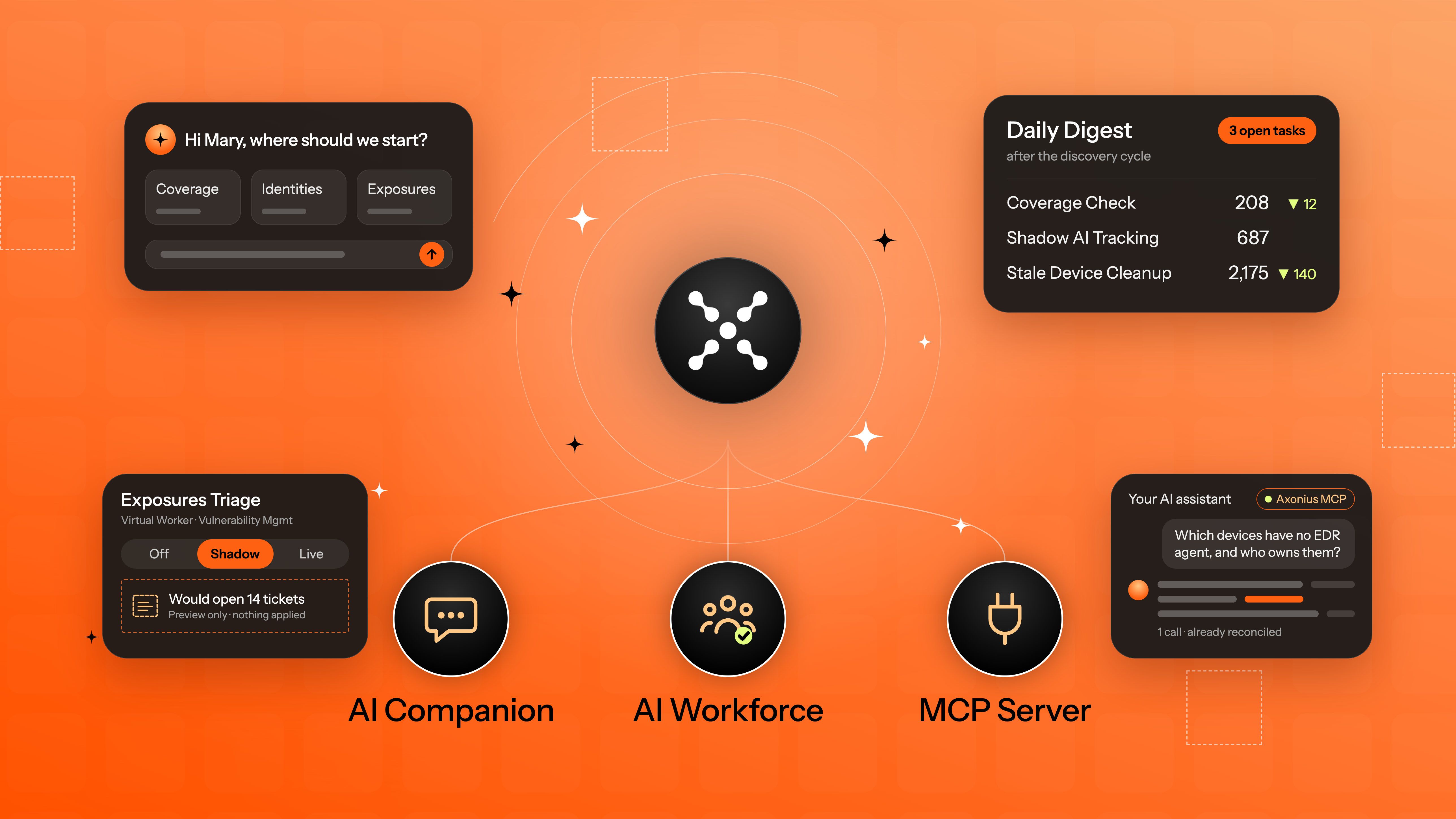
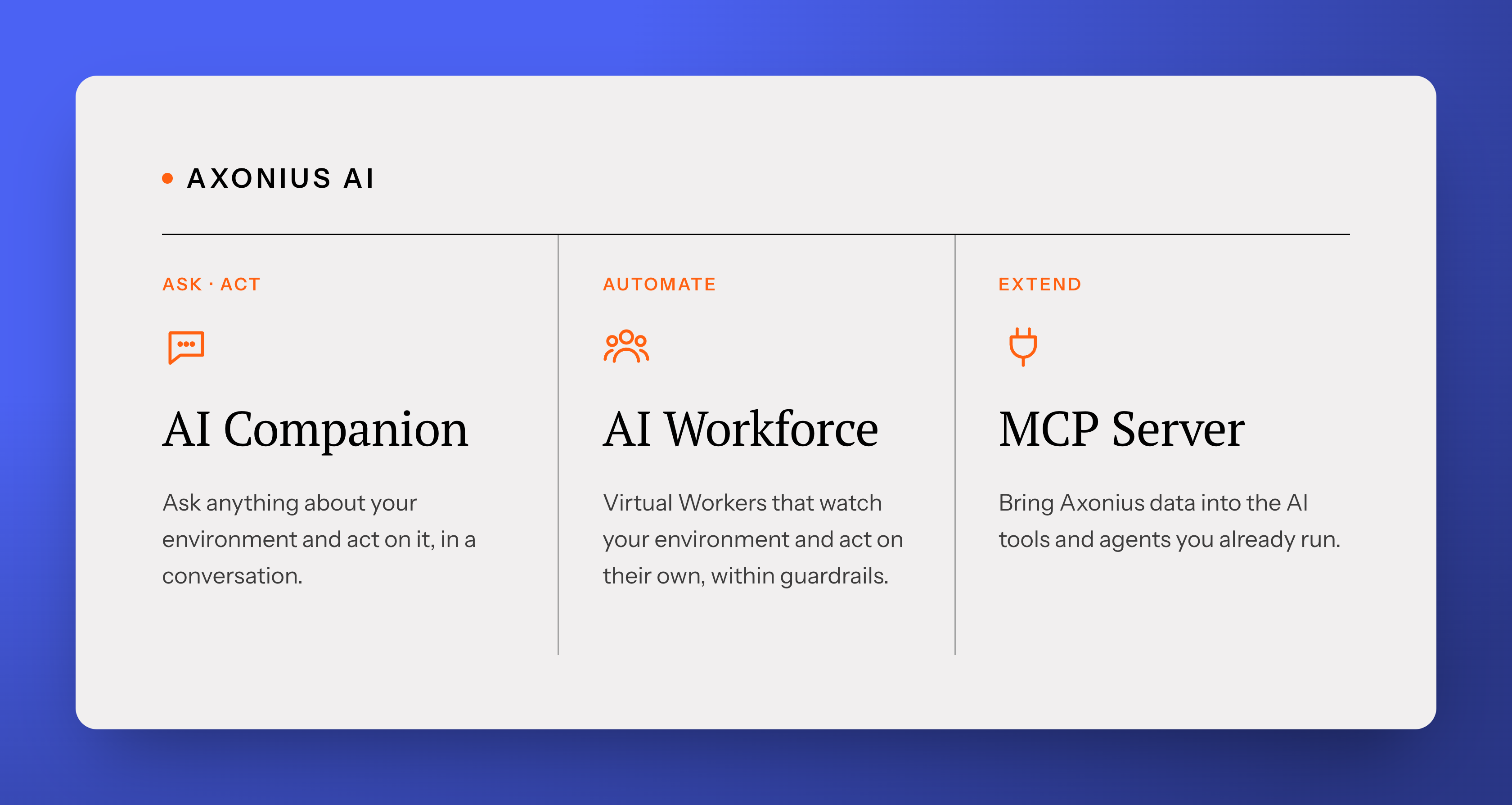
Axonius AI shows up across three surfaces, all built on the same trusted foundation:
- Axonius AI Workforce: Watch your environment with a team of Virtual Workers that act on their own, inside the limits you set.
- Axonius AI Companion: Ask anything and act on it, in a conversation.
- Axonius MCP Server: Extend Axonius data into the AI tools, AI agents, and automations you already run.
AI in security is moving from answering questions to doing the work. But security and IT teams don't want an AI agent they have to babysit, and they won't hand one the keys to their environment on faith. They want AI that earns its autonomy the way a new teammate does: showing its work, proving its judgment, and taking on more as trust grows. That's the future we're building, and with Axonius AI, it starts today.
"The value of data is measured in connections. Axonius AI connects those dots across our environment, turning tasks that once took hours into actionable insights in seconds,” said Mike Chasteen, staff security architect at Exemplar Luxury Group, formerly Saks Global. “Our team spends less time stitching together reports from disparate tools and more time acting on what actually matters. For a retail brand where trust and uptime are everything, that kind of speed and clarity makes all the difference."
One AI, one source of truth
Under all three surfaces is a core AI foundation reasoning over the same decision-grade asset model that powers the Axonius Asset Cloud, which is our reconciled view of the whole estate across more than 80 entity types. That's what makes the answers trustworthy:
- Natural language in, trusted data out: No query language, field paths, or adapter knowledge required. You describe what you want to know. The AI agent compiles the query, runs it against your live tenant, and explains what it found.
- Grounded in your data: Answers come from your actual environment. Every asset that Axonius discovers is aggregated, correlated, and deduplicated across cloud, on-premises, IT, and operational technology (OT).
- Governed by design: Every request is bound by role-based and attribute-based access controls, the same ones that govern the rest of the platform. Write actions, such as creating a ticket or enforcement, and you’ll be shown a preview and wait for approval. It’s all audited in one place.
This allows Axonius AI to understand what you mean much better than AI assistants relying on siloed context. Ask in your own words, and the AI agent works out the intent behind the prompt: which assets you’re asking about, which conditions matter, and what you're really trying to find. Then it reasons from that intent, carrying context across the conversation and bringing in the right expertise for the job automatically, so you never have to pick a specific tool or name a specific skill.
Axonius AI Workforce: from a companion you ask to a team that acts.
Announced today, Axonius AI Workforce is the newest capability for Axonius AI. Most enterprise AI waits for a prompt, answers, and marks the task as completed. The Axonius AI Workforce is proactive. It's a standing team of Virtual Workers organized by function that run continuously, track whether things are getting better or worse, and can act on their own inside boundaries you define. This is the agentic part of Axonius AI, and the part with no real parallel in enterprise cybersecurity tools. It's also where earned autonomy becomes real.
Plenty of AI agents have arrived in the last year. Most are built on a single vendor’s slice of your environment, limiting your team’s ability to take decisive action. The AI Workforce is built differently:
1. It runs autonomously
The Axonius AI Workforce account runs every check automatically after every discovery cycle with no prompt and no human kicking it off. By the time you open the platform in the morning, the work is done and the Daily Digest is waiting.
2. Every Virtual Worker owns a security result and tracks it over time
Each Virtual Worker is in charge of a KPI (i.e. one bottom-line headline). That number is tracked run over run (“12 fewer critical exposures active since last run”) with trend bars and automatic detection of which department moved worst. The KPI answers the two questions you care most about: “is this getting better or worse?” and “is this agent helping me?” It does so without anyone manually building a report.
3. It acts in three modes of autonomy, set by you
Every AI agent has three modes:
Off: Stops for human approval, like any Axonius AI Companion action.
Shadow: The check runs and previews exactly what it would have tagged, ticketed, or created to simulate the impact. Nothing is applied.
Live: The check applies the action automatically on every run, including scheduled ones, within its write cap.
4. It supports your own standing instructions
Each Virtual Worker has a specific input for your own standing instructions with a place where you can tell, in plain language, what to leave out, what to prioritize, or how to define its population. Examples include: “ignore lab devices tagged as Lab-Environment,” “treat the CMDB as the source of truth for ownership,” or “only flag findings with EPSS above 0.5.” Those instructions persist across every future run in your data scope, with no queries to rebuild, making the worker genuinely yours.
5. It's organized like your team and wired for action
Virtual Workers are grouped into the departments that reflect real-life security functions: endpoint security, vulnerability management, identity & access management, cloud and SaaS, AI security, IT asset management, GRC (governance, risk, and compliance), OT, and Axonius Administration. Each of these functions are surfacing the checks that have moved significantly since the previous check. This allows the right numbers to reach the right owners. A check doesn't just report a gap. If granted the permissions, it can trigger Enforcement Sets and Workflows directly (tag the assets, open the ticket, create the case, and close the gap) all inside its write cap and the actions an admin has approved.
Above all of it sits the Daily Digest. After every cycle, the AI reads all of its latest runs together and writes one synthesized summary including the ranking findings by severity, surfacing the top actions, and calling out what needs attention. It's a cross-check intelligence layer that tells you where to look first.
Put the differentiators together and the Axonius AI Workforce covers the standing work that never gets done consistently across all your assets because no one has time to research or get AI running consistently across all the assets and planes:
“Tell me what changed overnight.” The Daily Digest ranks it every morning.
“Is our coverage gap getting better or worse?” The Coverage Check headline and trend bars show direction, cycle over cycle.
“Triage and ticket our critical findings automatically.” Exposures Triage segments them by owner, previews the tickets in Shadow, and opens them once you go Live.
“Clean up dormant accounts at scale.” Dormant Accounts tags, cases, or triggers a disabled workflow every cycle, within your guardrails.
“What SaaS and AI tools are employees using that are not approved?” Shadow SaaS and Shadow AI Tracking surface unsanctioned apps and AI tools each discovery cycle, so you know what’s in use and who owns it.
“Is our internet-facing attack surface shrinking?” Internet-Exposed Assets tracks what’s reachable from outside and shows how that number moves over time.
Axonius AI Companion: ask anything and act on it.
Announced in July in preview, today we’re sharing the general availability of the Axonius AI Companion, an evolution of the Axonius AI Agent and the conversational front door to your environment. Ask a question in plain language and get an answer grounded in your asset data.
- “How many devices have no EDR agent, broken down by OS?”
- “Show me users who haven't logged in for 90+ days and are still enabled.”
- “Critical CVEs on internet-facing assets handling PII — enrich with owner and business unit, and rank by real risk.”
These are questions no single tool can answer, because each tool only sees its own slice of the asset data. With the Axonius AI Companion, you can turn output into actions, building a loop from discovery to remediation without ever abandoning the chat:
- “Open a ticket for the 47 devices missing our EDR agent.”
- “Save this as ‘Stale Servers — No EDR,’ chart it on my Vuln Management dashboard, and schedule it every Monday at 8am.”
Each of these actions stops for a preview and your approval before changes are made. This is where investigations, dashboards, and one-off cleanups happen: in the moment, driven by you.
Companion or Workforce? When to reach for each
Both the Axonius AI Companion and the Axonius AI Workforce leverage the same asset context and actions of the Axonius Asset Cloud. The choice depends on which mode fits the work in front of you.
Reach for the Axonius AI Companion when… | Reach for the Axonius AI Workforce when… |
|---|---|
Who’s it for? Anyone who needs an answer, whether they’re in security, IT, GRC, or an executive. It's a personalized workspace. Ask what you need, then turn the answer into a dashboard or report you can share with the team. | Who’s it for? Your security team. Virtual Workers are shared across the team, so everyone works from the same numbers and the same actions, and standing work is taken off everyone’s plates. |
The work is a question or a one-off action, right now. | The work is ongoing and should happen whether or not anyone remembers to ask. |
You're investigating an incident, building a dashboard, pulling a list, or ticketing a specific gap you just found. | You want a metric watched over time, or a policy enforced every cycle such as dormant accounts disabled, no EDR devices tagged, or tickets opened for critical findings. |
Example: “Which internet-facing servers are missing a patch for this new CVE? Open a ticket for the owners.” | Example: Exposures Triage runs after every discovery cycle, previews tickets in Shadow for a week, then opens them automatically once you trust it. |
Axonius AI also allows you to promote an Axonius AI Companion question into a Virtual Worker. Start a question in the Axonius AI Companion, and when you want it to run continuously, hand it to the Axonius AI Workforce.
Axonius MCP Server: asset truth inside your AI stack
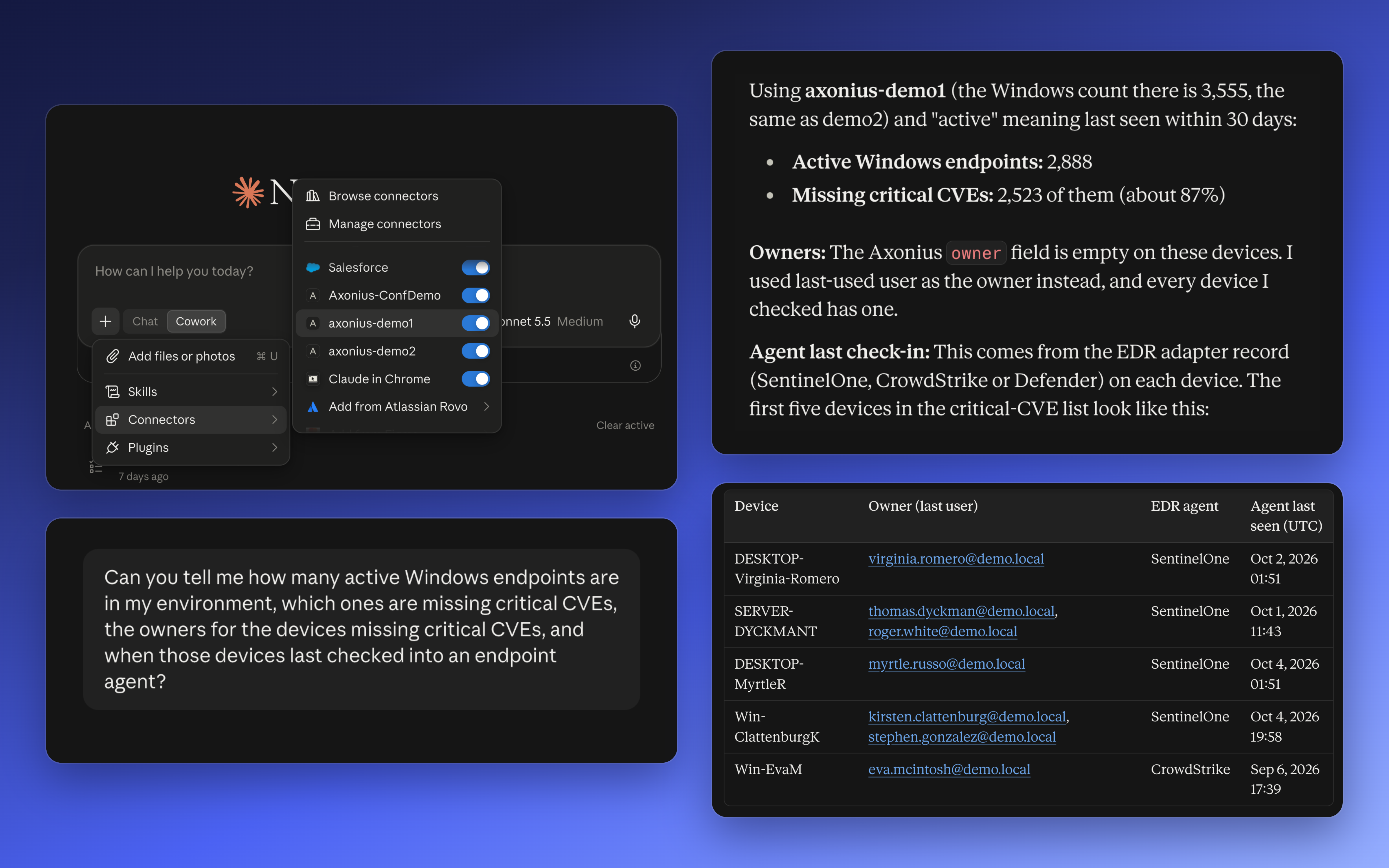
Announced in July in early access and also generally available, the Axonius MCP Server brings your Axonius data to the AI harness and systems you already have. You ask, the server runs it against your tenant, and returns a grounded answer that reflects your real asset estate without requiring siloed MCPs. This is the reverse of the Axonius AI Companion and Axonius AI Workforce, which bring our AI harness to your data inside the Axonius Asset Cloud.
Why one MCP beats many
Many tools in your security and IT stack now have their own MCP server, so why not point an AI agent at all of them? Ask which devices are missing an endpoint agent and who owns them, and each tool returns only part of the answer: CVEs without owners, agent status without exposures, owners without coverage, or a CMDB record that's out of date.
The AI agent has to stitch it all together itself, on every question. That's the reconciliation tax: more tool calls, more tokens, and answers that are slower and more likely to be wrong. With the Axonius MCP Server, reconciliation has already happened upstream, so one call returns one complete answer. Axonius calculates what's known, and your AI agents spend their reasoning on what needs judgment.
And the tax isn’t just in tokens. Many MCPs aren’t hosted for you, so you stand them up, patch them, and control who can reach them. Each one needs its own non-human identity (NHI), which means another credential to govern. The AI stitches the data together differently each time it runs, so the same question can take a different path and return a different answer, which is hard to defend in an audit. And many systems, from Active Directory (AD) to proprietary tools, have no MCP at all, leaving gaps you have to fill yourself.
The Axonius MCP Server replaces that sprawl with one governed connection: role-based and attribute-based access control, and a single audit trail.
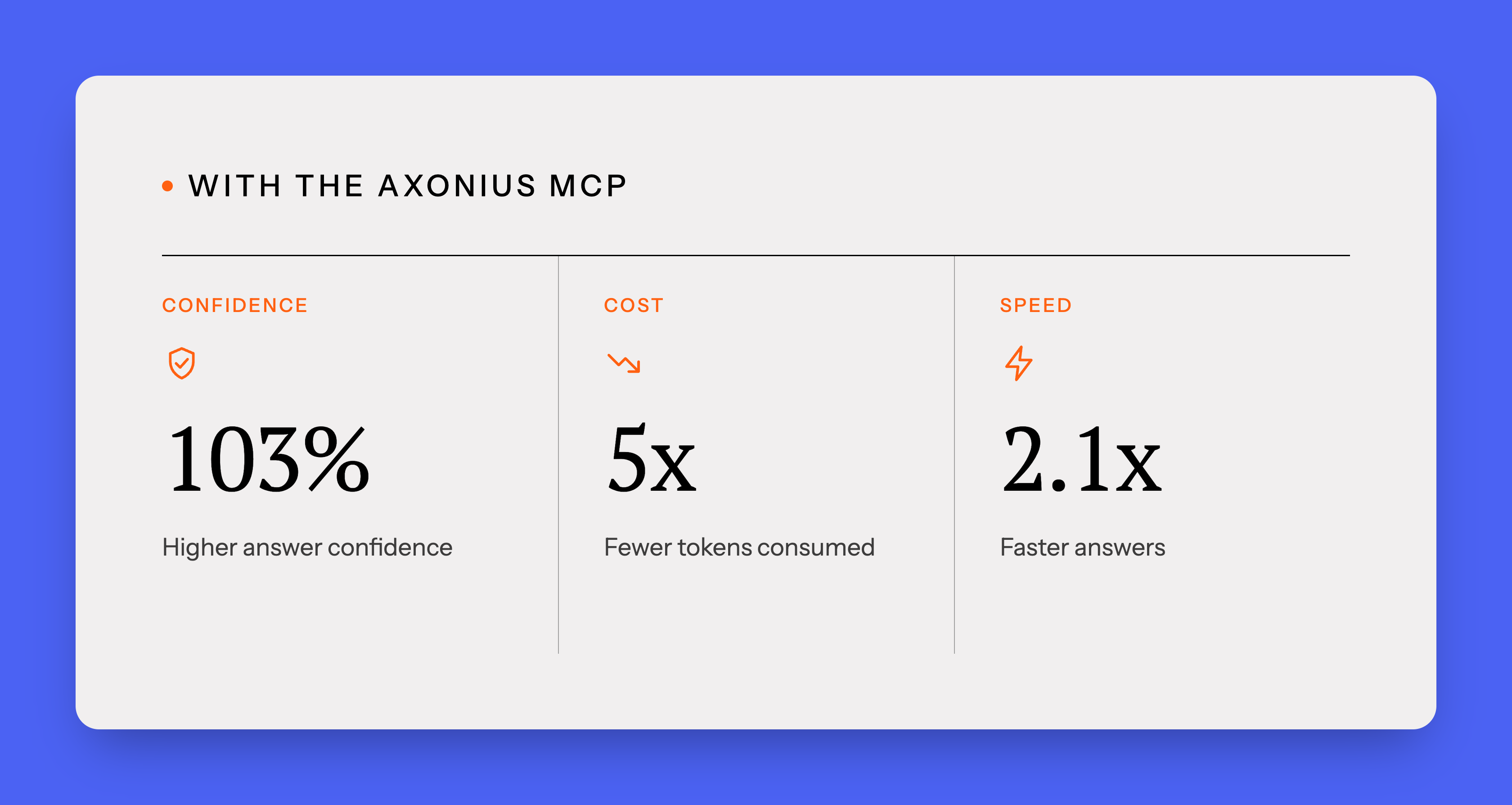
So, build all the AI agents you want. Just don't make them rebuild reconciliation. We put this to the test. In our own MCP benchmark, we ran the kinds of questions organizations typically bring to Axonius for asset intelligence and exposure management through two methods. Once with Axonius as the AI's context, and once across six separate MCPs (a small slice of a real environment).
Compared with the multi-MCP approach, Axonius delivered:
103% higher answer confidence
5x fewer tokens
2.1x faster answers
How it fits into your AI stack
Where the Axonius MCP Server really pays off is as one component in a larger workflow. Axonius as the source of asset truth and another AI tool taking the action:
MCP + AI app (research & reporting): Ask which assets a new CVE hits, research its exploitation and patch status in the same application, and get a ranked, environment-specific remediation list. Save the prompt and it becomes a recurring weekly CVE report.
MCP + SaaS automation (action): Feed asset context into the automation and ticketing platforms you already run so they can enrich, route, ticket, or remediate.
MCP + collaboration (delivery): Surface answers where your team already works, such as team chat, email, or a generated report.
Think of it this way. The Axonius AI Companion and Axonius AI Workforce are the end-to-end, action-taking AI inside Axonius. The Axonius MCP Server is how Axonius becomes the trusted asset input to every other AI workflow you're building.
Getting started
Open the Axonius AI Workforce to see what it found in your environment overnight, ask the Axonius AI Companion the question you couldn't answer this morning, or point your own AI tool at the Axonius MCP Server and let Axonius be your single source of truth. Request a demo and see Axonius AI in action in the Axonius Academy.
Availability
Announced today, the Axonius AI Workforce, Axonius AI Companion, and Axonius MCP Server have been generally available to customers since October 4, 2026.
Additional resources
Learn more about Axonius’ approach to AI for security.
Read the press release to learn more about the Axonius AI Workforce, Axonius AI Companion, and Axonius MCP Server.
Categories
- Artificial Intelligence Ai

Get Started
See how to make asset intelligence actionable with a guided demo:
- Stop chasing data — work from one asset model your entire team can trust.
- See what's exposed before it's a problem — surface coverage gaps automatically.
- Turn alert noise into action — cut thousands of alerts down, to the ones that matter.