Updates to Axonius Exposures to help fight operational drag

Ori Azgad
Director of Product Management, Axonius

Shimon Tzahi
Principal Product Manager, Axonius
Getting risk and exposure visibility across all your silos in a single place is hard. But once you get there, a new challenge emerges: operational drag. These are risks that hit analysis paralysis and don't get remediated due to a lack of data, prioritization, decision, or an owner to hold accountable. Today, that drag lands on security leaders, who end up figuring it out in endless meetings and email threads instead of doing actual security work. Worse, it becomes a blocker to proactive security. Exactly the muscle we need as we move toward agentic AI.
At Axonius, our engineering team made a call: to wage a war against this operational drag.
Today, we’ve announced updates to Axonius Exposures. These capabilities are meant to enable security teams to fight back against operational drag.
Asset Criticality Management
Here's a specific version of the drag problem: a Python CVE with a CVSS score of 5.0 arrives. You open it. The affected asset seems to be a regular employee laptop. At least, according to the configuration management database (CMDB). You spend 10 minutes and some Slack capital to confirm that's the case, but one extra crucial piece changes the entire puzzle. The "regular employee" is your data scientist that uses Python alongside Jupyter notebooks to analyse personally identifiable information (PII) data.
That's the problem with static criticality. It's not just the time wasted. It's that the answer you get from a point-in-time label is often wrong. Criticality isn't just a tag someone applied once. It's a function of what an asset actually is, what is doing, who uses it, what it's connected to, and what role it plays in your environment right now.
Announced in April as generally available, Asset Criticality Management has been further enhanced. Asset Criticality Management is rule-driven and dynamically linked to your real asset characteristics. When your data scientist moves teams, when a server is added to the payment card industry (PCI) subnet, and when a database hits production, the criticality of them changes automatically as your asset and infrastructure evolves.
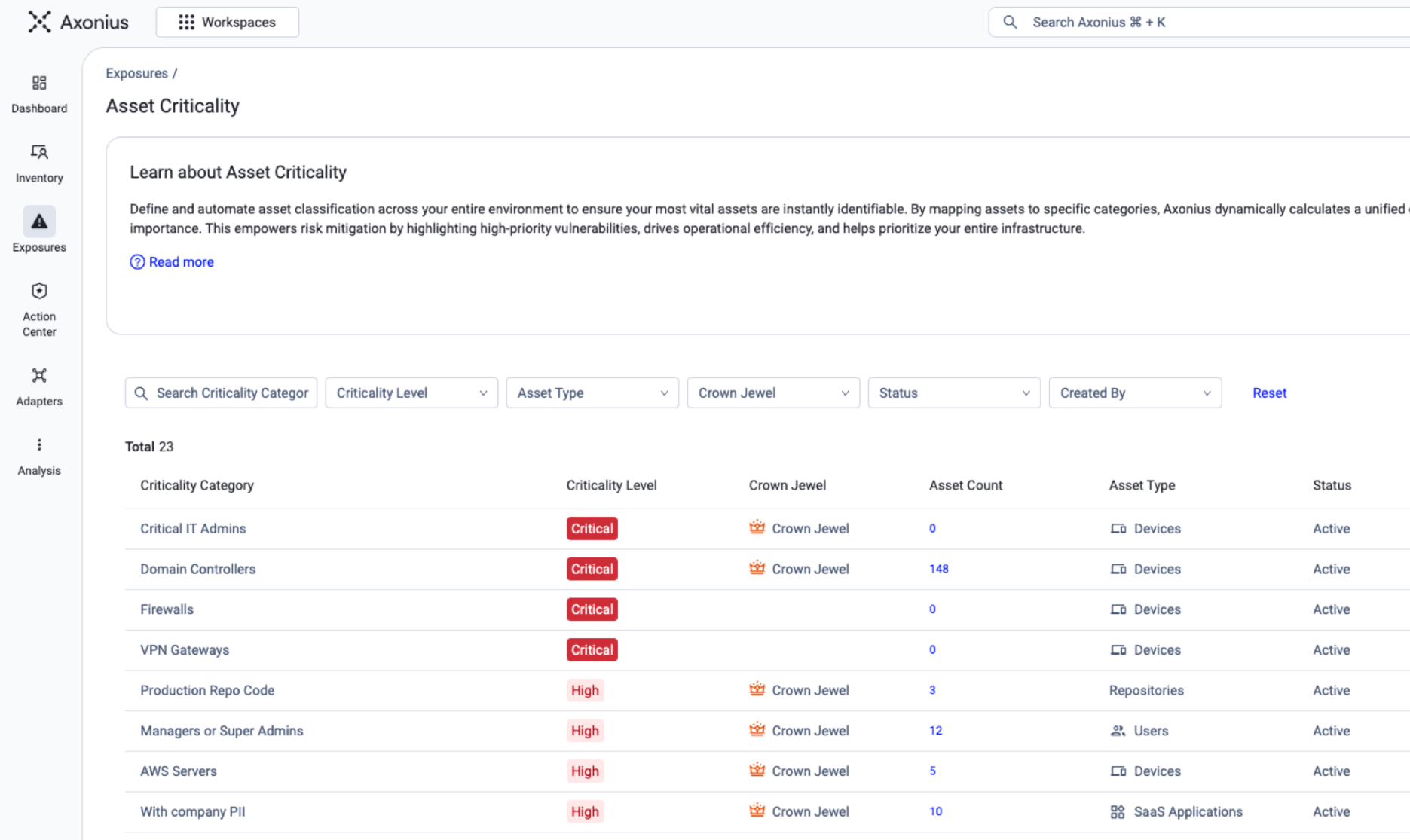
We ship with over 20 out-of-the-box categories covering the highest-stakes corners of any environment. But with everything in Axonius, you can define your own categories too that are scoped to any Axonius query, such as production tags, PCI subnets, cloud environments, and crown jewel applications. Whatever matters to your organization becomes a criticality rule.
The result: every security finding comes with dynamic business contextualization. The right priority, reflecting the right reality, without someone having to account for criticality drift.
Asset Aware Threat Intelligence Feed
Many security teams operate their response queue from threat intelligence feeds. The problem isn't that you have zero threat intel. It's how far your threat intel links to all the assets that make your attack surface. Your IT feed may be instantly linked to a specific subset of endpoints, like critical cloud workloads and vulnerability scanners. But to make sure the threat intel reaches consistently in all the places that vulnerabilities manifest (i.e. code repositories and libraries, on-premises servers, remote systems, and software inventories), you need to integrate all point-to-point tools.
So when an actively exploited vulnerability drops, you still end up stitching a large part of the picture manually. Which tool saw it, which asset types are affected, and which of those are actually exposed. The intelligence exists. It just doesn't reach your systems automatically. And you pay with manual work.
Announced today and generally available in August 2026, we're launching our Asset Aware Threat Intelligence Feed. It is a new view of Axonius Threat Intelligence that shows you the threat intel instantly correlated to all the asset types discovered by Axonius, aligned to your business context, and with recommended actions to fix the issue.
The moment a threat surfaces in the feed, it's already mapped to vulnerabilities across your entire attack surface (endpoints, containers, images, code repositories, and more). No matter the source system, it includes the impact and recommended ways to fix them.
With that, the drag between "threat published" and "full impact understood" collapses from days to seconds, while covering the whole picture, not just parts of it.
Why did we build these features?
Security professionals should focus on security
The most expensive thing in your security program (and team morale) is wasting your people's passion for security and time in information silos, Zoom, and Slack trying to work the context they don't get (despite all the data living in your systems). We built Asset Criticality Management and Asset Aware Threat Intelligence Feed, so context comes to findings automatically.
For security teams, asset criticality is dynamic
A criticality label is a photograph, but your security risk is a movie. An asset becomes risk critical as soon as it hits production and not after the CMDB is updated. We made criticality dynamic and rule-driven, so the priority is up-to-date and not a tag from six months ago.
Threat intelligence must be directly linked to assets
Threat intel disconnected to your assets is just news. It tells you a vulnerability is being exploited in the wild. It doesn't tell why and where it matters to you. That last mile from what intel exists and here's my impact is sprawled beyond production systems. It’s reaching workstations, compute images, code, and much more. We built the Asset Aware Threat Intelligence Feed to close that gap for a quick mobilization loop.
Operational drag is a technology/data problem
Everyone frames operational drag as a people/process problem, so they throw more meetings and more headcount at it. But the drag is also a technology/data problem, caused by information silos because security must safeguard everything touching confidential data (no matter where it lives). A data/silo problem doesn't get solved by working harder. We are taking it on ourselves to tackle this problem.
Operational drag affects both humans and AI
As security shifts toward agentic AI and proactive security, an AI agent inherits the same drag, silos, and broken inputs a human does. Feed it ambiguous criticality and disconnected threat intel and it will not be able to act or automate the confusion faster (garbage in/garbage out). Fixing the drag isn't just about relieving today's analysts. It's about providing the complete and durable context AI needs to deliver proactive security.
We're just getting started
We're so passionate about waging this war against drag that we got our engineers to speak about it themselves. What they built, in their own words on what the industry gets wrong, and how to help security leaders in the frontlines:
Non-CVE risk: Traditional exposure management stops at CVEs. Your risk doesn't.
Prioritization: 100+ risk scores, and not one your remediator will act on
Threat intel: Threat intelligence without asset context is just a news feed
Attack paths: Attackers take the path your map doesn't cover
Ownership: You found the security risk. Good luck finding who owns it.
Remediation at scale: You can't out-hire your risk remediation backlog
Reading about it is one thing. But seeing it in real life is another. Book a demo to see zero-drag exposure management in action.
Availability
Asset Criticality Management is generally available to customers.
Asset Aware Threat Intelligence Feed will be generally available to customers in August 2026.
Additional Resources
- Read the press release to learn more about the new capabilities across Axonius Cyber Assets, Axonius Exposures, Axonius Cyber-Physical Assets, and Axonius Software Assets.
- Read the press release and blog to learn more about Axonius AI Agent, Axonius MCP Server, and Docs for AI.
Read the blog to learn more about how asset intelligence is no longer optional in the AI era.

Get Started
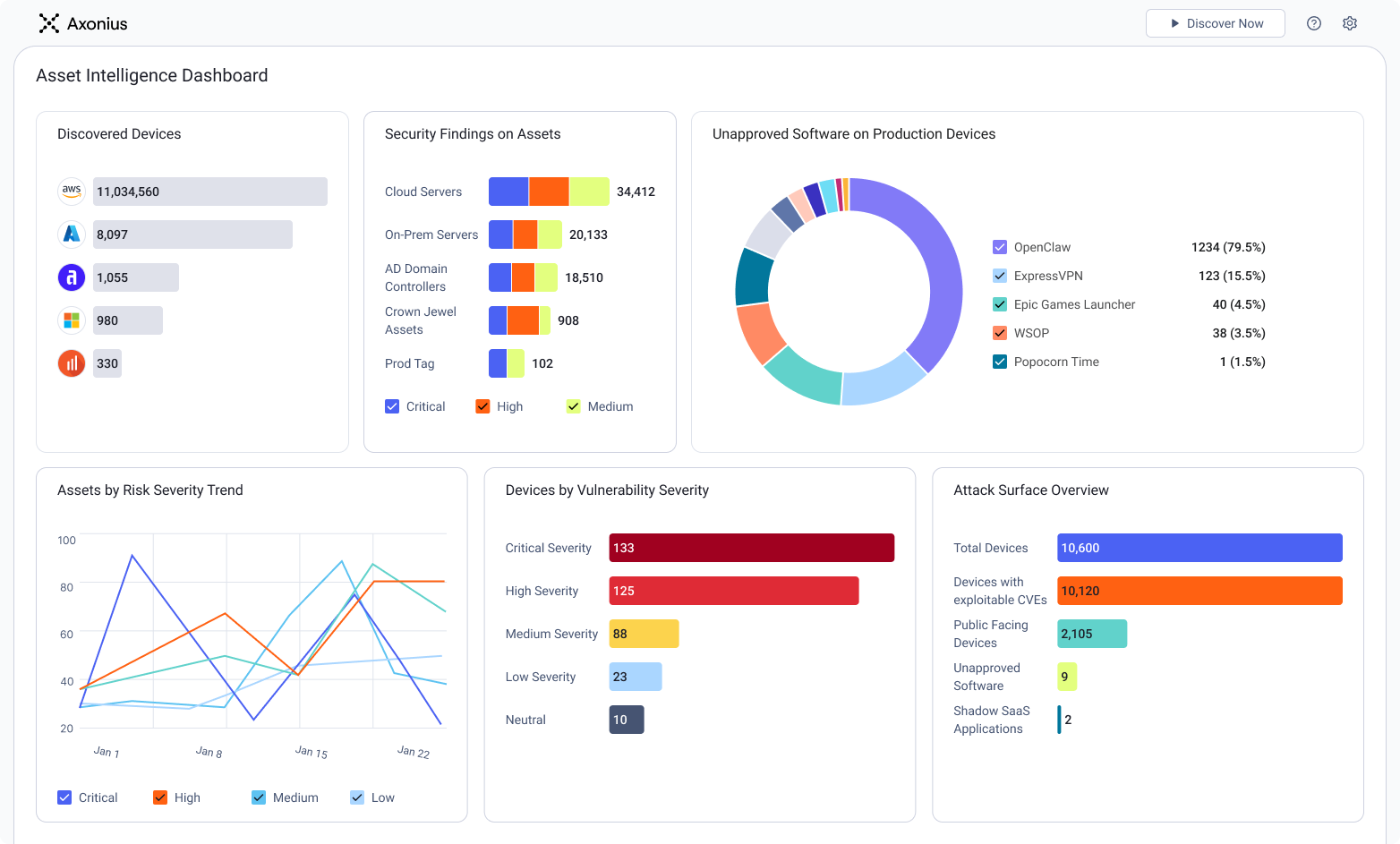
See how to make asset intelligence actionable with a guided demo:
- Stop chasing data — work from one asset model your entire team can trust.
- See what's exposed before it's a problem — surface coverage gaps automatically.
- Turn alert noise into action — cut thousands of alerts down, to the ones that matter.