Main takeaways:
CVE-2026-114938 (Java4Shell) is a critical flaw in OpenJDK’s Base64 decoder that can let an unauthenticated attacker run code on a Java service. This post covers affected versions, CPUs and fixed builds, and how to identify and remediate vulnerable assets using Axonius.
Intro
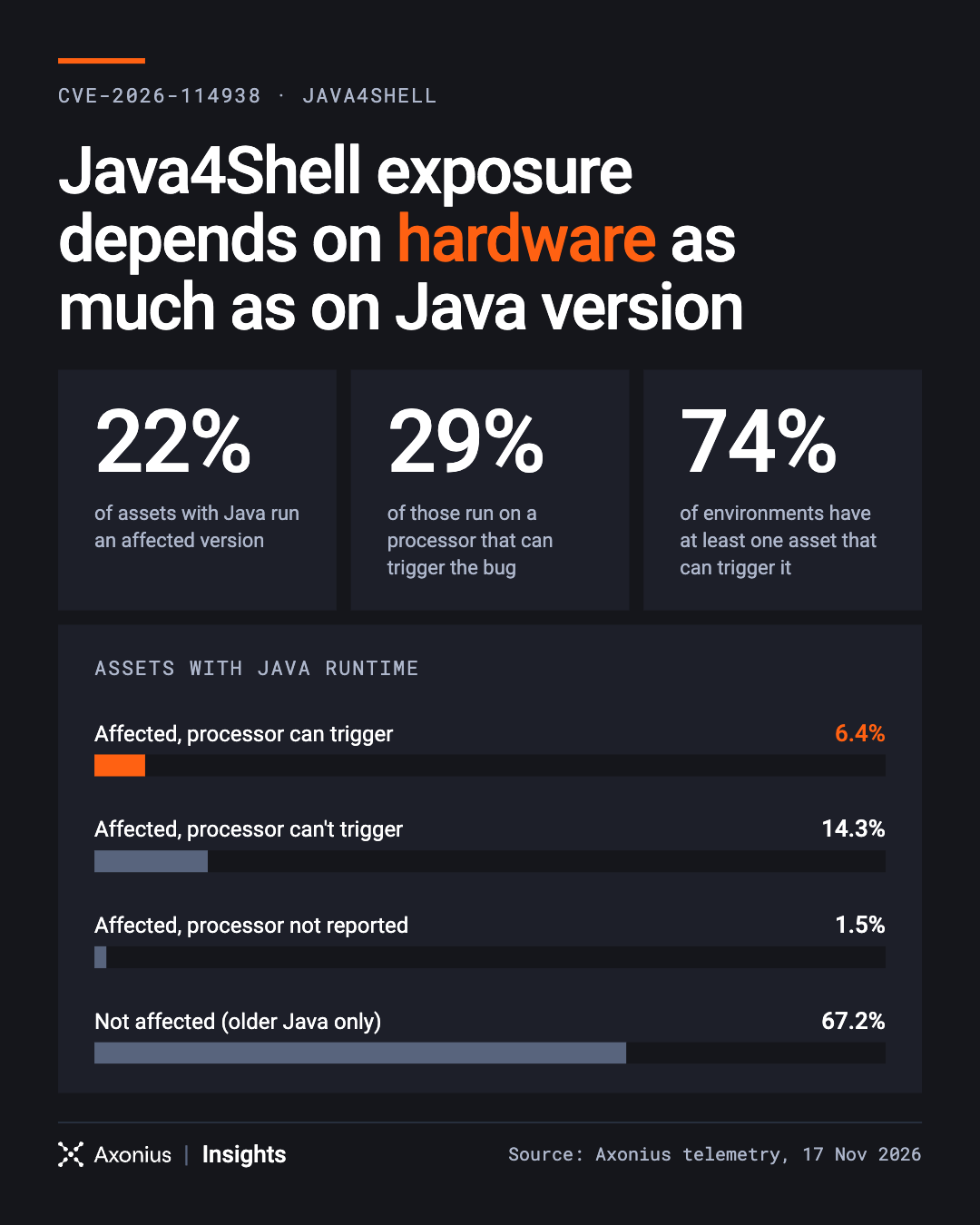
Java4Shell (CVE-2026-114938) is a critical flaw in the Base64 decoder built into OpenJDK, disclosed November 17. A short, malformed string sent to an affected Java service can leak memory and lead to remote code execution without logging in. Oracle and OpenJDK shipped fixes the same day, and other Java distributions are following on their own schedules. In Axonius data, more than 1 in 5 devices with Java ran an affected build on the day the fix shipped.
Nearly every organization runs Java. What matters here is which runtimes, at which builds, on which CPUs, and reachable by whom. Those answers typically sit across different tools: software inventory in your endpoint and container tools, CPU models in your cloud and hardware records, reachability in your network and attack surface data. Axonius helps teams put those together to scope Java4Shell impact quickly.
Overview
What it is. CVE-2026-114938 is a memory corruption flaw in OpenJDK's Base64 decoder, scored 9.2 under CVSS 4.0 and disclosed by Calif. On recent x86 CPUs, Java swaps in a hardware-accelerated Base64 routine that miscalculates its output length for certain padded inputs and writes past the end of its buffer.
Why is it serious. The overwrite can leak heap memory, including keys and tokens, and can be chained into remote code execution, before login in common products such as Jira, Confluence, Jenkins and Keycloak. Java clients that connect to a malicious server are exposed too. Full exploitation takes work, but crashing an exposed JVM is easy, and early probing traffic appeared within a day of disclosure. The researchers found and weaponized it with AI in a few hours, so expect others to follow quickly.
Who's exposed. Three things have to be true of a system:
It runs OpenJDK 17.0.6 or newer below its distribution's fixed build. That covers Oracle Java SE and GraalVM, Eclipse Temurin, Amazon Corretto, Azul Zulu, Microsoft, Red Hat, BellSoft Liberica and SAP SapMachine. Oracle also lists its Java 8 Performance Pack build (8u511b33-perf) as vulnerable.
It runs on an x86 CPU with AVX-512 VBMI: Intel Xeon Ice Lake, Sapphire Rapids, Emerald Rapids or Granite Rapids, or AMD EPYC and Ryzen on Zen 4 or newer. ARM CPUs, including AWS Graviton and Apple silicon, are not affected.
It decodes untrusted Base64 with Java's built-in decoder. Authentication headers, tokens, SAML messages and file uploads all qualify, and so does an outbound TLS connection to a hostile server.
Each condition lives in a different system. Software versions come from endpoint, container and vulnerability tools. CPU models come from cloud instance types and hardware inventory. Whether a service is reachable comes from network and attack surface data. The first two are answerable from inventory if those sources agree. The third depends on the application, so treat every match on the first two as exposed.
Timeline
Date (2026) | Event | Source |
|---|---|---|
Nov 12 | Oracle pre-announces 11 Java SE fixes for its November 17 update. | Oracle |
Nov 17 | Details leak ahead of coordinated disclosure, and The New York Times reports on the flaw. | NYT; Calif |
Nov 17 | OpenJDK publishes a security advisory. Oracle releases fixed Java SE builds at 1:00 p.m. PT. | OpenJDK; Oracle |
Nov 17 | Calif publishes Java4Shell with a proof of concept. CISA issues an alert urging immediate patching. | Calif; CISA |
Nov 18 | Azul ships fixed Zulu builds and Amazon ships fixed Corretto 21 and 25. Debian fixes land in unstable. | Vendors |
Nov 18 | Early probing traffic seen; no confirmed successful exploitation. | GreyNoise |
What to do now
On your schedule, patch what has a fix, upgrade what never will, apply the JVM flag where you can't patch yet, and track every other distribution until it ships. Expect the rollout to be slow. In Axonius data, 86% of affected assets on supported Java were already behind the October 2026 Java update when this one landed.
Steps:
01 List every Java runtime with its distribution, version, CPU and architecture, including Java bundled in applications and container images.
02 Install fixed builds where they exist, starting with Oracle's November 17 releases, then restart each Java process. A running JVM keeps the old code until it restarts.
03 Where you can't patch yet, start the JVM with
-XX:-UseBASE64Intrinsics, which turns off the accelerated decoder. The alternative,-XX:UseAVX=2, stops Java from starting on ARM hosts, so confirm each host's architecture before pushing it fleet-wide. After restarting, check the flag took effect withjcmd <pid> VM.flags.04 Prioritize internet-facing Java services on qualifying CPUs, and limit who can reach them.
05 Watch each distribution's advisory and patch as soon as its fixed build ships.
06 Rebuild container images once their base images are fixed.
Fixed builds by runtime:
Runtime | How it updates | What it takes |
|---|---|---|
Oracle Java SE 17 | Oracle update | 17.0.21.1 or later |
Oracle Java SE 21 | Oracle update | 21.0.13.1 or later |
Oracle Java SE 25 | Oracle update | 25.0.5.1 or later |
Oracle Java SE 27 | Oracle update | 27.0.1.1 or later |
Java 18–20, 22–24, 26 (any distribution) | Out of support | No fix. Upgrade to a fixed 21, 25 or 27 build |
Oracle Java SE 8 Performance Pack | Oracle update | 8u513-perf or later |
Azul Zulu 17, 21, 25 | Azul release | 17.0.21.1, 21.0.13.1, 25.0.5.1 or later |
Amazon Corretto 21, 25 | Amazon release | 21.0.13.1.2, 25.0.5.1.2 or later (Corretto 17) |
Temurin, Microsoft, Red Hat, Liberica, SapMachine | Vendor's own release | Pending as of Nov 18 |
Debian openjdk packages | Distribution security update | Fixed in unstable only; stable pending |
Ubuntu and RHEL openjdk packages | Distribution security update | Pending as of Nov 18 |
Assess your exposure with Axonius
Java4Shell is a reconciliation problem before it's a patching problem. The version is in one tool, the CPU in another, the owner in a third, and exposure in a fourth. Axonius reconciles what your endpoint, cloud, container, vulnerability and identity tools each report across 1,400+ adapters, so you get one list of affected runtimes, including bundled and forgotten ones, with the hardware, owner and exposure context to rank them.
Find. Search Aggregated Security Findings for CVE-2026-114938. Tenable and Qualys have released detections, so findings will fill in as scans run. Until then, query installed software for Java runtimes below the fixed builds, on devices and in containers, including runtimes bundled inside applications.
Prioritize. Rank the results by internet exposure, Critical asset status and CPU model, so services that can actually trigger the bug go first.
Assign. Open a tracked ticket for each owner through the Axonius Action Center, with the Java distribution and build it runs and the build it needs.
Fix or mitigate. Push fixed builds through your endpoint or configuration management tool. Where no fix exists yet, apply -XX:-UseBASE64Intrinsics, and use the CPU architecture column to keep -XX:UseAVX=2 off ARM hosts. Restrict network access to internet-facing Java services on qualifying CPUs until they're patched.
Confirm and track. Save the query and re-run it to confirm each asset moved, then again as each distribution ships its fix.
Run it with the Axonius AI Companion. Paste this prompt to build the list, the priorities and a patching worklist in one pass:
1. Do I have any open Security Findings for CVE-2026-114938?

2a. Find DEVICES running Java where the version is:
    - Java 17: 17.0.6 and above, below 17.0.21.1
    - Java 21: below 21.0.13.1
    - Java 25: below 25.0.5.1
    - Java 18–20, 22–24, 26: any version (out of support, no fix coming)
    - Java 27: below 27.0.1.1
    - Oracle Java 8 Performance Pack: below 8u513-perf
    Note: version storage format varies by distribution (Zulu stores its own
    build number, not the OpenJDK upstream version) — flag any distribution
    where the version format doesn't align with these thresholds.

2b. Run the same query on CONTAINERS.

3. Of the unpatched assets from 2a and 2b, how many run non-Oracle builds
   (Installed Software vendor ≠ Oracle Corporation)?

4. Of the unpatched assets, surface the highest-priority ones by:
   - Internet exposure (Inbound Exposed / Inbound Partially Exposed)
   - Crown jewel or Critical asset status
   - Installed software includes Keycloak, Jira, Confluence, Artifactory,
     Jenkins or PingFederate
   - CPU name contains Ice Lake, Sapphire Rapids, Emerald Rapids, Granite
     Rapids (Intel) OR Zen 4, Zen 5, EPYC 9, Ryzen 7000+ (AMD) — check CPUs
     field availability first; if fewer than ~20% of the population has CPU
     data populated, drop this filter and note the gap.

5. Build a patching worklist table on My Dashboard with these columns:
   hostname, OS, CPU architecture, Installed Software (parent field, refined
   to Java entries — do NOT request vendor / version / path as separate
   columns, they cannot be paired), Owner, Last Seen.
   Also add a donut of the vulnerable population by Java vendor — the donut's
   per-field filter must be scoped to Java software names only, otherwise
   it will show vendors of all co-installed software on those devices.
Or navigate directly: go to Assets > Exposures > Aggregated Security Findings and search for CVE-2026-114938. Where your scanner hasn't reported the CVE yet, go to Assets > Compute > Devices, search for software named Java, OpenJDK, Temurin, Corretto, Zulu, Liberica or SapMachine, and compare versions to the fixed builds above. In the New Navigation Experience, use Exposures > Aggregated Security Findings and Inventory > All Assets > Compute > Devices.
Evidence and sources
Calif: Java4Shell (disclosure, root cause, exploitation, affected products, mitigations)
Oracle Critical Security Patch Update, November 2026 (Oracle Java SE fixes)
Conclusion
AI is finding and weaponizing vulnerabilities faster than patch cycles move. Know what you run before the next one lands. Get a short briefing when the next critical vulnerability lands, with what to scope first.
Book a demo with Axonius today.
Methodology
Findings in this report are based on an anonymized snapshot of de-identified, statistically pooled asset metadata captured on November 17, 2026, across a sample of U.S. enterprise environments. All data points reflect high-level, aggregate cross-sections intended to provide the broader security community with realistic benchmarks for scoping and remediation.