DoW Instruction 8430.01 Software Readiness Starts with Asset Inventory
Brian "Stretch" Meyer
Field Chief Technology Officer, Axonius Federal Systems

The DoW Mandate: Mission Success Means Complete and Continuous Software Asset Inventory.
DoW Instruction 8430.01 makes software a managed, evidenced, continuously monitored asset. Meeting it depends on knowing what software you actually have, and where it runs.
On September 8, 2026, the Office of the DoW Chief Information Officer issued DoW Instruction 8430.01, "Accelerated Mission Software." The issuance establishes policy, assigns responsibilities, and provides procedures for software modernization and management within the DoW to maximize lethality in an era of software-defined warfare, and it promotes reusing software to achieve efficiencies and accelerate capability delivery pursuant to Public Law 118-187.
The scope in Section 1.1 is deliberately wide. It reaches acquisition and non-acquisition programs containing software, including national security systems within DoW authorities and defense business systems, regardless of dollar value. If an organization writes, buys, or operates software for the Department, this issuance reaches it.
The core shift: software is a managed asset, not a delivery
The DoW directive is clear: software is a strategic asset to be managed as an enduring capability throughout its lifecycle, enabling the timely delivery of warfighting capabilities and advanced technologies such as artificial intelligence. The DoW continuously modernizes, manages, and governs software.
That word "continuously" carries the weight. Components are directed to incorporate software component analysis, telemetry, observability, and automated monitoring to support proactive maintenance, rapid vulnerability mitigation, software supply chain risk management, responsiveness to user needs, and adaptation to evolving mission and threat environments. Under the Manage policy in Paragraph 1.2.b, components manage software assets to maintain accountability throughout the lifecycle, supporting portfolio management, investment decision making, and cybersecurity.
Proactive maintenance and lifecycle accountability rest on the same foundation: a current, complete, authoritative record of what software exists, where it runs, and what condition it is in.
Three requirements that turn on inventory
Verifiable assurance as a condition for operation
The instruction sets a hard gate: all software operated on DoW networks and systems will be supported by machine-readable evidence of its component composition, build integrity, and application security. Read that carefully: it applies to everything operating, not only to everything newly delivered. An organization that cannot enumerate what is running on its networks cannot demonstrate conformance for it.
cATOs across custom and commercial software
The instruction requires components to ensure an accurate cATO is generated and maintained for all covered software in accordance with DoW-approved standards, providing the composition information necessary for supply chain analysis such as vulnerability and license management. Component heads must generate and maintain cATOs for custom software and capture cATOs for COTS software, track provenance and pedigree, and disclose and remediate vulnerabilities. Producing a cATO for code you build is a pipeline problem. Capturing and reconciling cATOs for the commercial software already deployed across the estate is an inventory problem.
Continuous supply chain monitoring
The instruction directs components to continuously monitor software deployed on DoW networks, both COTS and custom-developed, for vulnerabilities and supply chain risks, and to require vendors and developers to report any discovery of critical or actively exploited vulnerabilities to the designated authority within a timeframe specified by the DoW CIO as a condition for deployment or continued use. When that disclosure arrives, a clock starts. The only question that matters in the first hour is where the affected component is running. That answer comes from inventory or it does not come at all.
Reuse and license rationalization run on the same data
You cannot rationalize licenses you cannot see, and you cannot reuse what is not discoverable. Both directives sit downstream of an accurate, deduplicated view of the software and SaaS footprint, including the applications acquired outside the formal procurement path.
The instruction pushes hard on reuse. Component heads are directed to use existing GOTS, COTS, or SaaS solutions before developing new non-commercial software, to leverage freely licensed open-source software before buying commercially supported open source or proprietary offerings, and to procure software using DoW enterprise agreements unless mission or cost dictate otherwise. Paragraph 2.4 assigns USW(A&S) responsibility for supporting software asset management, enterprise sourcing, and license rationalization.
Where Axonius Federal Systems helps
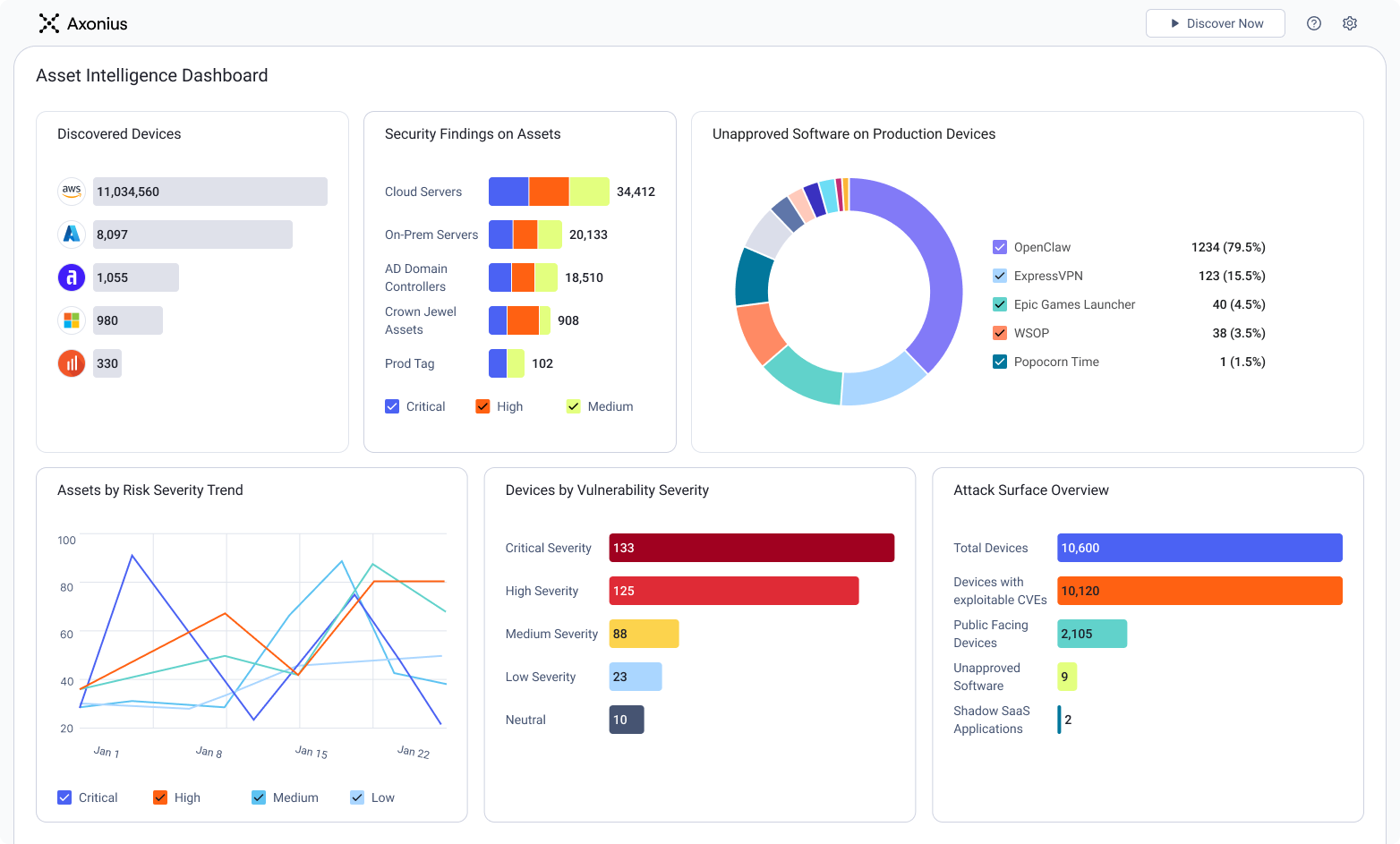
We give federal organizations the asset and software inventory these requirements assume. The platform correlates data from the security, IT, cloud, and identity tools an agency already operates, then resolves it into one authoritative record of devices, cloud workloads, installed software, SaaS applications, and identities. There is no new agent to field and no new sensor to sustain, which matters in an environment already carrying more tooling than it can keep current.
For 8430.01 specifically, that record does three jobs. It answers where a given software component is deployed the moment a vulnerability disclosure arrives, which is the difference between a same-day scoping answer and a multi-week survey. It surfaces end-of-life, unauthorized, and unmanaged software across the estate, along with the coverage gaps where security controls are not reporting at all. And it produces the continuous portfolio picture that license rationalization, enterprise agreement decisions, and software asset inventory reporting all depend on, regenerated automatically rather than assembled by hand ahead of each review.
Because policies run continuously, drift becomes actionable rather than discovered. When a system falls out of an approved software baseline, when a cATO goes stale, or when a newly disclosed component appears somewhere it was not expected, the platform can open the ticket, notify the owner, or trigger the enforcement action.
Start where the evidence has to come from
Paragraph 3.2 directs components to treat testing, security scanning, compliance checks, and deployment as continuous activities, not final gates. That is the culture change 8430.01 is really after, and it applies as much to the software already running as to the software being built. The tenets are clear about the destination: embrace change through continuous feedback, build security and quality in rather than on, automate to the greatest extent possible, and default to enterprise reuse.
Every one of those tenets assumes someone can see the estate. Accelerated mission software is the goal. An accurate, continuously refreshed inventory is what makes the acceleration safe.
What the instruction asks for, and what it takes
Requirement in 8430.01 | What it depends on | How Axonius supports |
Machine-readable assurance evidence for all software operated on DoW networks (Para. 3.5.a) | A complete enumeration of what is actually operating, including systems no single console covers | Correlates existing tools’ data to identify deployed software and assets needing assurance evidence. |
Accurate cATOs maintained for all covered software, custom and COTS (Para. 3.5.b, 2.8) | A reconciled software inventory that maps components to the hosts and environments running them | Reconciles software and asset context to connect available cATO information with deployed hosts and environments. |
Continuous monitoring of deployed software for vulnerabilities and supply chain risk (Para. 3.5.h) | Fast, queryable answers to "where is this component deployed and who owns it" | Locates affected software, owners, and coverage gaps; initiates policy-based notifications or remediation workflows. |
Reuse before buy, enterprise agreements, license rationalization (Para. 2.8, 2.4) | A deduplicated view of installed software and SaaS across the enterprise, including shadow acquisitions | Unifies software and SaaS portfolio data to inform reuse, license rationalization, and enterprise agreement decisions. |
Software asset inventory reporting (Para. 2.8) | Reporting that regenerates from live data rather than from a periodic manual survey | Continuously refreshes software and asset inventory data for repeatable portfolio and stakeholder reporting. |
Preparing for 8430.01?
Axonius Federal Systems gives agencies a complete, continuously updated inventory of assets, software, SaaS, and identities using the tools they already own. Turning asset intelligence into intelligent action.
Source: DoW Instruction 8430.01, "Accelerated Mission Software," Office of the DoW Chief Information Officer, effective September 8, 2026, approved August 31, 2026 by Kirsten A. Davies, DoW Chief Information Officer. Cleared for public release. Available on the Directives Division website.

Get Started
See how to make asset intelligence actionable with a guided demo:
- Stop chasing data — work from one asset model your entire team can trust.
- See what's exposed before it's a problem — surface coverage gaps automatically.
- Turn alert noise into action — cut thousands of alerts down, to the ones that matter.