Every asset class, one operating model, and you can check the work

Jim Armstrong
Sr. Director, Product Marketing, Axonius

Every question or decision in a security program starts with an asset record. Which devices are exposed? Who owns the fix? What falls in scope for the audit? Revealed this week, Axonius AI works on answering the hard questions you face every day about those assets. The explosion of AI and potential for augmenting the security team also raises the stakes: an AI agent acting on incomplete or opaque data doesn't reduce risk. It moves faster in the wrong direction.
So the foundation has to meet a higher bar. It has to cover every asset class, including the ones that never fit in an IT inventory. It has to reach into the parts of each asset that carry new risk. And the people and AI agents who rely on that foundation need to know how it reached its conclusions.
Today, we spotlight new additions that move the Axonius Asset Cloud toward that bar:
Announcement | What's New |
|
|
|
|
|
|
|
|
IoT, OT, and IoMT in the same asset model as IT
Announced in April in early access and now generally available, Axonius Cyber-Physical Assets brings OT, IoT, and medical devices into the same asset model as IT. Axonius Cyber-Physical Assets is now feeding into the same platform (Axonius Asset Cloud) as Axonius Cyber Assets and Axonius Exposures. The programmable logic controller (PLC) on the plant floor and the engineering laptop beside it resolve into one model. They feed the same exposure workflows and trigger the same actions. There's no separate data model and no separate console to reconcile later.
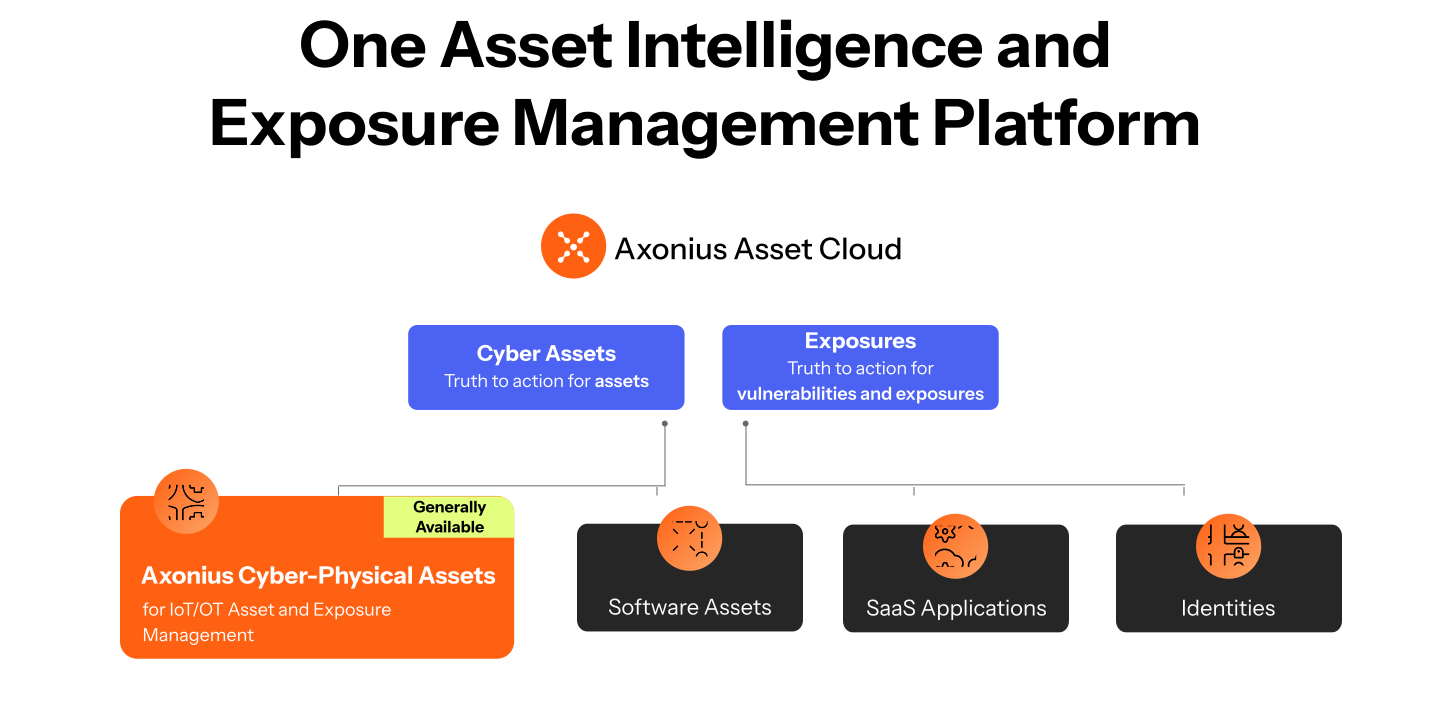
Other recent additions to Axonius Cyber-Physical Assets include:
Device fingerprinting: Discovery starts with network inspectors that passively observe traffic and fingerprint devices across more than 150 attributes, including make, model, firmware, OS, and location.
Network connectivity mapping: The network inspectors also catch unmanaged IT devices sharing those networks. Axonius Cyber-Physical Assets then maps which devices talk to each other and how.
Risk context beyond Common Vulnerabilities and Exposures (CVEs): Factor in operational concerns like operational role and impact along with exploitability and Common Vulnerability Scoring System (CVSS).
Audit-ready evidence: Maintain continuous validation and generate audit-ready evidence for IoT/OT along with every other asset in the Axonius Asset Cloud.
Device intelligence hub: Fill the gaps that passive discovery leaves, flag incomplete device profiles, and run protocol-aware jobs inside approved maintenance windows. Every query lands in an auditable fetch history.
Cellular IoT coverage: Bring cellular IoT fleets into the asset model with the new Cisco IoT Control Center adapter.
Post-quantum cryptography readiness starts with the cryptography you can already see
Announced today as generally available, Post-Quantum Cryptography Readiness for the Axonius Asset Cloud enables organizations to prepare for post-quantum migration using cryptographic data they already collect.
Quantum computers will have the power to break widely used public-key systems like RSA and Elliptic Curve Cryptography (ECC). While practical quantum computing may still be years away, adversaries collect encrypted data now and plan to decrypt it once quantum computing matures. Regulators have noticed. In the United States, Executive Order 14412 (Securing the Nation Against Advanced Cryptographic Attacks) and OMB M-26-15 (Execution of the Migration to Post-Quantum Cryptography) moved post-quantum migration from guidance to mandate, with agency migration plans due this month. The National Security Agency's Commercial National Security Algorithm Suite 2.0 (CNSA 2.0) applies to national security systems from January 1, 2027. The European Union, United Kingdom, Canada, and Australia follow the same sequence: inventory in 2026 and critical systems through 2030.
Where should a post-quantum migration begin? Start with the cryptography already visible through the tools you run. Tie each vulnerable certificate and transport layer security (TLS) endpoint to its asset and owner. Then find the long-lived certificates that stay valid past the migration cutoff. Those won't rotate out on their own, and they form the backlog that can't wait.
That's an asset intelligence question before it's a cryptography question. Post-Quantum Cryptography Readiness answers it from the data that organizations already collect. There's no new sensor or agent to deploy. The dashboard reads cryptographic data flowing through existing adapters: vulnerability scanners, endpoint detection and response (EDR), endpoint management, certificate lifecycle platforms, cloud providers, and live TLS endpoint scans.
The migration picture: View certificates by algorithm family, key algorithm, key size, signature algorithm, issuer, and source.
The migration backlog: See vulnerable certificates that remain valid past the cutoff and need intervention.
TLS termination points: Assess PQC-ready TLS across cloud and on-premises load balancers, including Amazon Web Services (AWS), F5, Google Cloud Platform (GCP), and Microsoft Azure.
Legacy crypto hygiene: Flag computers that still allow weak encryption, plus unencrypted drives and machine images.
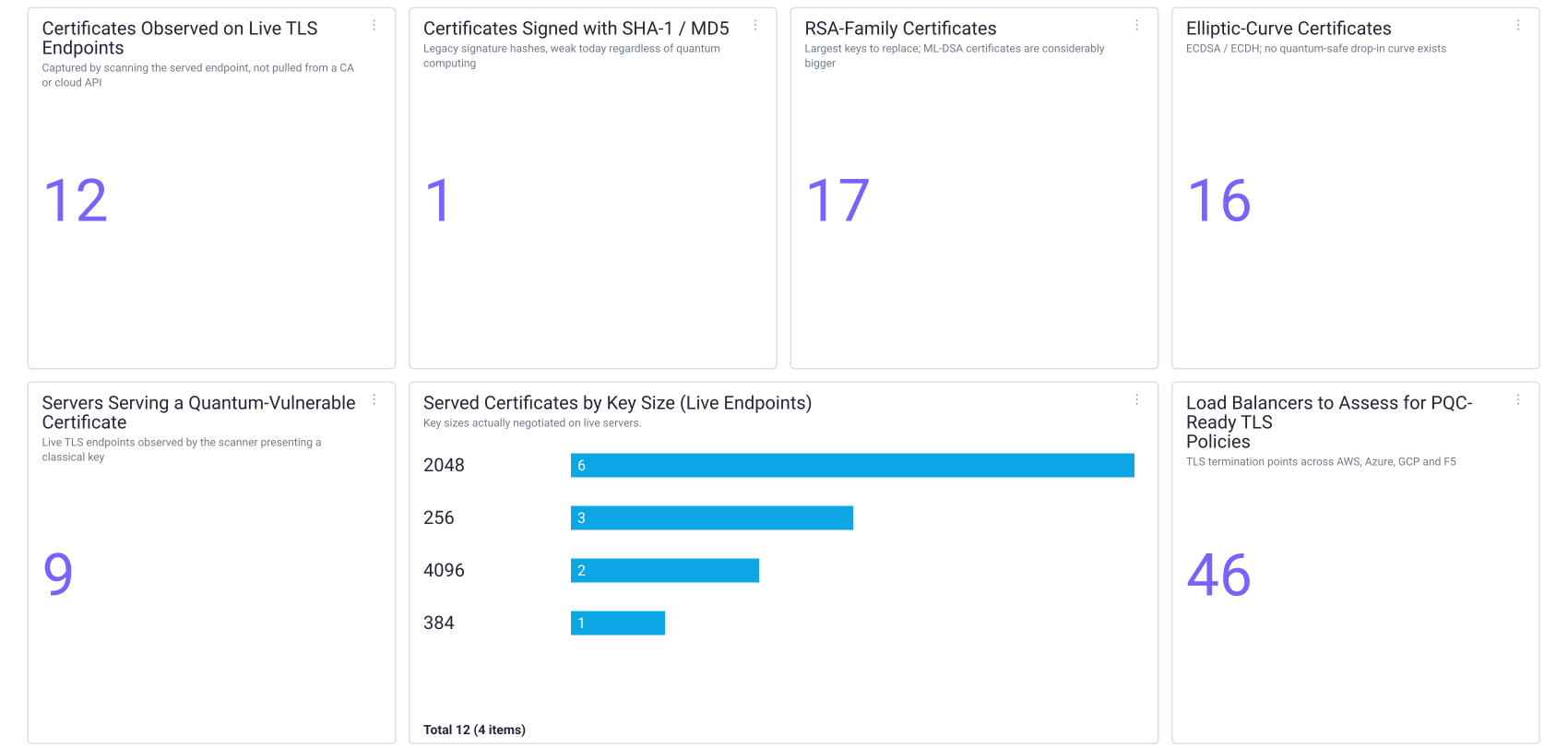
Every finding sits on an asset that Axonius already correlates, with its owner, its source, and the actions available on it. PQC queries can drive Enforcement Sets in the Axonius Action Center, so organizations can act on findings from the same view. Because the queries recognize post-quantum algorithms, the vulnerable count falls as certificates migrate. The dashboard that shows the problem also tracks the progress, which is what program leads and auditors need. It gives you the baseline your migration plan builds on.
Context360 allows you to see how Axonius built every asset record
Announced today as generally available, Context360 for the Axonius Asset Cloud shows the work behind our asset intelligence. Correlation sits at the core of the Axonius Asset Fabric. Until now, organizations saw Axonius’ output but not its reasoning. Most platforms hand you a merged record and ask you to trust it. Others hand you the raw data and ask you to decide which source is right. Context360 shows our work.
It also brings everything about an asset into one view, so both people and AI work from the same verified record, and can act on it from the same place.
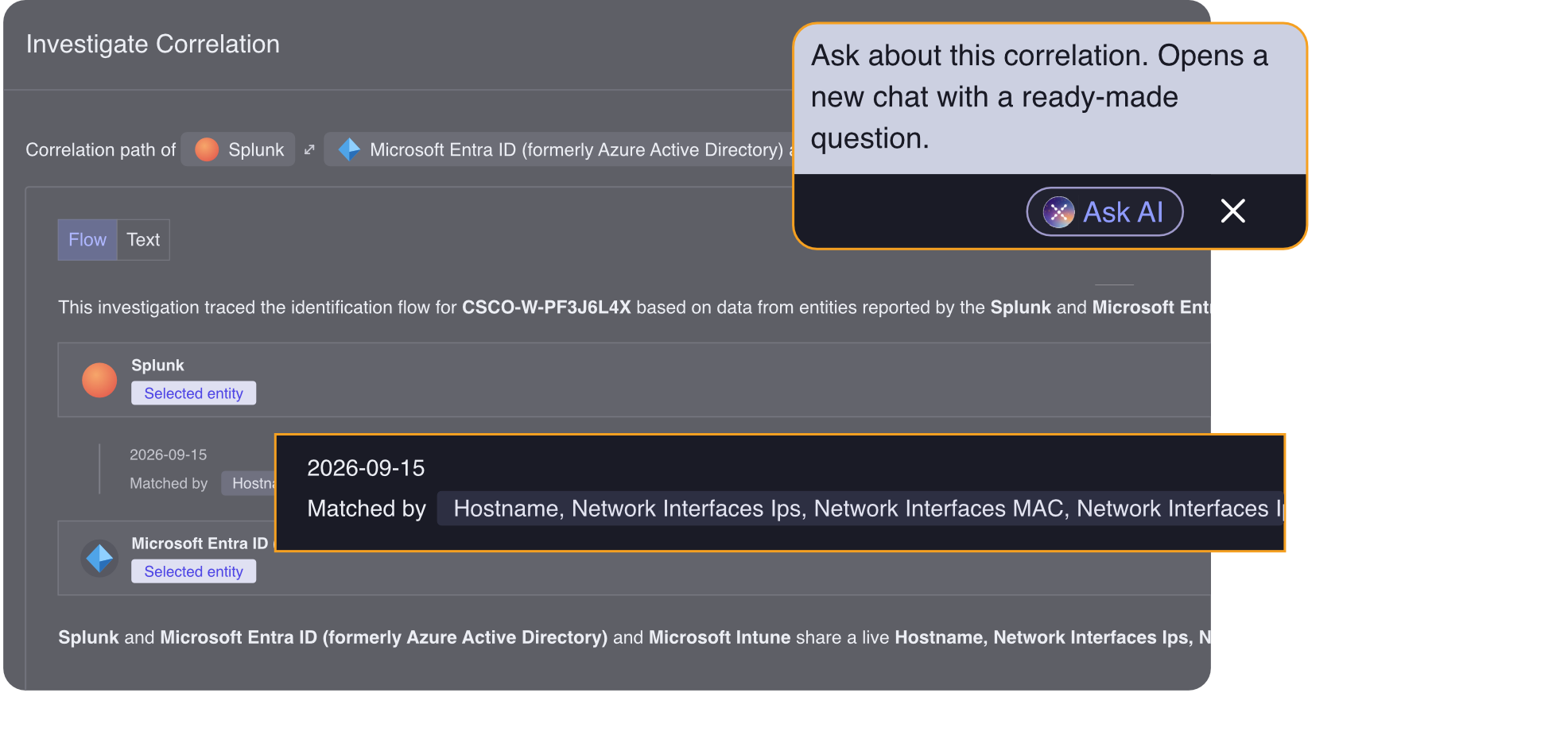
How can I tell why two source records became one asset? Open the asset in Context360 and use Explain. Explain shows how source records resolved into one asset and why some stayed separate. Context360 brings every question about a single asset into one view:
Investigation shows what changed on the asset, and when.
Comparison shows how field values differ across sources and between two points in time.
Link correlates assets into a single record.
Explain describes the decision trail to resolve or not resolve records into a single asset
Actions lets security and IT teams enrich, tag, enforce, and remediate from the same place.
Axonius AI works inside this view to explain what it sees and act on it. Security analysts and AI agents read the same verified record, so a human can check exactly what an AI agent relied on. Context360 is our patented correlation engine at work, instead of a black box.
The payoff differs by team. Security operations center (SOC), incident response, and vulnerability management teams get trustworthy asset context mid-investigation. IT operations and asset owners get clear ownership and fewer duplicates. Governance, risk, and compliance (GRC) and audit teams get a defensible answer to "why is this record classified or scoped this way?"
End ticket pile-up by turning AI recommended actions into focused remediation
Announced today as generally available, AI Recommended Actions Ticketing Flow for Axonius Exposures fixes the broken hand-off between AI recommending a remediation or mitigation and the security and IT teams adopting it without feeling overwhelmed.
Ticket fatigue is real. While AI recommendations are incredibly valuable, they can easily become just another pile of tasks in an already overflowing backlog. To actually drive adoption, security and IT teams need these recommendations grouped logically. They need the 'why' behind the risk and the exact steps to mitigate it, delivered together.
The updated ticket flow in Axonius Exposure simplifies this dynamic. Now, you can move from an AI-recommended action to actively mobilizing your security and IT teams in as few as two clicks. It brings the remediation effort into focus by grouping tickets together by remediator, regardless of the underlying assets, allowing you to batch remediation in whatever way makes sense for your operational workflow.
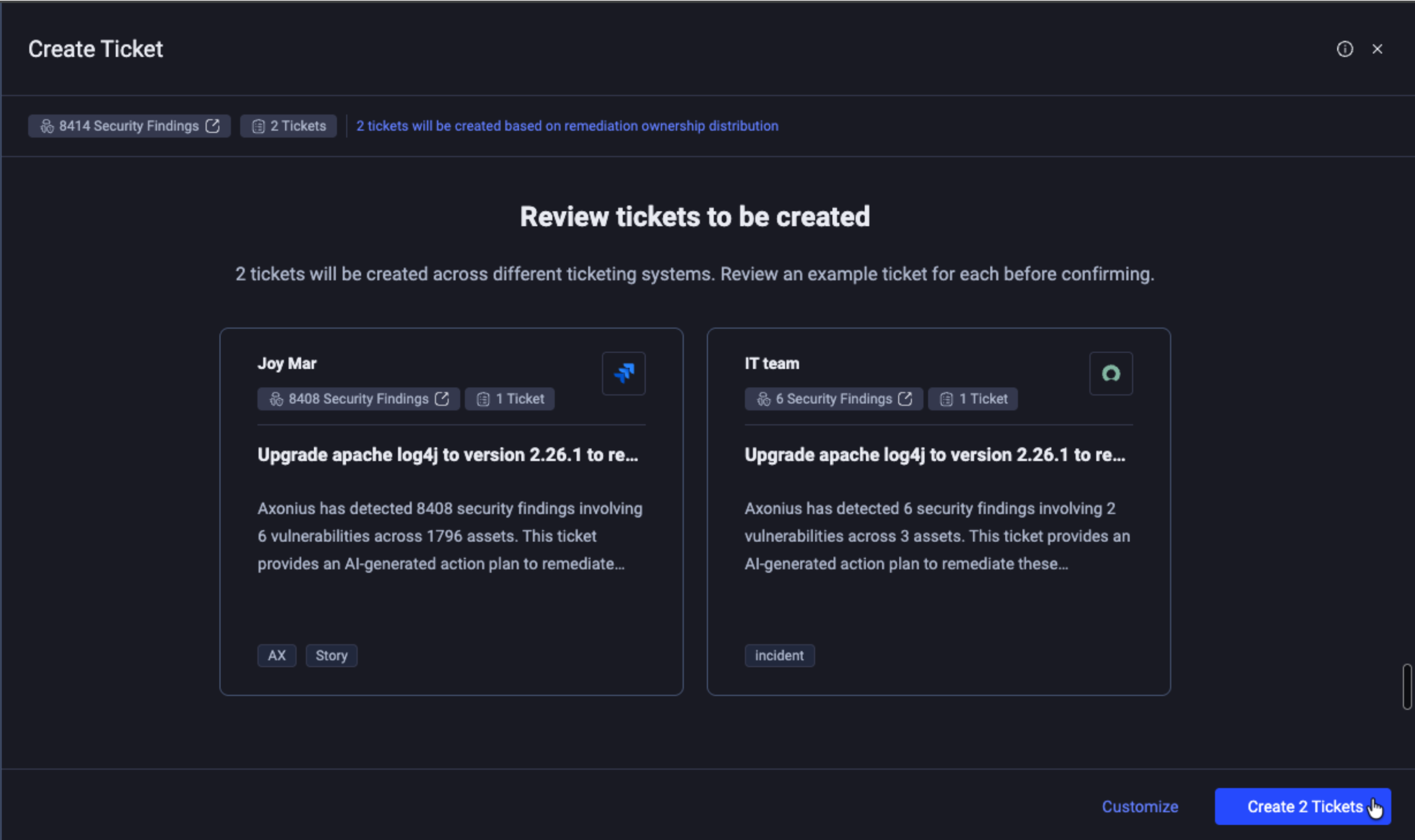
One recommendation means just one ticket per owner. You see the risk, you click, and the right team gets exactly what they need to reduce the attack surface without the burden of a bloated ticket queue.
Getting started
Ask your account team for a walkthrough of Axonius Cyber-Physical Assets, Context360 (for the Axonius Asset Cloud), or the Post-Quantum Cryptography Readiness (for the Axonius Asset Cloud).
Availability
Axonius Cyber-Physical Assets, Post-Quantum Cryptography Readiness, Context360, and Axonius AI Recommended Actions Ticketing Flow are generally available to customers.
Additional resources
Read the press release to learn more about Axonius Cyber-Physical Assets, Post-Quantum Cryptography Readiness (for Axonius Asset Cloud), and Context360 (for Axonius Asset Cloud).
Categories
- Asset Management
- Endpoint And Iot Security
- Compliance And Frameworks

Get Started
See how to make asset intelligence actionable with a guided demo:
- Stop chasing data — work from one asset model your entire team can trust.
- See what's exposed before it's a problem — surface coverage gaps automatically.
- Turn alert noise into action — cut thousands of alerts down, to the ones that matter.