From Prompt-to-Action: Self-aware environments for the AI era

Ivan Dwyer
Principal Product Marketing Strategist, Axonius
Welcome to another Axonius Launch Week. Over the next few days, we’ll be sharing a lot of what we’ve been building. As is becoming tradition now, I wanted to kick things off with a perspective on the market and what we’re doing about it.
Anyone who has worked in cybersecurity for more than 5 minutes knows that change is the only constant. But the pace of change in the AI era has reached escape velocity, outpacing human understanding. The "vulnpocalypse" has much of the industry fixated on burning down an endless backlog of findings. We have super intelligence at our fingertips, right? Point an agent at the firehose and hope it keeps up.
We’re approaching this from a different angle. Where others see a firehose, we see a series of loops. Each one keeps the security fundamentals in place, with a complete picture of every asset, identity, and the exposures they carry, the right controls and configurations applied, and a minimum viable attack surface that's continuously monitored.
And as AI takes hold, those loops become more autonomous, leading to the holy grail of cybersecurity: self-aware environments.
The path to self-aware environments
In its simplest form, security operations runs in three modes: reactive, proactive, and preventative. Most of the autonomy conversation today is happening in reactive mode. Agents triage alerts, investigate incidents, and run response playbooks on their own. That’s real progress to address fatigue and toil, but it’s not enough to meet the demands of the AI era. When preventative work still runs on periodic reviews and audits, and proactive work still runs on ticket queues and schedules, you’re still facing an endless firehose.
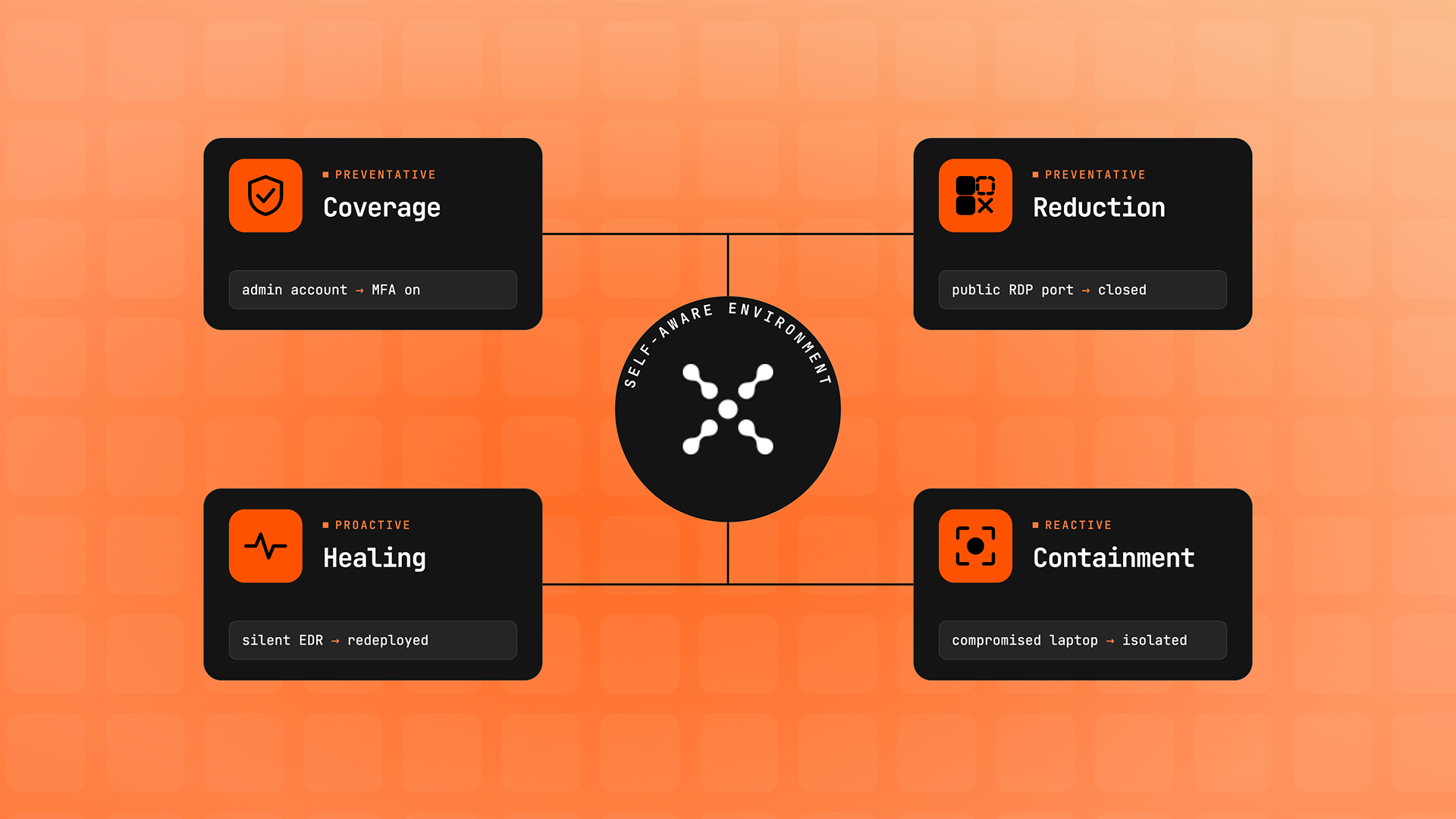
A self-aware environment is designed to bring autonomy to all three modes at once, working from the same picture. It knows what good is supposed to look like, has the ability to observe any instance that drifts, can tell a legitimate change from a real risk, and acts within the boundaries you set. People step away from the firehose and start directing the system.
This has always felt aspirational, but it's closer than it appears. It depends on total attack surface visibility, with every asset, identity, and exposure reconciled and kept current. It also depends on the ability to act on what that visibility shows.
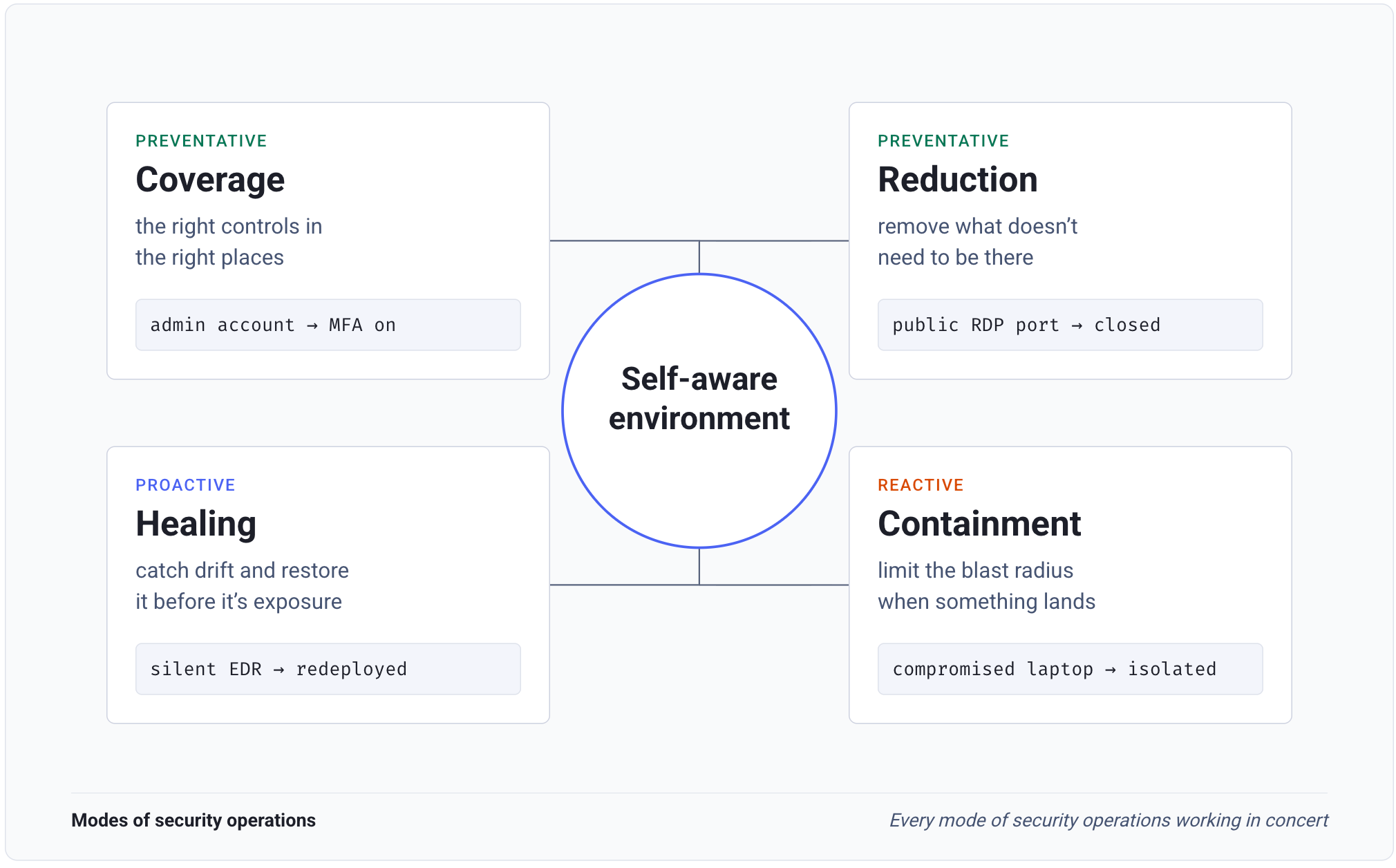
With visibility and actionability working together, a self-aware environment maintains each operating mode on its own:
Coverage: The right controls in the right places, from endpoint protection on every server to MFA on every privileged account.
Reduction: Anything that doesn’t need to be there gets removed, like the orphaned VM or the public RDP port that shouldn’t be open.
Healing: Drift gets caught and restored before it turns into exposure, like an endpoint agent that quietly stopped reporting.
Containment: When something is compromised, the blast radius is limited fast, starting with isolating the affected asset.
Getting there starts with how we ask. In the AI era, that’s a prompt. Investigations often start with some form of “show me…,” but that’s passive. Let’s take a lesson from the first rule of improv: “yes, and.” Rather than asking to see servers missing endpoint protection, make sure every server runs it. Find the gaps, redeploy the agent, and keep doing it as new servers appear. Now we’re prompting with intent.
The prompt-to-action loop
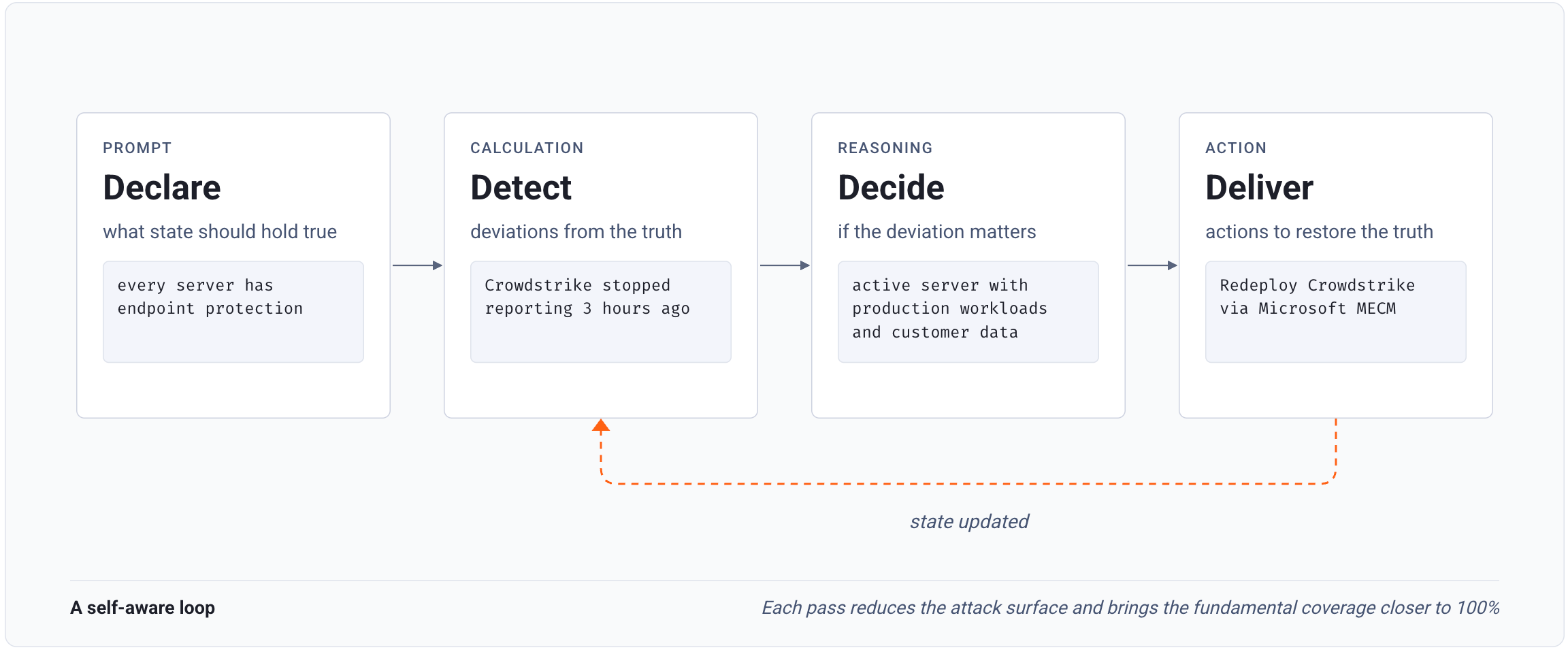
The query has always been the canonical unit of work in Axonius. It’s how you get answers, make decisions, and take action. Now a prompt makes it a loop.
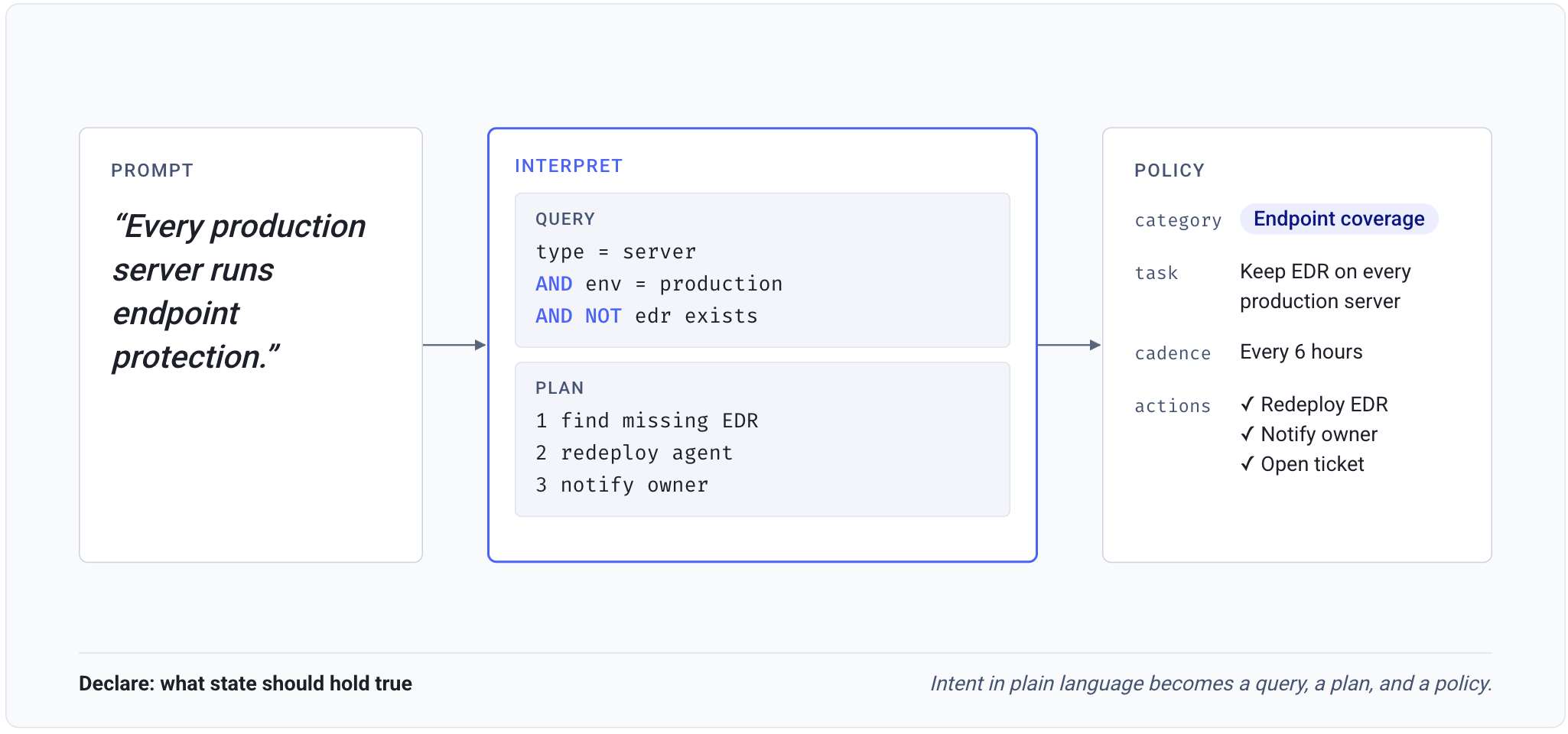
Declare: what state should hold true
Start with intent. Every production server runs endpoint protection. Every privileged account has MFA. No end-of-life software in prod. Said in plain language, the prompt becomes the policy the environment holds itself to when the conditions are precise.
That’s harder than it sounds. “Production server” means something different in every organization, a cloud tag here, a CMDB field there, a naming convention somewhere else. “Endpoint protection” might mean one EDR on workstations and another on servers. Ask any single tool and you’ll only get its version of the answer.
A self-aware environment resolves every one of those terms against reconciled data, with one record per asset and fields normalized across every tool. That’s what turns a prompt into a policy. It evaluates the same way every time, and it reflects how your organization actually works.
Detect: deviations from the truth
Once a policy is in place, the environment is held against it. The goal is to catch drift and exposure early, before it becomes an issue. That could be an endpoint agent that stopped reporting on a production server, a new privileged account without MFA, a workload that slipped out of its approved configuration, or a service that became internet-facing when it shouldn’t.
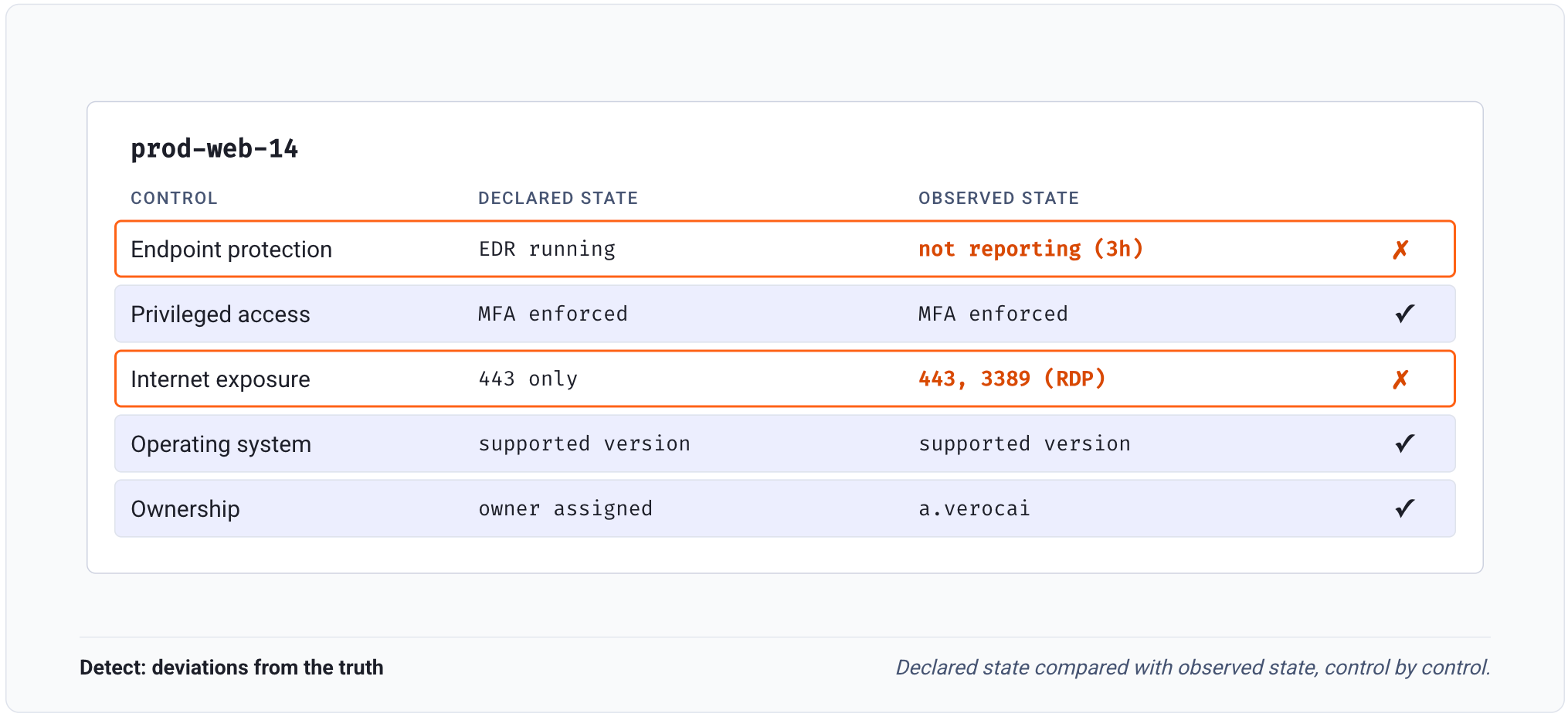
The hard part is that drift often lives in negative space. Your EDR will tell you where it’s running, but not where it’s missing. The same goes for the account that isn’t in the directory or the service nobody knew was exposed. No domain-specific tool can see what isn’t there.
A self-aware environment finds those gaps by reconciling every system that touches devices, identities, software, and infrastructure, and keeping that picture current across millions of records.
Decide: whether the deviation matters
Not every deviation deserves immediate action, and this is where security teams drown in front of the fire hose today. Take the server that stopped reporting. Is it a decommissioned test box, or an active server running production workloads with customer data?
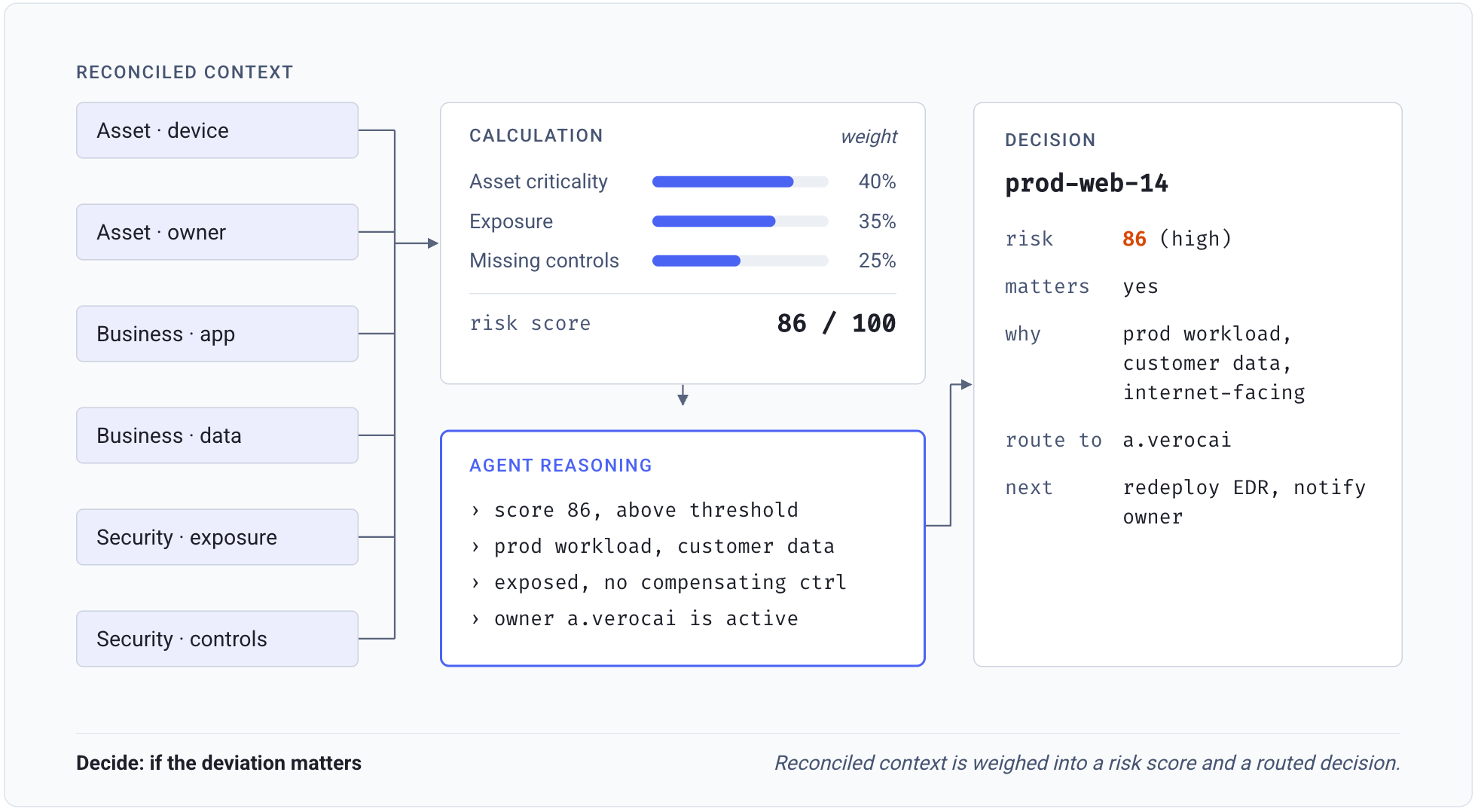
To answer those questions, you need comprehensive asset, business, and security context. What the device is and who owns it, which application and data it supports, how exposed it is and what controls are around it, etc. Today that context lives across a dozen tools, and stitching it together by hand is the slowest part of every decision. Get any of it wrong and things go sideways fast. The fix lands with the wrong owner, a real risk slips down the list, or the action runs on the wrong device.
In a self-aware environment, the context is already assembled, fully reconciled, and traceable back to its source. Once teams start to trust it, that's where AI plays a larger role. An agent can make the call across thousands of deviations, and it can take on more of the load as that confidence grows.
Deliver: the right restorative actions
Depending on the deviation, the right action might be closing a visibility gap, assigning an owner, tagging an asset, restoring a configuration, containing a compromised device, or deploying a fix. Often it’s several at once. The loop closes when the right action restores the original intent.
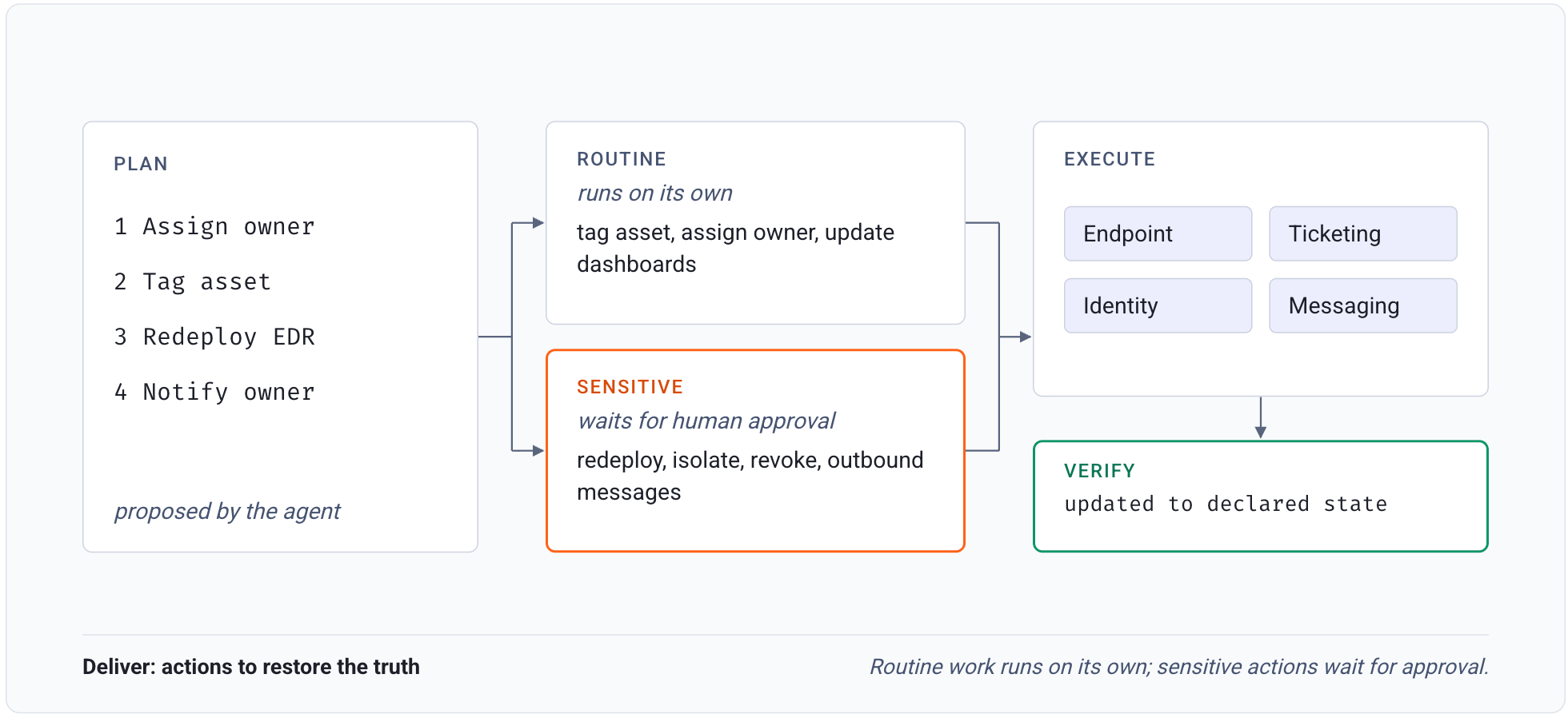
Acting is where the rubber meets the road. In a loop, the system touches downstream systems and applications, and the wrong action can do more damage than the drift it was originally meant to correct. The challenge is that the action destinations are as fragmented as the source data. One fix happens in the endpoint console, another in the identity provider, and the follow-up lives in a ticket system.
A self-aware environment brings action into the same place the context lives, connected to the tools your teams already use, so the right action gets chosen with the full picture in view. From there, AI can plan the response and carry it out. Routine work like tagging assets or assigning owners can run on its own. Anything sensitive, like a change to a production system, is proposed as a plan and waits for a human to approve it. That's how operations moves from human-in-the-loop to human-at-the-edges, setting intent, approving what matters, and trusting the rest.
Closing the loop
Self-aware environments get built one loop at a time. Start with the fundamentals that matter most to you. Every turn reduces the attack surface and improves the response. Over time, you get off the firehose.
And that’s what this Launch Week is all about. We’ll share how we’re bringing AI into every stage of the loop, built on the same reconciled ground truth that’s been at the heart of the Axonius platform since day one.
You’ll see agents that watch for drift on their own and only come to you when a decision needs a human. You’ll see expert help built right into the platform for anyone on the team. You’ll see a way to bring that same ground truth into the AI tools you already use. And since AI is now part of the environment too, you’ll see a way to discover and govern it like any other asset.
Categories
- Artificial Intelligence Ai

Get Started
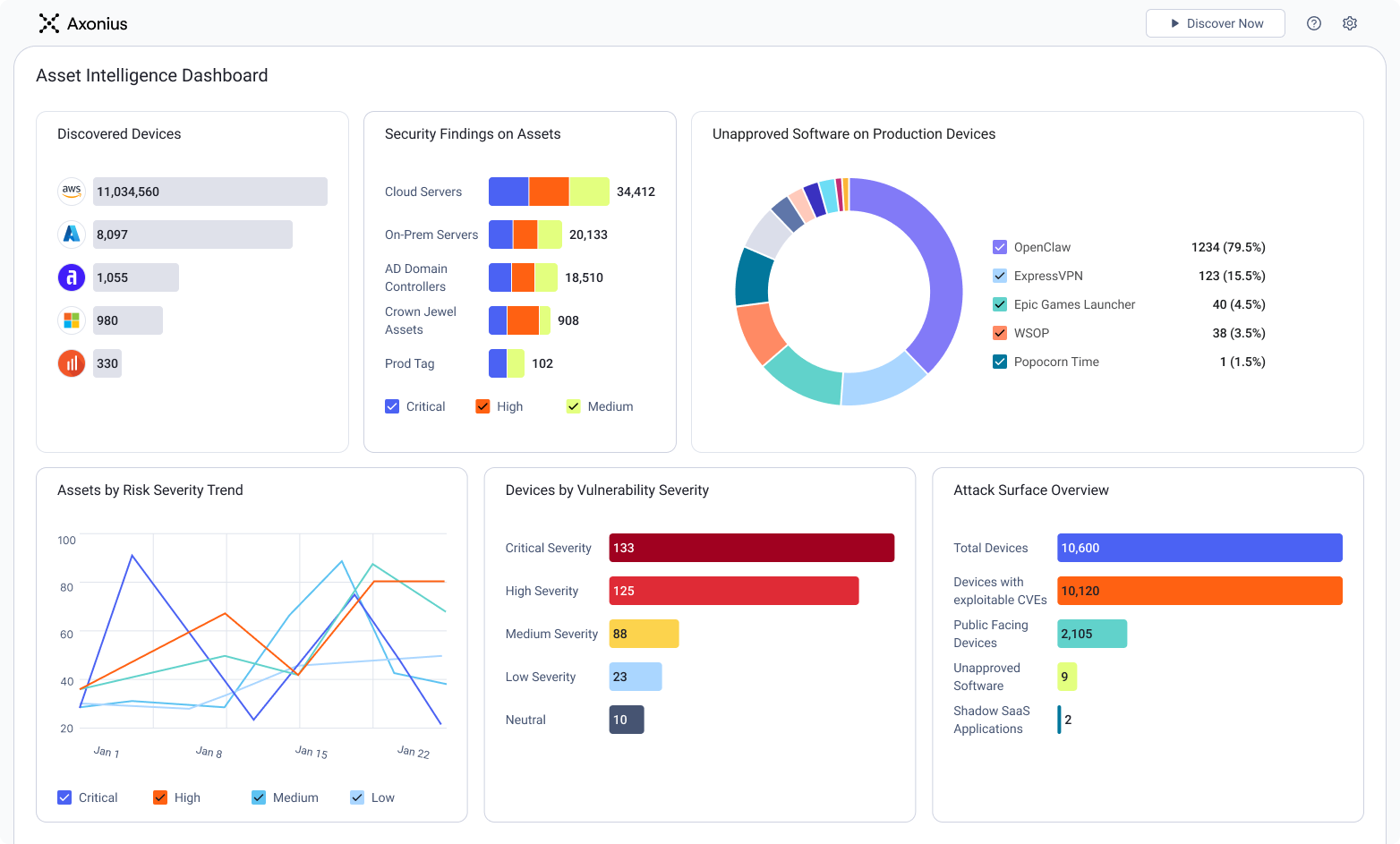
See how to make asset intelligence actionable with a guided demo:
- Stop chasing data — work from one asset model your entire team can trust.
- See what's exposed before it's a problem — surface coverage gaps automatically.
- Turn alert noise into action — cut thousands of alerts down, to the ones that matter.