Axonius named an Overall Leader in the KuppingerCole Analysts Leadership Compass Attack Surface Management 2026

Ivan Dwyer
Principal Product Marketing Strategist, Axonius
Attack surface management (ASM) has always been one of the fundamental disciplines of every cybersecurity program. Knowing what you have, where it's exposed, and whether it meets policy has been the starting point long before AI entered the picture. What the AI inflection point has changed is the scale and urgency of those fundamentals. As AI explodes the volume and reach of assets, and accelerates how quickly weaknesses are found and exploited, the gaps that security teams once had time to work through now carry immediate risk.
KuppingerCole Analysts Leadership Compass Attack Surface Management 2026 reflects that shift. The report argues that AI-driven vulnerability discovery raises the urgency of continuous discovery, validation, prioritization, and remediation, and that vendors offering visibility without the ability to act may see their position weaken.
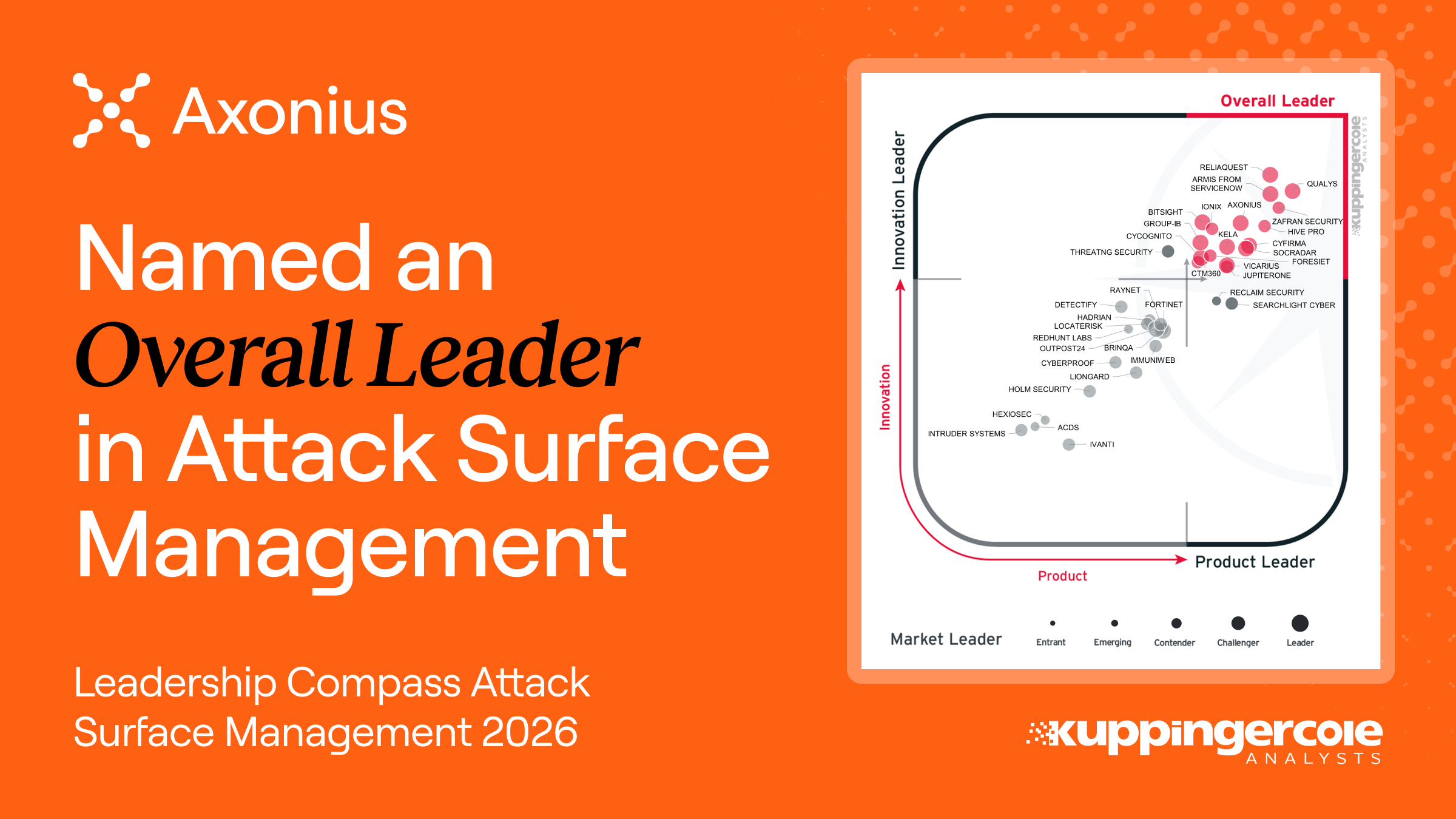
In that context, KuppingerCole Analysts named Axonius an Overall Leader, and a Leader in Product, Innovation, and Market.
About the research
The Leadership Compass assesses ASM vendors on how well they discover assets continuously, validate which exposures are truly exploitable, and move prioritized findings into remediation. Vendors are rated on Product, Innovation, and Market Leadership, with the Overall rating reflecting the balance of all three. This year's edition also reflects how quickly the market is changing, with the AI attack surface, spanning models, agents, and Model Context Protocol (MCP) servers, treated as its own area of evaluation.
Axonius was named a Leader in all four dimensions, one of 15 vendors recognized as Overall Leaders. KuppingerCole Analysts summarizes the placement as:
“Axonius is an Overall Leader with its Asset Cloud, combining extensive third-party integrations with asset intelligence, exposure management, contextual risk analysis, and automated remediation workflows across existing security and IT tools.”
The assessment also reflects a structural choice in how Axonius approaches the problem. Every tool in a security stack sees the environment through its own lens. An endpoint detection and response (EDR) tool sees endpoints, an identity provider sees accounts, a cloud console sees workloads, and a scanner sees vulnerabilities. Each view is accurate within its own boundaries, but misses the context of the larger attack surface. The problem is that risk never respects those boundaries. A single exposure might involve an unmanaged device, an over-permissioned identity, a misconfigured cloud resource, and an owner recorded in yet another system. When the answer sits across domains, a tool confined to one domain can only return a partial answer.
Axonius sits above any stack, rather than inside it. Instead of adding another scanner, Axonius connects to the security and IT tools an organization already runs, reconciling what each one sees into a single picture of assets and exposures, and then acting back through those same tools. That position is what turns fragmented signals into decision-grade insights.
KuppingerCole Analysts lists “excellent asset intelligence and CAASM capabilities” among Axonius's strengths, and concludes that Axonius “should be on the shortlist of any enterprise looking for a combination of CAASM and an exposure management platform.”
How AI changed the attack surface, and defense-in-depth with it
The explosion of the attack surface and the compression of operational timelines in the AI era change the logic of defense-in-depth. Layers were typically designed around the most likely touchpoints, with the aim of slowing a potential attacker down. But attackers no longer follow the economics or the predictable paths we're used to designing for. As a result, the principle has to become defense-in-depth-and-breadth.
Breadth brings the fundamentals back in fashion. With more ways in, every asset has to be known, owned, protected, and configured to policy. Compliance programs once treated roughly 80% control coverage as a passing bar. Compliance has never equaled security, but that bar was accepted given the realities of visibility and capacity. The hard truth of the AI era is that coverage expectations must move closer to 100%.
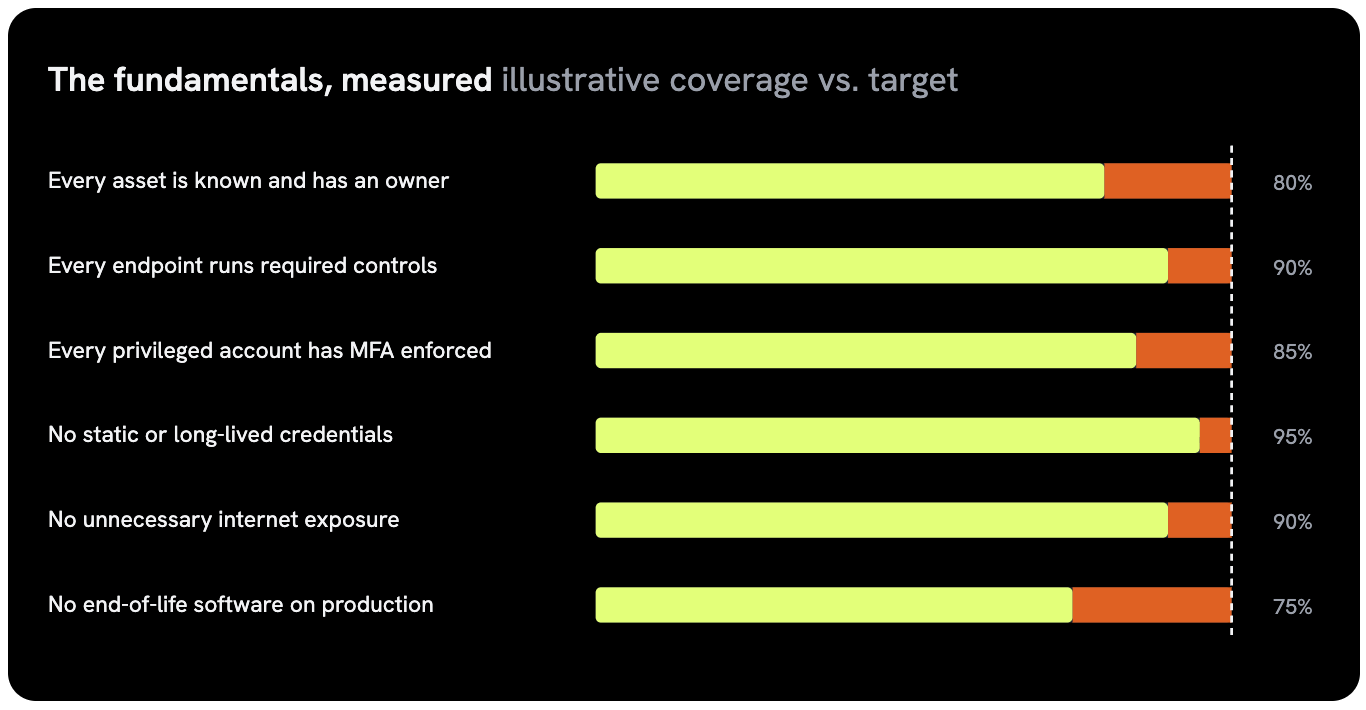
But 100% of what? Each tool measures coverage from its own vantage point. Every console can look healthy while missing the negative space where it has no visibility. Only an inventory reconciled across every source gives a true denominator. That's what asset intelligence provides, and KuppingerCole Analysts sees this gap across the market: “Many customers still lack the internal know-how, resources, and continuous visibility needed to understand their full attack surface.”
The operational shift from periodic to continuous to autonomous
The fundamentals themselves largely remain the same, but the expectations around them have changed. For the past several years, every discipline that surrounds the attack surface (asset management, vulnerability management, exposure management, and posture management) has been driven by the shift from periodic to continuous operations. For many organizations, this shift is largely underway.
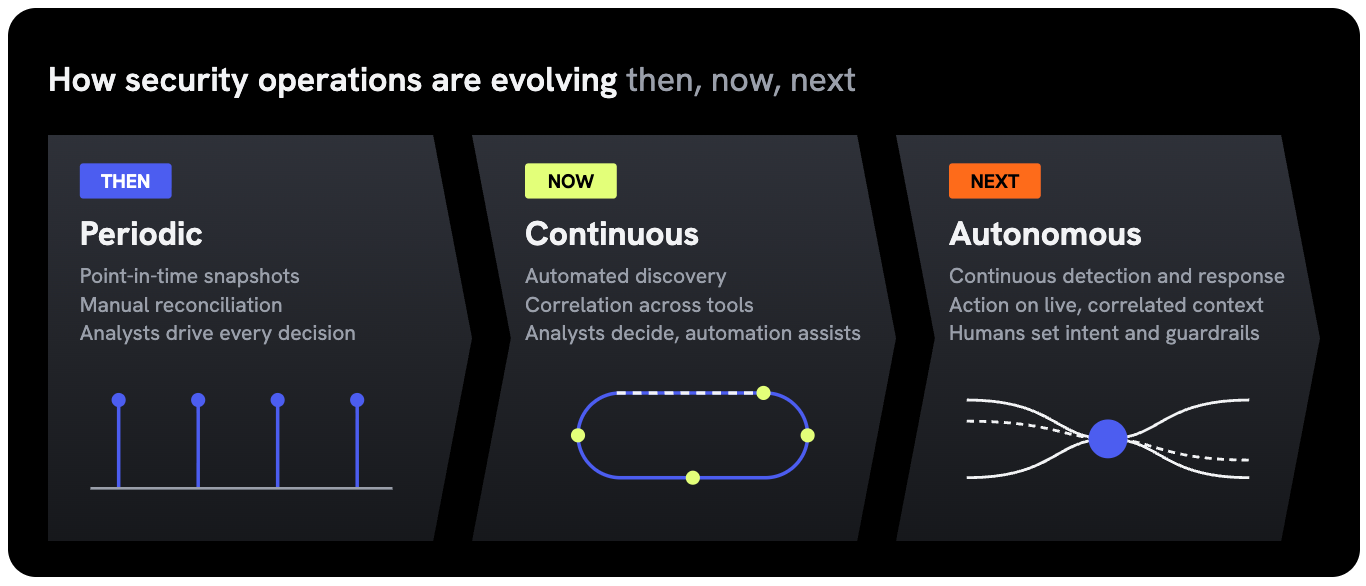
The next evolution is making those programs more autonomous. But one point of caution: you can't go from periodic straight to autonomous, because continuous operations are what get a program in line. Define the goals and set the guardrails with the right context underneath. Skip that step, and autonomy just automates yesterday's blind spots.
KuppingerCole Analysts sees the market heading the same way. The report cites ASM's continuous monitoring as its advantage over scheduled exercises, and it expects agentic AI to take on more of the operational work under human approval and oversight. As the report puts it: “AI should not replace security teams. It should help them understand, prioritize, and reduce exposures more efficiently.” That's autonomy built on a continuous foundation.
How Axonius enables a self-aware attack surface
The goal of all this is an attack surface that is self-aware. It knows what it's made of, knows what it's supposed to look like, notices when the two diverge, and restores itself within the boundaries people set. KuppingerCole Analysts defines the purpose of remediation as reducing the customer's attack surface, and a self-aware attack surface is how that reduction holds over time instead of eroding between reviews.
Axonius is built around a simple loop that makes this possible.
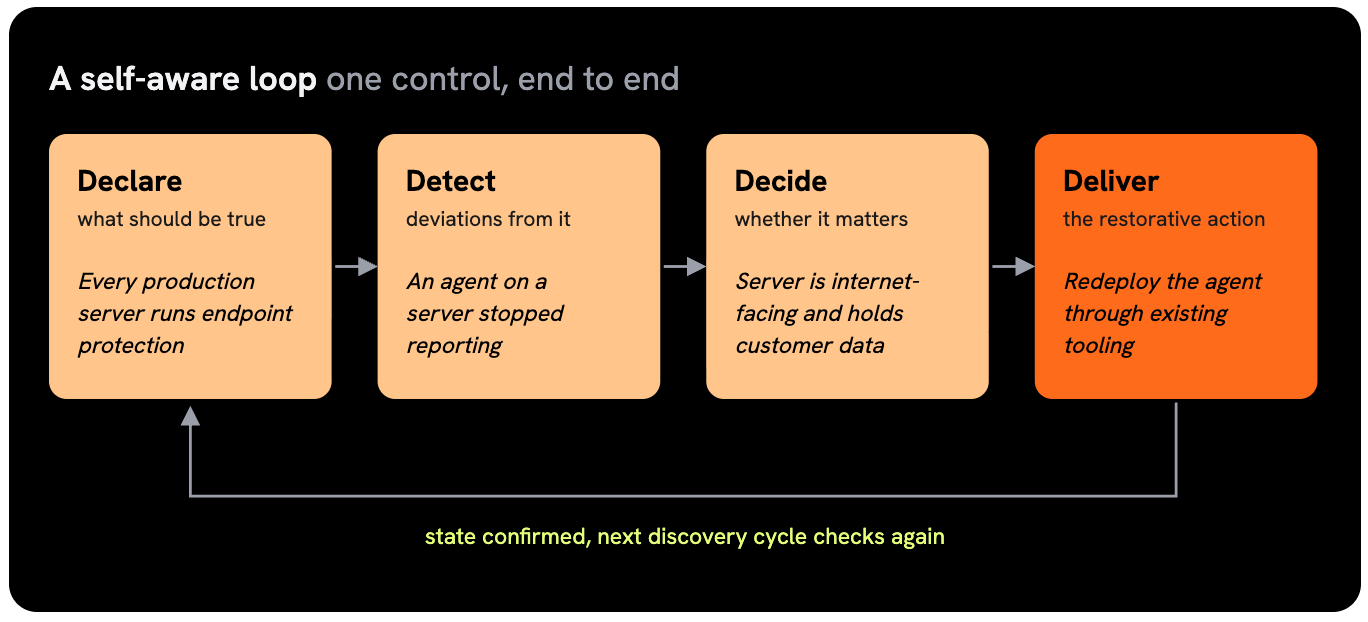
Declare. A query in Axonius is a declaration of what should be true, such as “every production server runs endpoint protection.” It becomes a standing policy, measured against a reconciled inventory, so coverage is counted against the true denominator rather than one tool's view.
Detect. Every discovery cycle tests that declaration again. Drift shows up within a cycle and not at the next audit. Because the data is reconciled, a gap is a fact, not a disagreement between consoles.
Decide. Axonius places each deviation in security, asset, and business context, so an internet-facing server holding customer data rises above a lab machine with the same gap, and every finding lands with an owner.
Deliver. Through direct actions, Axonius carries the response through the tools that security teams already run, whether that's opening a ticket, notifying an owner, or running the fix, with approvals wherever a change needs a human decision. KuppingerCole Analysts notes that the Axonius Action Center “provides extensive remediation orchestration.”
In practice, that means the environment starts to take care of itself. When an endpoint agent stops reporting on a production server, the next discovery cycle catches it, the platform understands why that server matters, and the agent gets redeployed through the tooling you already have. The same pattern applies to an unmanaged SaaS application that needs an owner, or end-of-life software that needs a plan. Every loop that closes moves coverage a little closer to that 100% bar and keeps it there.
The standard comes from the security team. Defining what good looks like, what matters most, and where the guardrails belong is the most consequential work in the program. In a self-aware environment, it carries everywhere: a policy defined once is upheld across every asset, every cycle. That's what it takes to hold the fundamentals at the standard the AI era demands.
Additional resources
Read the KuppingerCole Analysts Leadership Compass Attack Surface Management 2026 for more information.
KuppingerCole disclaimer
© 2026 KuppingerCole Analysts AG. All rights reserved. Reproducing or distributing this publication in any form is prohibited without prior written permission. The conclusions, recommendations, and predictions in this document reflect KuppingerCole Analysts' initial views. As we gather more information and conduct deeper analysis, the positions presented here may undergo refinements or significant changes. KuppingerCole Analysts disclaims all warranties regarding the completeness, accuracy, and adequacy of this information. Although KuppingerCole Analysts' research documents may discuss legal issues related to information security and technology, we do not provide legal services or advice, and our publications should not be used as such. KuppingerCole Analysts assumes no liability for errors or inadequacies in the information contained in this document. Any expressed opinion may change without notice. All product and company names are trademarks™ or registered® trademarks of their respective holders. Their use does not imply any affiliation with or endorsement by them.
KuppingerCole Analysts supports IT professionals with exceptional expertise to define IT strategies and make relevant decisions. As a leading analyst firm, KuppingerCole Analysts offers firsthand, vendor-neutral information. Our services enable you to make decisions crucial to your business with confidence and security.
Founded in 2004, KuppingerCole Analysts is a global, independent analyst organization headquartered in Europe. We specialize in providing vendor-neutral advice, expertise, thought leadership, and practical relevance in Cybersecurity, Digital Identity & IAM (Identity and Access Management), Cloud Risk and Security, and Artificial Intelligence, as well as technologies enabling Digital Transformation. We assist companies, corporate users, integrators, and software manufacturers to address both tactical and strategic challenges by making better decisions for their business success. Balancing immediate implementation with long-term viability is central to our philosophy.
Categories
- Axonius News

Get Started
See how to make asset intelligence actionable with a guided demo:
- Stop chasing data — work from one asset model your entire team can trust.
- See what's exposed before it's a problem — surface coverage gaps automatically.
- Turn alert noise into action — cut thousands of alerts down, to the ones that matter.