Introducing IAVM directive support in Axonius Exposures
Kelsey Henry
Federal Field Product Manager, Axonius

Frederico Hakamine
Technical Evangelist Director, Axonius
Information assurance vulnerability management (IAVM) directives identify cybersecurity vulnerabilities that require U.S. defense agencies to take action within defined timelines. Once a directive is issued, the clock is already running—and time spent determining which systems are affected is time taken away from remediation. That’s where complete, reliable asset visibility becomes critical.
Today, we’ve announced that Axonius Exposures now automatically correlates IAVM directives with a continuously reconciled asset inventory to identify affected systems across an environment. U.S. defense agencies can move faster from directive receipt to a comprehensive, defensible view of affected assets, giving security teams more time to prioritize remediation and reduce risk.
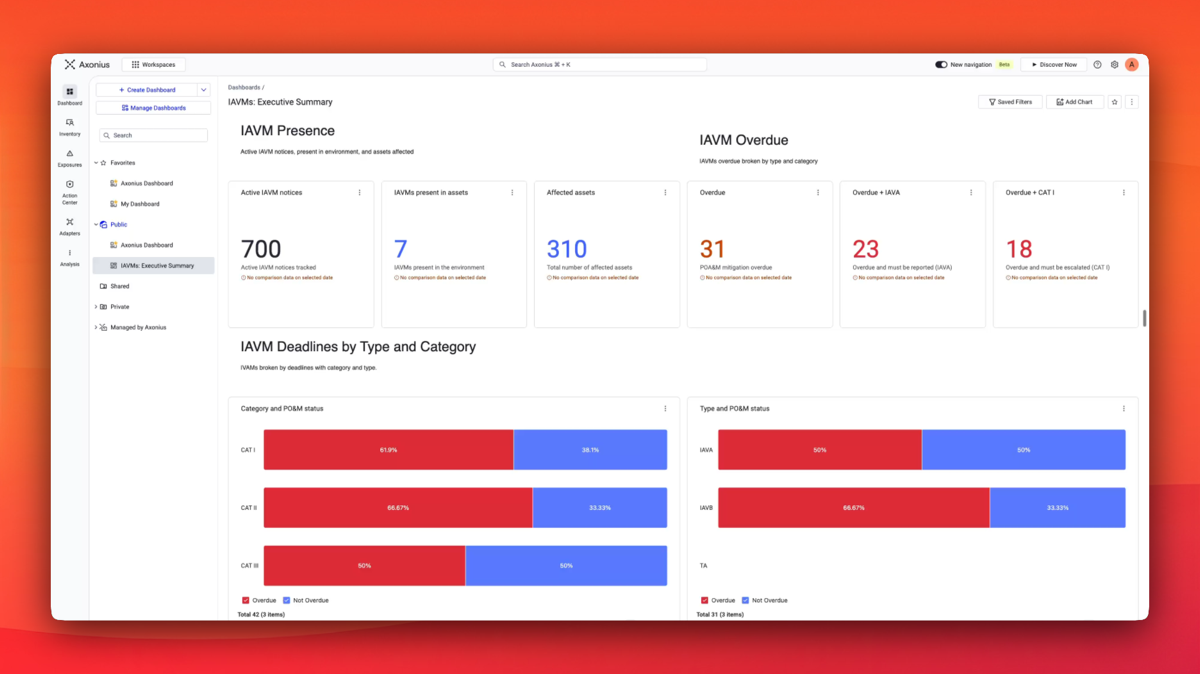
See how Axonius provides a centralized view of IAVM directives, affected assets, and their impact across your attack surface:
Why did we build this?
IAVM directives establish time-bound requirements for addressing vulnerabilities across the Department of Defense Information Network (DoDIN). USCYBERCOM, through the Department of Defense Cyber Defense Command (DCDC), provides operational direction and oversight, while U.S. defense agencies are responsible for meeting applicable remediation or mitigation requirements.
When a directive arrives, security teams must determine the full scope of affected assets. That often means cross-referencing vulnerability scan results against configuration management databases (CMDBs), asset inventories, and other authoritative sources to identify systems the vulnerability scanner may have missed and reconcile differences between datasets to establish confidence in coverage.
That data validation often falls to security professionals working under deadline pressure. Time spent manually comparing sources, investigating coverage gaps, and validating affected assets is time that could be spent prioritizing and executing remediation.
The compliance clock does not stop for data reconciliation. Information assurance vulnerability alerts (IAVAs) and other time-sensitive directives establish finite remediation windows, and affected assets do not fall outside those requirements simply because they are missing from vulnerability scan results.
What's new and how it works
Axonius Exposures now ingests incoming IAVM directives and maps them to every affected asset across a reconciled environment, reducing the manual work required to determine which systems may be affected. Axonius helps security teams save 70% to 90% of the time previously required for compliance, incident response, and vulnerability management (VM) for commercial organizations. With native IAVM support, we now extend those same operational efficiencies to U.S. defense agencies.
When a directive arrives, Axonius produces an affected asset list grounded by our continuously updated asset inventory across 40+ asset types and 1,400+ bi-directional integrations.
By combining IAVM directive visibility with other capabilities in Axonius Exposures such as asset criticality management, remediation ownership, and the Axonius Action Center, security teams can move beyond identifying affected assets to operationalizing remediation. Programs with vulnerability scanning coverage gaps can prioritize impacted systems, assign ownership, track remediation timelines, and initiate ticketing and response workflows from the context of a reconciled asset inventory.
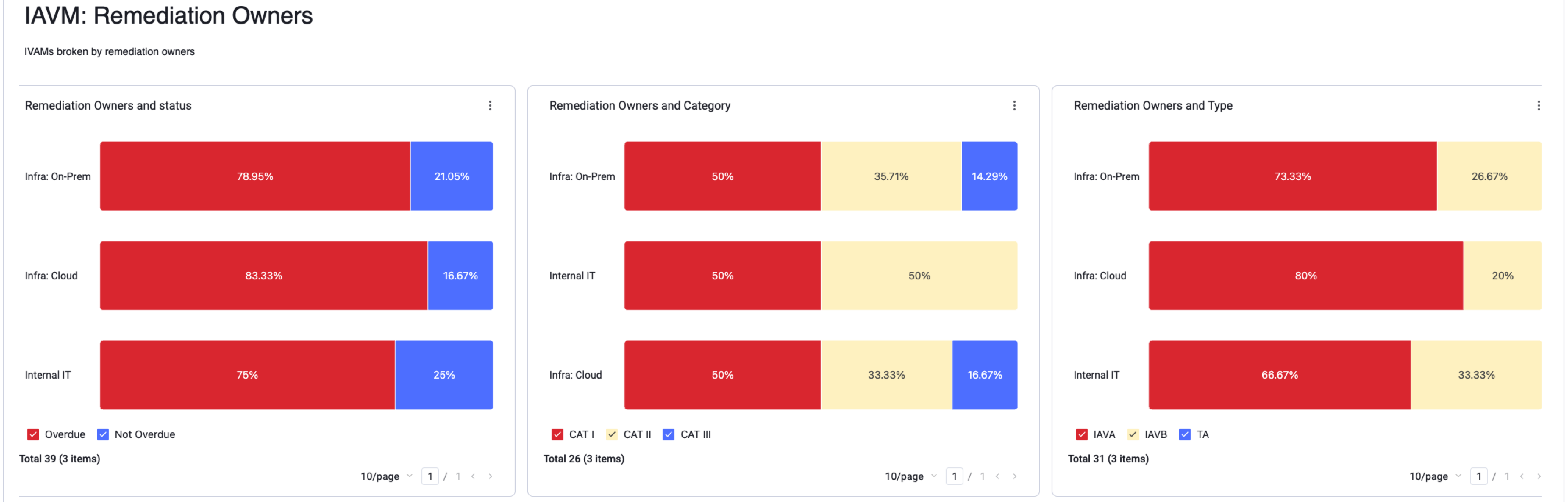
In short, as soon as an IAVM directive hits, Axonius can now automatically identify the affected asset, its owner, and get them mobilized to do the fix.
Who benefits
Information Assurance Officers (IAOs) and VM program leads spend considerable time correlating IAVM directives to affected assets. IAVM support reduces that manual effort by mapping directives to a continuously reconciled asset inventory across the environment.
Programs with vulnerability scanning coverage gaps can use Axonius to identify gaps in scanner coverage while extending IAVM-to-asset visibility beyond scan results. CVE-based analysis against the broader asset inventory helps surface potentially affected systems that may be missing from VM data.
U.S. defense agencies subject to IAVM requirements face the same challenges: multiple sources for asset data, gaps between scan cycles, and compliance timelines that continue while security teams reconcile their data. The same directive-to-asset correlation applies across these environments.
Existing Axonius Federal Systems (AFS) customers with Axonius Exposures can apply IAVM directive support to the reconciled inventory already in place without additional infrastructure or rebuilding the asset model. Cybersecurity programs already using Axonius for asset intelligence or exposure management have the foundation needed to support the directive-to-asset workflow.
Getting started
- Existing Axonius customers can activate IAVM support through their federal account team.
- Organizations evaluating Axonius for the first time can request a technical walkthrough or proof-of-concept (PoC) scoping: Request a Demo.
Availability
IAVM in Axonius Exposures is available to U.S. defense agencies in early access.
Additional resources
Learn more: read the press release about IAVM in Axonius Exposures.
Categories
- Threats Vulnerabilities

Get Started
See how to make asset intelligence actionable with a guided demo:
- Stop chasing data — work from one asset model your entire team can trust.
- See what's exposed before it's a problem — surface coverage gaps automatically.
- Turn alert noise into action — cut thousands of alerts down, to the ones that matter.