You can't out-patch agentic AI. Proactive is the only cheat code left.

Frederico Hakamine
Technical Evangelist Director, Axonius

The (cybersecurity) revolution 'bout to be televised. You picked the right time, but the wrong guy.
Whenever a security blog opens with Gil Scott-Heron and Kendrick Lamar, you know it will be interesting. I never planned to borrow it for a security piece; but I had to, because change is happening in front of us. And the cycle is only accelerating: from the White House's Gold Eagle vulnerability initiative, to the Five Eyes Cyber Agencies joint statement, and open weight models closing in on Mythos-level cyber capability, all in a month. Let's unpack the change and why proactive security is the playbook security leaders need to drive.
The revolution: weaponization of Agentic AI
The revolution we are going through is Agentic AI, widely available to be weaponized, and its impact. With this event, everything we built our programs around is rapidly becoming obsolete: security pace set by compliance audits, slow patching with permissive SLAs, ignoring business criticality and internet exposure as signals of urgency, and over-rotating on CVEs at the expense of other vectors like misconfigurations and shadow IT.
All of it built for a world that no longer exists.
We're moving into one where AI is weaponized at machine speed, and defenders are outnumbered. With this level of automation, you can't out-hire or out-hour the problem, your whole strategy has to be rethought. And fast: Zero Trust took many years to deploy. This revolution is pacing a lot faster.
That's the revolution. And here's the part that should stop you: it's not only your gut feeling.
The flashing signal: when governments that hardly agree start saying the same thing
Different countries in different continents, legal systems, and politics, are all converging on the same sentence, in different words: Time is compressing. Get ahead of vulnerabilities and embrace cyber resilience. The evidence is substantial:
The UK Cyber Security and Resilience Bill, introduced to Parliament in late 2025, backed by the NCSC's formal threat assessment naming AI-assisted vulnerability research and exploitation "the most significant AI-cyber development" in the near term, and projecting further compression of the disclosure-to-exploitation window through 2027.
The EU Cyber Resilience Act, in force since December 2024: alongside NIS2 and the EU AI Act, making security-by-design a legal baseline across the bloc.
The Five Eyes cyber agencies (US, UK, Australia, Canada, and New Zealand) issued a joint statement in June 2026 with unusually direct language: cyber risk assumptions, they warned, can now become outdated in "months, not years."
CISA's BOD-26-04 replaced CVSS-score deadlines with risk-based patch timelines — exposure, known exploitation, exploit automation, and impact — explicitly citing AI-accelerated exploitation as the reason.
And beyond cyber-specific law, the same urgency is bleeding into AI governance regimes worldwide: from China's algorithm and generative-AI rules to the OECD AI Principles now adhered to by 47 countries, writing "robust, secure, safe" into structurally different systems. A global chorus, not a regional quirk.
Different flags, with the same language and with unprecedented urgency, outpacing even the vast majority of commercial businesses. When roughly 60% of the world's GDP starts legislating the same instinct at once, that's a tell.
You picked the right time…
If you made it this far in my post, you picked the right time to think and act on this. You get that the urgency is different now. And chances are you're already deploying strategies to address it — patching faster among them.
So the ground is shifting fast with a timeline compression. The gap between a flaw existing and a flaw being exploited is collapsing from weeks to even negative hours.
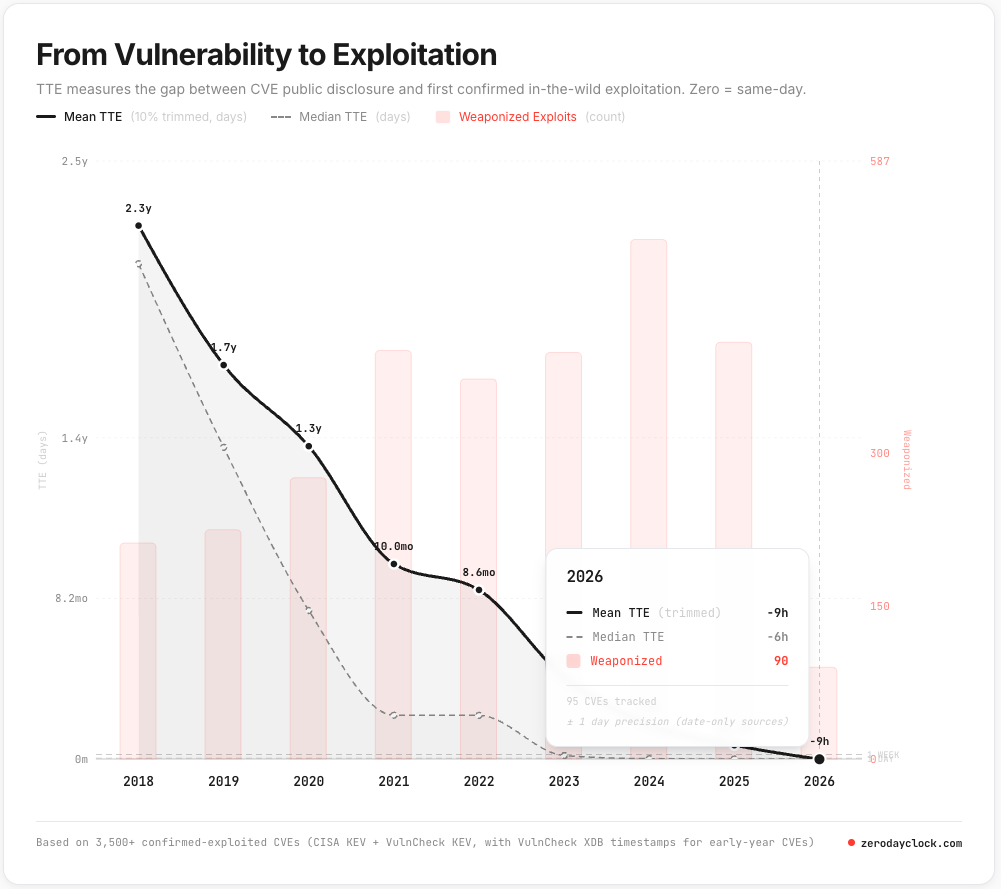
And the reflex has been unanimous: go faster. Out-detect, out-triage, out-patch. Shrink the mean-time-to-remediate. Win the game of speed against an attacker who just got a machine-speed engine. Accelerate the response to risk until you're faster than the threat.
That instinct is right. What if it isn't enough?
...but the wrong guy (if you chose to only react faster)
If your entire strategy is to react faster, you've entered a footrace against a fully automated opponent. In a world of AI versus AI, where attackers outnumber defenders, out-reacting the attacker is a race you are structurally built to lose. You cannot only rely on patching when vulnerabilities are exploited before they're even catalogued.
Speed of reaction still matters; nobody is making the case to go slow. But if reacting faster is your silver bullet, you're ignoring the window of opportunity before the attack exists.
Proactive becomes table stakes
Proactive security (i.e. harden systems, implement least privilege, ensure security coverage of all systems, proactively detect and address shadow IT, proactively decommission stale assets) is your unique durable advantage over AI attackers: the opportunity to reduce risks before they even appear.
For years we put proactive security as the last step: the thing you do after the fires are out, the aspirational top of the model. That framing is dead. In an AI-versus-AI world, being proactive is table stakes. It's your chance to protect before the race even begins.
And proactive has a prerequisite that's non-negotiable: you need to know what to protect first (all the things interfacing with your data and processes), what their weaknesses are, and how to address them with confidence. Something we call the durable context.
That's the defender's advantage. It's the one asymmetry that still favors you: nobody can, or should, know and proactively protect your environment better than you do. AI gives the attacker speed, but only after a vulnerability is discovered. Protecting your own ground before the shot is fired is how you take the race off the table.
Start Monday morning
Don't wait for a strategy offsite. This week, pull one thing: a complete, current inventory of everything that touches your data and processes: assets, identities, services, including the shadow IT and stale systems you've been meaning to get to. Rank it by business criticality and internet exposure, and set a hardening goal. That map will give you the playbook to protect ahead.
The revolution is here. Governments across half the world's economy are codifying the same warning at once. The right time is now.
Don't pick the wrong guy.
To learn more about how Axonius can help you deploy a proactive security program, book a personalized demo with one of our specialists.
Categories
- Artificial Intelligence Ai
- Asset Management
- Compliance And Frameworks
- Endpoint And Iot Security
- Security
- Management
- Cloud And Saas Security
- Threats Vulnerabilities

Get Started
See how to make asset intelligence actionable with a guided demo:
- Stop chasing data — work from one asset model your entire team can trust.
- See what's exposed before it's a problem — surface coverage gaps automatically.
- Turn alert noise into action — cut thousands of alerts down, to the ones that matter.