Every asset is an AI asset (Part 1): When the human leaves the loop

Teju Shyamsundar
Principal Manager, Product Marketing, Axonius
AI might be your most diligent employee yet: always on and everywhere… give or take your token bill.
The laptop in front of you runs a copilot. The meeting you just left had an AI notetaker in it, reading and storing everything that was said. The cloud workload that got fixed overnight wasn't touched by a person; an agent investigated the alert, decided on a fix, and shipped it. Even the PLC on a factory floor is running a model now, rejecting defective parts in real time based on patterns no engineer hand-coded.
Somewhere in your environment right now, agentic software is looking at your assets and deciding what to do about them. And for a growing share of those decisions, nobody signed off.
That's the shift this series is about: every asset is an AI asset now. Over three posts, I’ll dig into what that means, why the assets multiplying fastest are (probably) the ones you govern the least, and what it takes to build an inventory AI can be trusted to act on. This first post is about the shift itself, and the assumption it breaks.
For most of the history of security operations, we leaned on a comforting assumption: a human was the last check. An analyst read the alert. An admin approved the change. If the data was a little stale or the inventory a little incomplete, a person usually caught it before anything went wrong. That assumption is slowly but surely going away. It's worth sitting with what that means.
Three ways AI now touches every asset
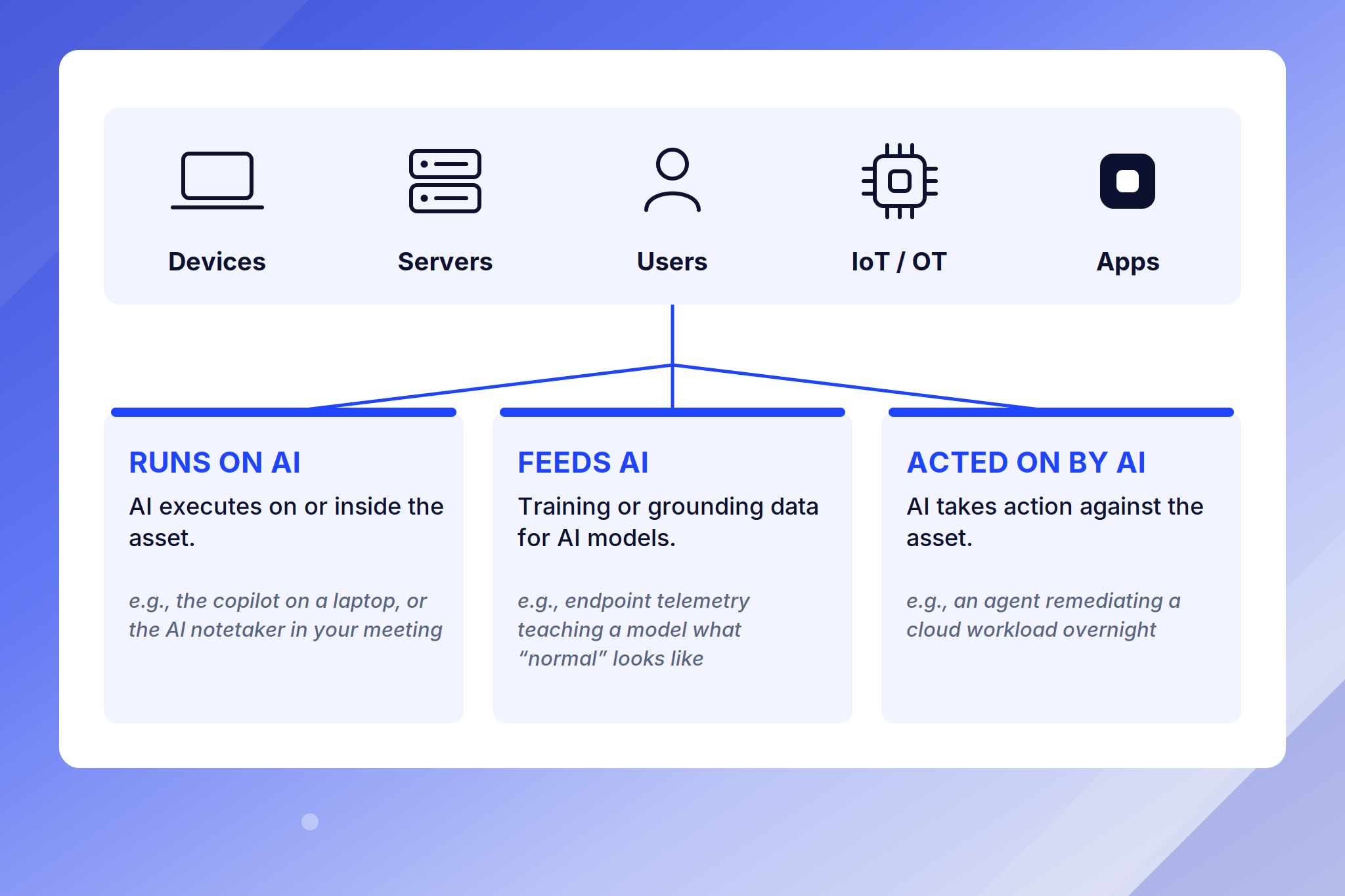
Every asset in your environment now does at least one of three things with AI, and many do all three.
It runs AI. The copilot on the endpoint, the model embedded in a SaaS app, the notetaker in the meeting, the inference running on an OT controller.
It feeds AI. Every device, identity, and workload is training data or grounding context for something. Your detection models learn what "normal" looks like from it. Your prioritization engine decides what matters based on it.
It gets acted on by AI. This is the new one. Agents now investigate, ticket, isolate, and remediate, increasingly without a human in the loop.
Once you look at assets this way, the line between "our security tools" and "our assets" blurs. The asset is the thing AI runs on, learns from, and acts against. Which means your asset inventory is now your AI security posture, whether you've decided to treat it that way or not.
AI is only as good as what it can see
Gartner now ranks enabling and protecting AI as the number one priority for CISOs in 2026. That matches what most security leaders are feeling. The pressure to put AI to work is real, and so is the upside.
Here’s the catch. The thing that makes AI useful — that it can act on your environment — is the same thing that makes bad data risky. AI is only as good as what it can see. When the underlying inventory is incomplete, outdated, or contradictory, AI doesn't fix the problem. It compounds it.
A person working from a stale spreadsheet makes one wrong call and, with the context they have, likely catches it during review. An agent working from the same stale data makes that call a thousand times before anyone notices. At machine speed, bad assumptions compound faster than any team can catch them, and the blast radius of a confident, wrong action grows the moment you take away the human who used to absorb (and, ideally, fix) the mistake.
The discipline gap
This isn't a story about invisible assets nobody knows exist. You know the agents are there. You know your team stood up AI services last quarter. Awareness isn't the gap.
Discipline (and time, resources, etc.) is. We (attempt to) track the fundamentals for laptops and servers: who owns them, what they can access, whether they're still needed, when they should be retired. And even those fundamentals are challenging for security and IT to get right.
The AI layer? Even harder.
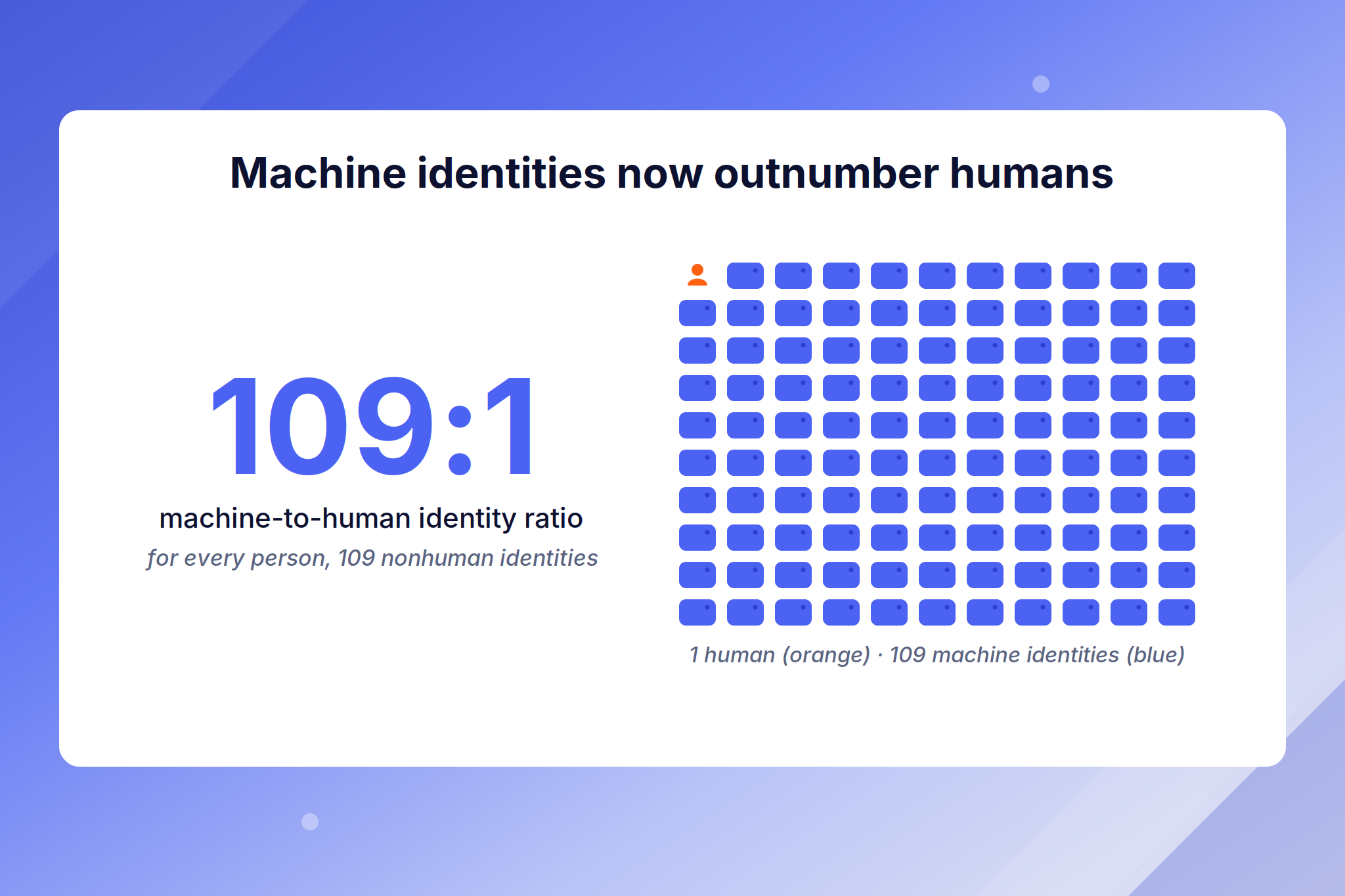
The agent has standing access and no owner of record. The service account wired to a model was created for a project that shipped months ago and never got turned off. By various industry estimates, machine identities now outnumber human ones by at least 50 to 1, and by some counts more than 140 to 1 (Okta, CyberArk, Palo Alto Networks), and very few of them get the review a new employee's access would.
That looseness was maybe survivable when a person was the final check. It stops being survivable when an agent acts on that same untrusted data on its own. An agent reasoning from a stale inventory will confidently isolate a device that no longer exists, ticket a team that no longer owns a system, or wave through the exposure that actually mattered because the asset looked low-priority in a record nobody updated.
What "good" looks like: durable context
The fix isn't to slow down AI adoption. It's to give AI something solid to stand on.
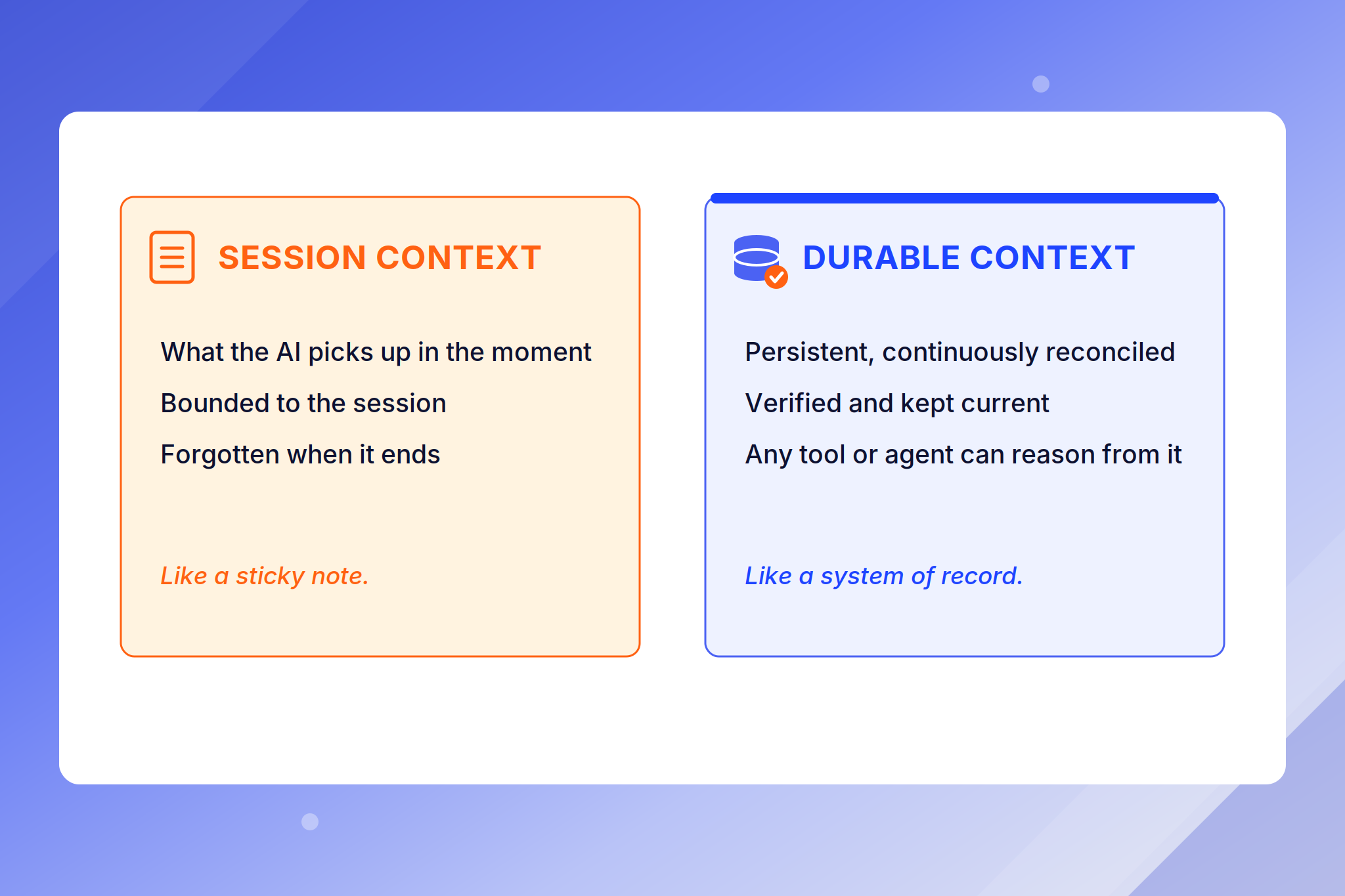
Think of it as the difference between durable context and session context. Session context is what an AI carries on its own: whatever it picked up in the last few minutes, bounded and easy to forget. Durable context is a persistent, continuously reconciled picture of your environment, verified and kept current, that any tool or agent can reason from. One is a sticky note. The other is a system of record.
It shows up in the reasoning loop, too. An agent rarely answers in one shot; it works in a loop, gathering context, checking it, acting, checking again. That loop needs something to ground itself on. Without a single source of truth, the agent hunts across three, four, or five disconnected systems that each tell a slightly different story.
At worst, it loses the thread, context rots, and it fills the gaps with confident guesses, the polite word for which is hallucination. At best it assembles the right answer, but only after burning a chunk of your monthly token budget on a question a durable source of truth could have settled in one call. Bad grounding costs you twice, once in accuracy and once in tokens, and that second cost is one worth coming back to when we dig into the real ROI of AI in security.
The organizations getting the most out of AI in security are the ones building that durable layer first, because everything downstream — detection, prioritization, autonomous remediation — is only as trustworthy as the asset inventory and context underneath it.
The question to ask now
Before you ask what AI can do for your security program, ask a narrower one: what is your AI actually acting on, and are you governing it like a real asset?
In Part 2, we’ll get specific about the assets driving this shift — the agents, machine identities, and AI services you already have — and what it takes to track them like everything else you own. Stay tuned!
Categories
- Artificial Intelligence Ai

Get Started
See how to make asset intelligence actionable with a guided demo:
- Stop chasing data — work from one asset model your entire team can trust.
- See what's exposed before it's a problem — surface coverage gaps automatically.
- Turn alert noise into action — cut thousands of alerts down, to the ones that matter.