Axonius recognized in Exposure Assessment Platforms in the Gartner® Hype Cycle™ for Security Operations, 2026

Ivan Dwyer
Principal Product Marketing Strategist, Axonius
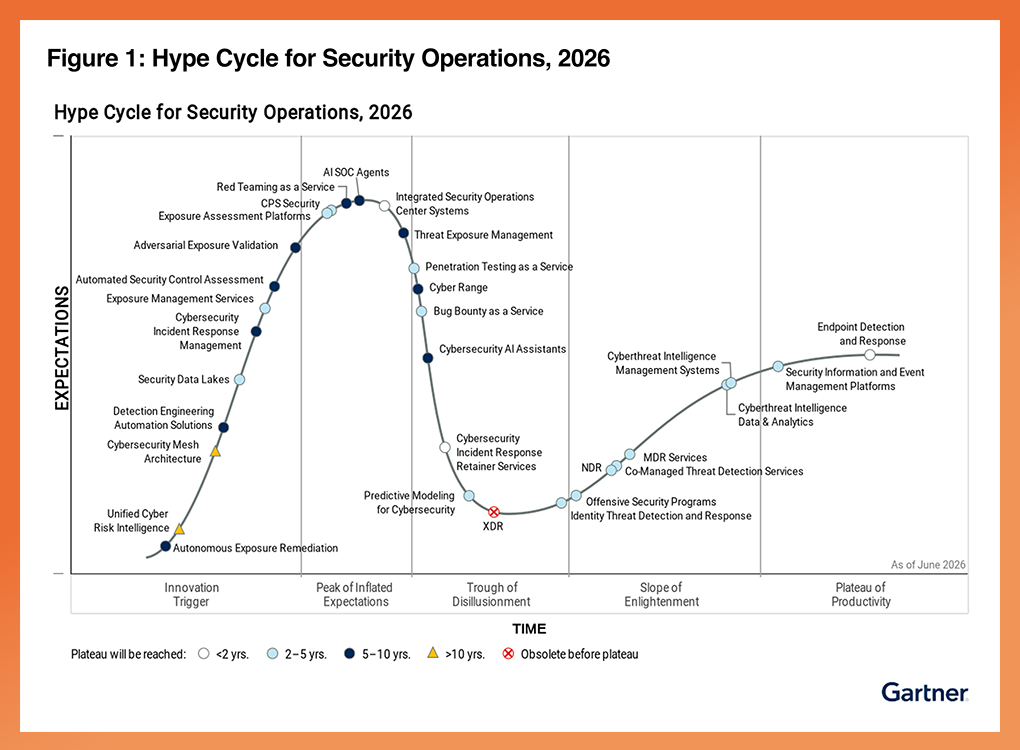
AI is collapsing every timeline. Security operations (SecOps), a space already defined by speed and volume, is seeing explosive market moves across every practice. Whether it’s reactive incident response or proactive exposure management. Gartner® is keeping pace and recently released the Hype Cycle™ for Security Operations, 2026. At Axonius, we've been adapting to the same market shifts and landed on similar conclusions.
Axonius was recognized in Exposure Assessment Platforms (EAP) for the first time. EAP represents a market convergence we've been building towards: asset management, attack surface management, vulnerability management, and exposure management converging into one platform. Let’s focus on what it all means going forward.
SecOps goes continuous
The Hype Cycle covers more than thirty categories, each with its own set of considerations. One overarching theme held across all of them: every SecOps practice must be continuous, not point-in-time, grounded in asset intelligence. This shouldn’t come as a surprise. Since the first cloud service went live decades ago, the attack surface has been expanding at an exponential rate, shaping everything we know about cybersecurity today. What AI has done more recently is push that reality past any point of debate: programs built for human-paced disclosure can’t keep up with machine-speed discovery.
Gartner first introduced Continuous Threat Exposure Management (CTEM) as a program-level operating model before the recent AI tidal wave. Kudos for the foresight. We've seen more organizations adopt the methodology as an evolution of static asset management and legacy risk-based vulnerability management (RBVM), and have played a hands-on role in how our customers put it into practice across industries.
A takeaway from this work: when everything must be continuous, it starts at the foundation and spreads outward. Visibility has to keep up with a business that changes constantly, not a static inventory. Prioritization has to weigh the full spectrum of context rather than blanket scores. And remediation only works when it runs through the security and IT teams and tools already in place.
Where Axonius sits in EAP
In the AI era, a continuous program is only as reliable as the data surrounding it. Reconciling asset and exposure data into decision-grade asset intelligence is the durable context layer Axonius has built with the Axonius Asset Cloud, and it’s the same layer the EAP space is converging around.
Gartner rates EAP as a high-benefit category in early-mainstream adoption, and defines it as platforms that continuously identify and prioritize exposures across diverse asset classes, then route them to remediation through the systems an organization already runs. The bar is contextualized and prioritized intelligence with the ability to coordinate a fix.
Gartner user recommendations for the EAP category track closely to the AI-Ready Exposure Management playbook we published in response to Claude Mythos. Let’s walk through their recommendations in order as they follow a hierarchical maturity curve.
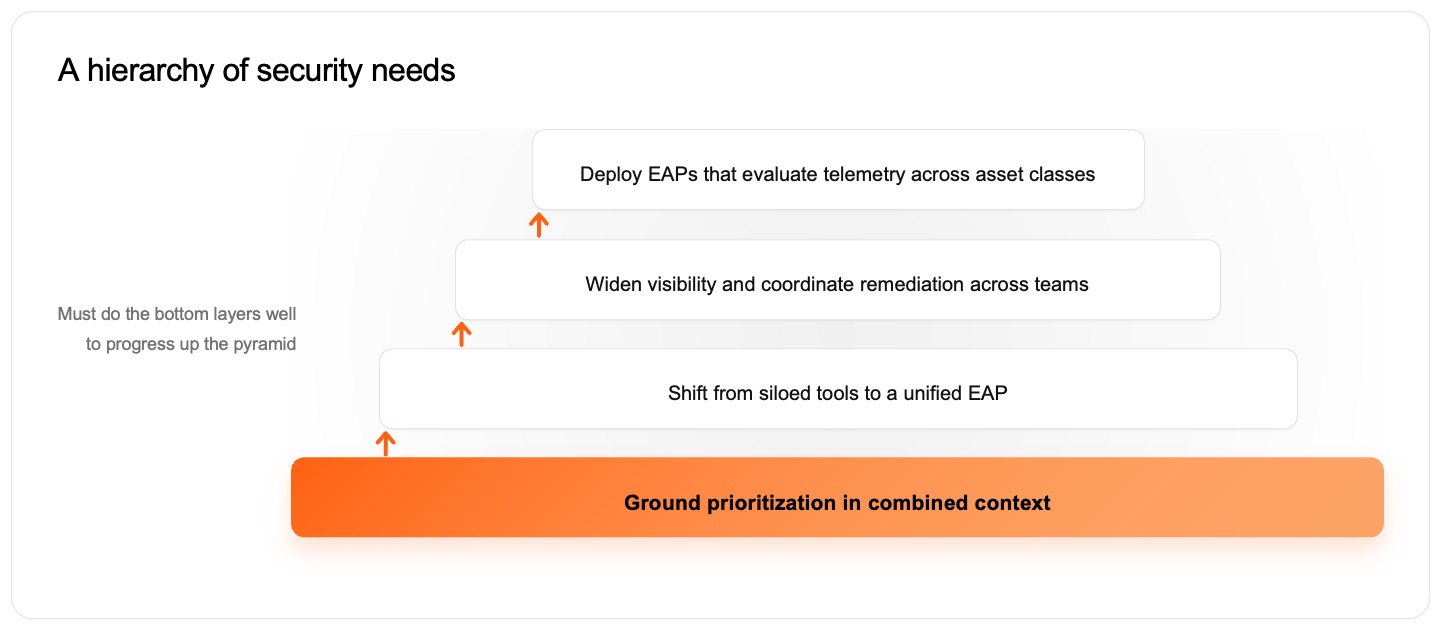
Ground prioritization in combined context
Gartner frames its first recommendation as taking an outcome-driven approach, but read it closely, and it's really about context: identify the context prioritization depends on, keep its quality and ownership intact, and correlate signals into a dynamic, evidence-based risk rating.
That is durable context in practice: security, asset, and business context on every finding. Run prioritization on security signals alone, and everything looks equally urgent. Add what the asset is, what it's worth, and who owns it, and the few findings that actually threaten the business separate from the thousands that don't. That separation only holds when the data underneath is durable: reconciled across sources and current as the environment changes.
Shift from siloed tools to a unified EAP
Gartner recommends consolidating asset, attack surface, and vulnerability management (VM) from separate tools, with AI assisting prioritization, remediation, and attack path analysis.
That unified, cross-domain view is how we built Axonius Exposures. The exposures that get exploited are usually compound: an internet-facing server that is also missing endpoint protection and reachable by an over-permissioned identity. A scanner sees the common vulnerabilities and exposures (CVE), a cloud security posture management (CSPM) tool sees the misconfiguration, an identity tool sees the access, but no single one sees the toxic combination. Exposures scores them in one model, so those conditions surface instead of hiding across three consoles.
Widen visibility and coordinate remediation across teams
Gartner recommends choosing platforms whose integrations run in both directions, to widen visibility, sharpen prioritization, and coordinate remediation across teams.
The Axonius Adapter Network, now over 1,400 integrations strong, is bi-directional by design, and the Action Center turns that into over 600 direct actions on the systems that security and IT teams already run. Remediation is never one-size-fits-all, because the blast radius of a fix depends on the context. A patch to a spare laptop is harmless; the same patch to a production system half the business runs on is not. Some fixes are safe to automate. Others need guardrails, a human decision, or a handoff. Making that call at scale takes decision-grade asset intelligence underneath: what an asset is, what it connects to, and what breaks if you touch it.
Deploy EAPs that evaluate telemetry across asset classes
Gartner recommends starting with control configurations and expanding coverage into cloud, identity, and SaaS posture.
This is where the Axonius Asset Cloud compounds. Every asset class adds a fresh lens, such as end-of-life (EOL)/end-of-support (EOS) software, SaaS misconfigurations, and identities with excessive permissions. The return is in the correlation: an over-permissioned identity is a minor finding until you learn it can reach an internet-facing host running EOL software. Incorporating each new domain strengthens both layers at once (richer asset intelligence underneath and broader exposure management on top), so the platform gets sharper the more of the environment it covers.
Where SecOps is headed
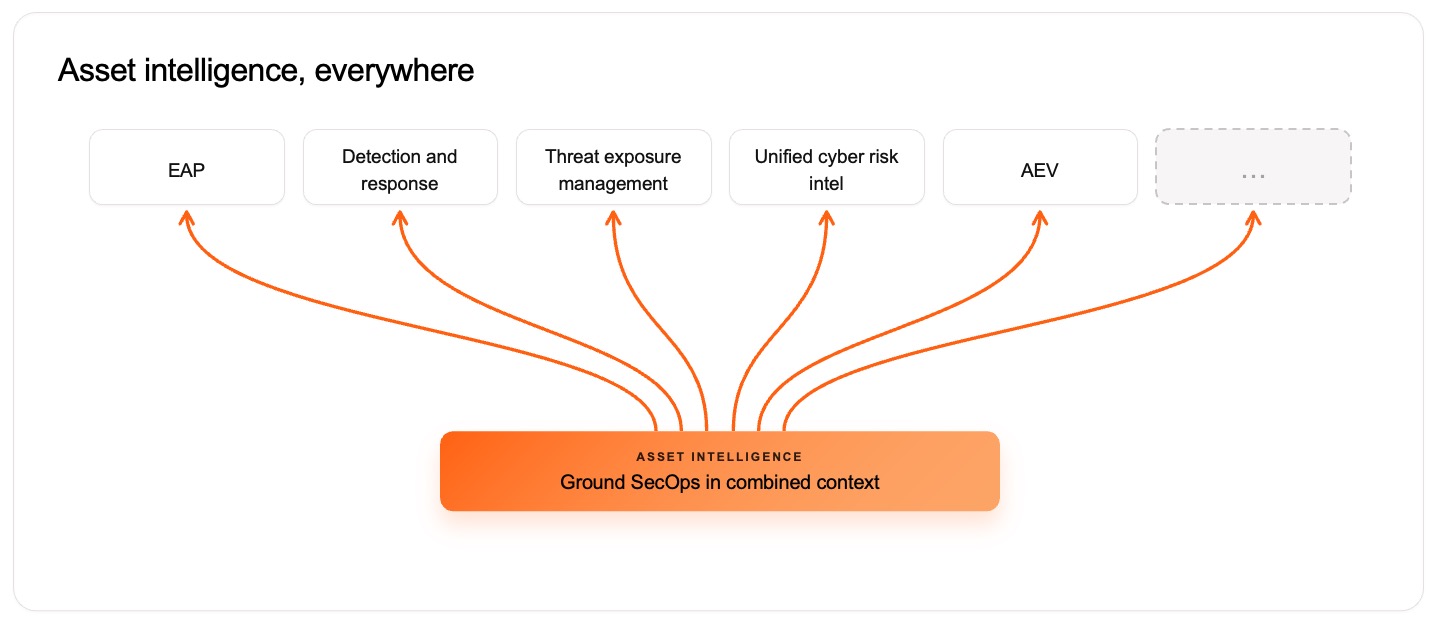
Now let’s zoom out from EAP and look across the rest of the Hype Cycle. Every transformational entry shares a dependency that is easy to miss in the enthusiasm (and fear) around AI: decision-grade asset intelligence.
Detection and response triage depends on asset context to move faster.
Exposure remediation has to know who owns an asset before making a recommendation.
Cyber risk intelligence needs a normalized foundation to fuse its signals onto.
Adversarial validation is only as good as the asset model it tests against.
Everything is pointing in the same direction and resting on the same trusted foundation.
While much of the autonomous transformation in this Hype Cycle is still years out, the foundational layer is what any security and IT team can deploy today. We put numbers to it in our business case for asset intelligence.
Download the report
Read the Gartner Hype Cycle for Security Operations, 2026 for more information.
Gartner Disclaimer
Gartner, Hype Cycle of Security Operations, 2026, Darren Livingstone, Jonathan Nunez, 5 June 2026
GARTNER and HYPE CYCLE are trademarks of Gartner, Inc. and/or its affiliates.
Gartner does not endorse any company, vendor, product or service depicted in its publications, and does not advise technology users to select only those vendors with the highest ratings or other designation. Gartner publications consist of the opinions of Gartner’s business and technology insights organization and should not be construed as statements of fact. Gartner disclaims all warranties, expressed or implied, with respect to this publication, including any warranties of merchantability or fitness for a particular purpose.

Get Started
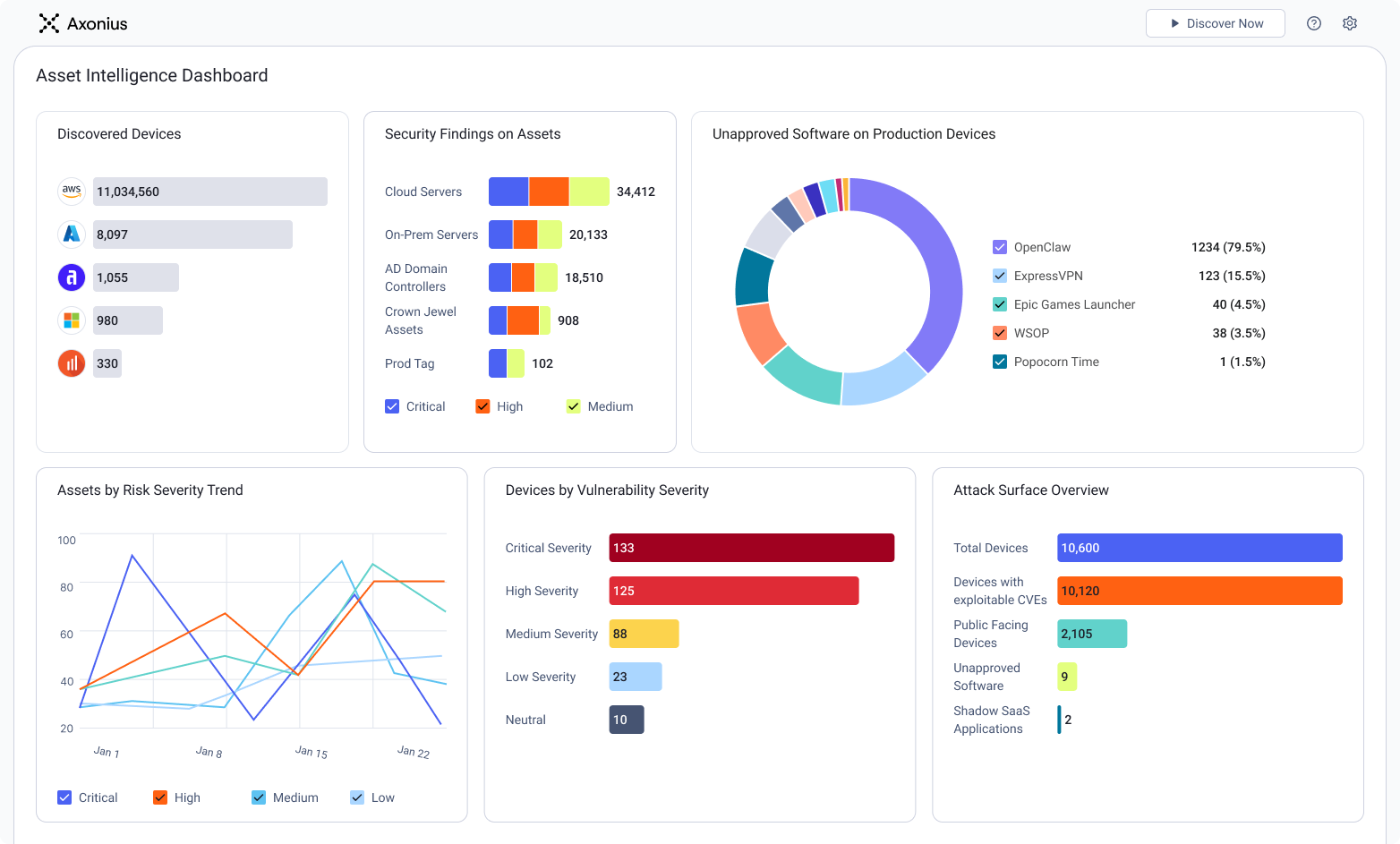
See how to make asset intelligence actionable with a guided demo:
- Stop chasing data — work from one asset model your entire team can trust.
- See what's exposed before it's a problem — surface coverage gaps automatically.
- Turn alert noise into action — cut thousands of alerts down, to the ones that matter.